Non-Woven Fabrics Explained: What SMS, SMMS, Spunbond PP and GSM Mean for Gowns, Caps and Covers
What spunbond PP, meltblown, SMS and SMMS non-wovens are, what GSM means, and how to balance breathability and barrier when specifying gowns, caps and covers.
Published · 7 min read

Key facts
- A non-woven is a sheet of fibres bonded by physical or chemical means, without weaving, knitting or paper making (ISO 9092 definition, as published by EDANA).
- Spunbond (S) layers give strength; meltblown (M) layers, with filaments down to about 1 micron, give barrier. SMS stacks spunbond-meltblown-spunbond and SMMS adds a second meltblown layer.
- Single-use surgical products are made predominantly of polypropylene or polyester, and spunbond and SMS are the most common fabrics for isolation gowns.
- GSM (grams per square metre) is fabric weight, not a barrier rating. Barrier comes mainly from structure: meltblown layers, coatings or films.
- There is a trade-off: impermeable materials reduce microbial transfer but compromise the wearer's thermal comfort, which is why breathable microporous films exist.
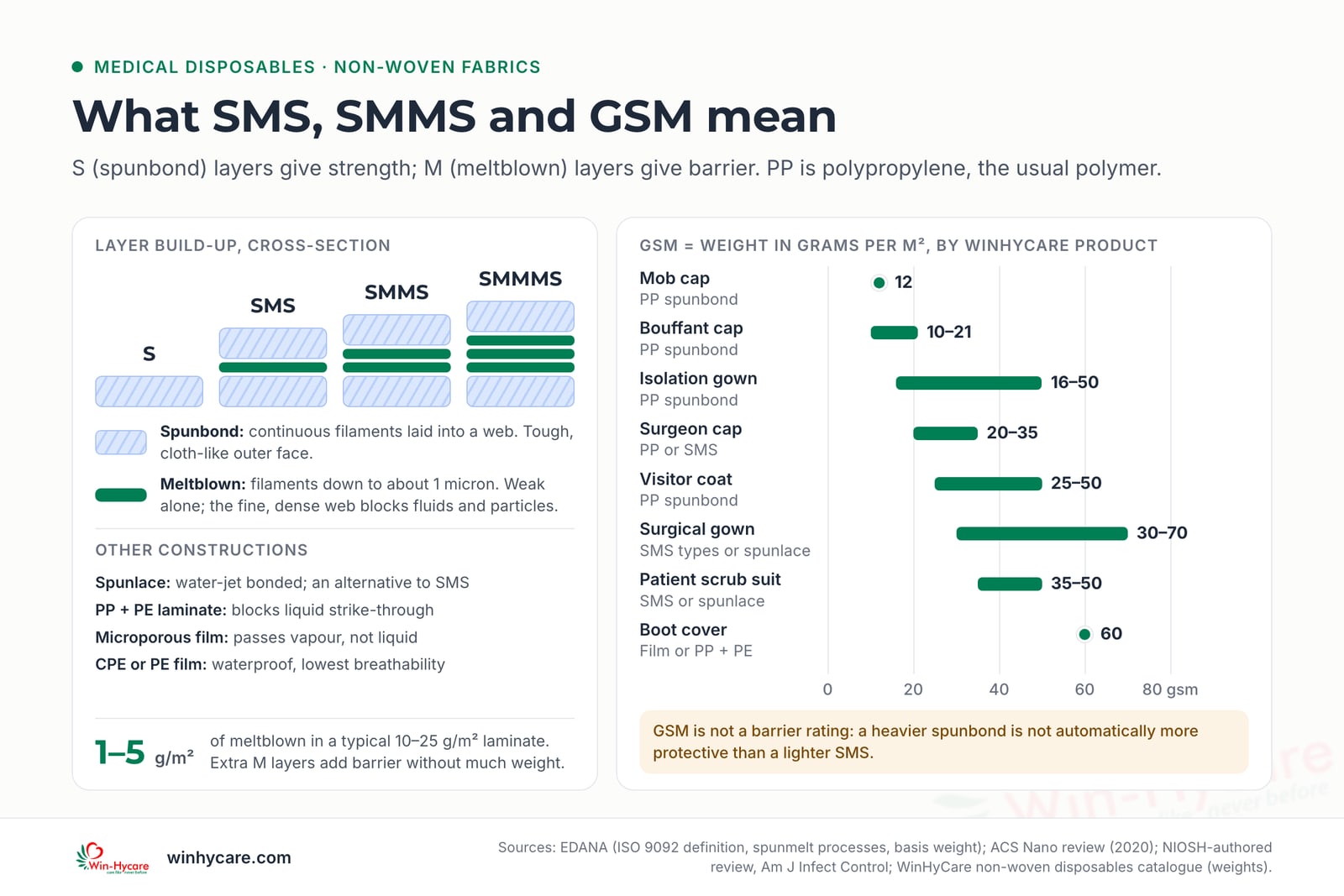
Non-woven fabric is a sheet of fibres bonded together without weaving or knitting, and almost every disposable gown, cap, cover and mask is made from it. The letters on a specification sheet describe the layers: S is spunbond, which gives strength, and M is meltblown, which gives barrier. SMS is spunbond-meltblown-spunbond; SMMS adds a second meltblown layer. PP is polypropylene, the usual polymer, and GSM is the fabric’s weight in grams per square metre. You will see all four across our medical non-woven disposables catalogue.
Once you can read those letters, you can tell whether a quote is offering the fabric your task needs or simply a heavier version of the wrong one.
What is a non-woven fabric?
The ISO 9092 definition, published by the industry association EDANA, is the one standards and tenders use: “A nonwoven is an engineered fibrous assembly, primarily planar, which has been given a designed level of structural integrity by physical and/or chemical means, excluding weaving, knitting or paper making.”
Put simply, fibres are laid into a web and bonded directly into a sheet. EDANA describes several bonding routes, two of which matter for medical disposables. Calendering “uses heat and high pressure applied through rollers to weld the fibre webs together at high speed.” Hydroentanglement “uses fine, high pressure water jets to cause the fibres to interlace,” and is sometimes called spunlacing. That is where the “spunlace” option on surgical gown and scrub-suit specifications comes from.
What do spunbond and meltblown mean?
Both are “spunmelt” processes, which EDANA describes as making non-woven webs directly from thermoplastic polymers. The difference is in the filaments.
Spunbond. Continuous filaments are drawn out and laid into a web. EDANA notes the spunlaid process gives “increased strength compared to carding, due to the attenuation of the filaments,” and reserves the word spunbonded for thermally bonded spunlaid fabric. Spunbond is the tough, cloth-like outer layer of most gowns and the whole fabric of light caps and covers.
Meltblown. Molten polymer is blown apart by hot air into much thinner filaments, “with a minimum diameter of 1 micron,” roughly speaking, and low tensile strength. On its own, meltblown is weak. Its value is the fine, dense web, which blocks fluids and particles far better than coarse spunbond.
Polypropylene is the default polymer. A 2020 review in ACS Nano found that single-use surgical products “are predominantly made of polypropylene or polyester.”
What is SMS fabric, and how is SMMS different?
SMS sandwiches a meltblown layer between two spunbond layers, so you get the strength of spunbond on the outside and the barrier of meltblown in the middle. The same ACS Nano review describes these laminates as combining “strong and durable spun-bond materials with the relatively weaker melt-blown materials with better wicking and barrier properties and finer and higher surface area fibers,” and lists SMS, SMMS and SSMMS as the most commonly used.
The meltblown share is small. That review gives typical laminates of 10–25 g/m² with only 1–5 g/m² of meltblown microfibres. Adding a second meltblown layer (SMMS) or a third (SMMMS) raises barrier without simply making the whole fabric heavier.
| Fabric | Construction | What it brings | In our range |
|---|---|---|---|
| PP spunbond (S) | Single layer of spunbond filaments | Strength, breathability, low cost; limited fluid barrier | Bouffant and mob caps, isolation gowns, visitor coats, sleeve covers, shoe covers |
| SMS | Spunbond-meltblown-spunbond | Meltblown barrier inside a strong, soft outer face | Surgical gowns, surgeon caps, patient gowns, bed sheets |
| SMMS / SMMMS | Two or three meltblown layers | More barrier at a given weight | Surgical gowns |
| Spunlace | Fibres interlaced by water jets (hydroentangled) | An alternative to SMS on gown and scrub-suit specifications | Surgical gowns, patient scrub suits |
| PP + PE film laminate | Spunbond face with polyethylene film | Blocks liquid strike-through; breathes less | PE-coated isolation gowns, boot covers |
| Microporous film | Film that passes vapour but not liquid | Fluid resistance with some breathability | Boot covers |
| CPE or PE film | Plastic film, no fibres | Waterproof, lowest breathability | CPE gowns, aprons, sleeve covers, shoe covers |
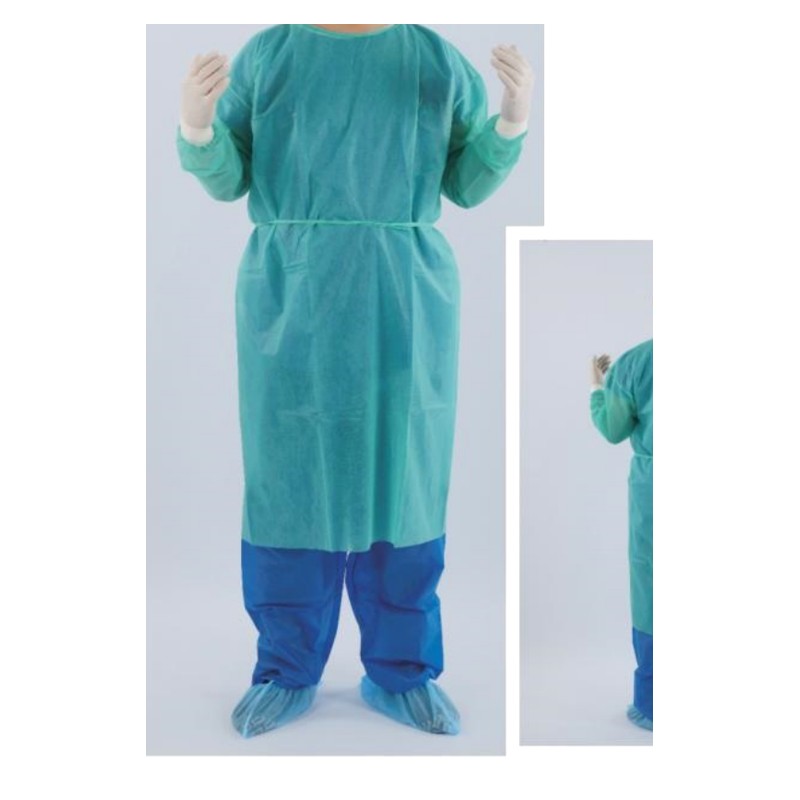
For isolation gowns specifically, a NIOSH-authored review notes that “the most commonly used nonwoven fabrics for isolation gowns are spunbond and spunbond/meltblown/spunbond technologies.”
What does GSM mean on a non-woven specification?
GSM is basis weight. EDANA’s glossary defines basis weight as “the mass of a unit area of fabric,” with grams per square metre as the example unit. A 35 gsm fabric weighs 35 grams per square metre.
GSM is useful for three things: comparing quotes like for like, checking batch consistency, and judging strength, opacity and feel. It is not a barrier rating. Barrier depends mostly on structure, meaning the meltblown layer or film, so a heavier spunbond fabric is not automatically more protective than a lighter SMS. A gown specification that lists only “50 gsm” and nothing about barrier leaves the most important property undefined.
Typical weights in our catalogue show how GSM tracks the job:
| Product | Fabric | Weight |
|---|---|---|
| Mob cap | PP spunbond | 12 gsm |
| Bouffant cap | PP spunbond | 10–21 gsm |
| Surgeon cap | PP or SMS | 20–35 gsm (PP), 25–35 gsm (SMS) |
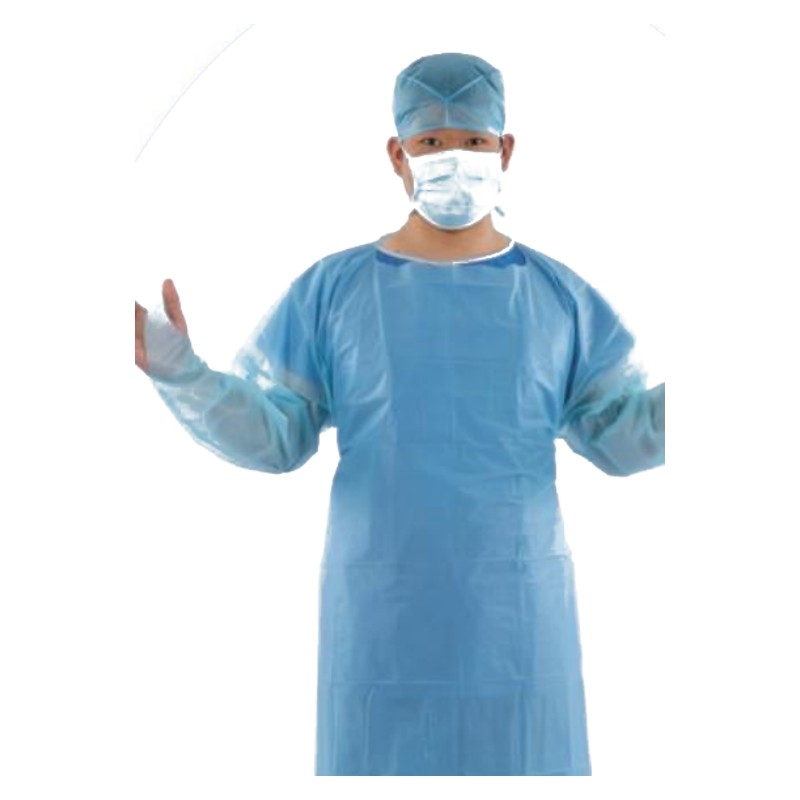
| Isolation gown | PP spunbond | 16–50 gsm |
| Visitor coat | PP spunbond | 25–50 gsm |
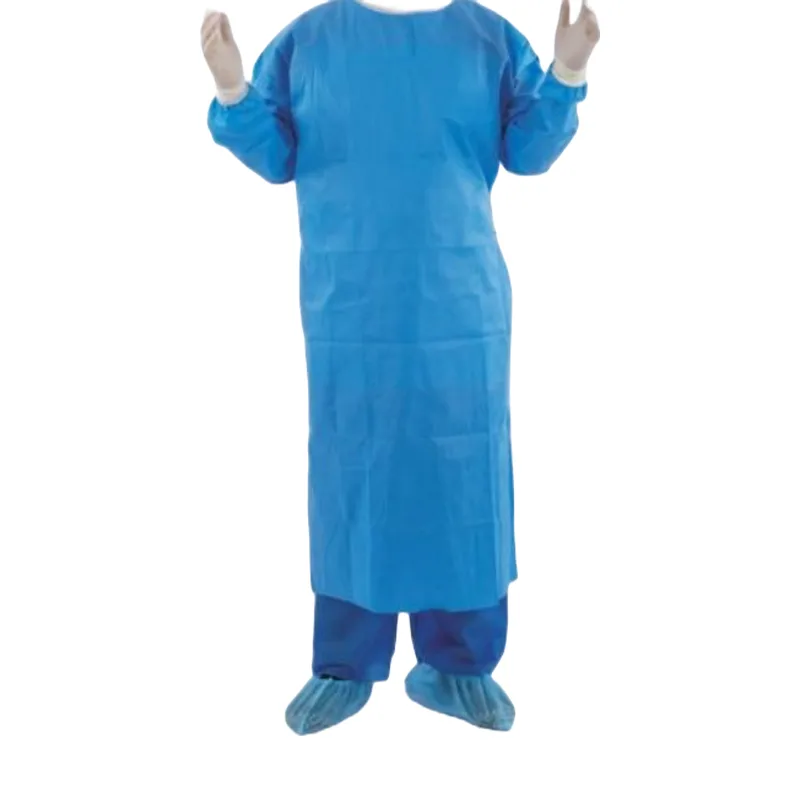
| Surgical gown | SMS, SMMS, SMMMS or spunlace | 30–70 gsm |
| Patient scrub suit | SMS or spunlace | 35–50 gsm |
| Boot cover | Microporous film or PP + PE | 60 gsm |
A cap only has to hold hair, so 12 gsm does the job. A surgical gown has to survive a long procedure under fluid, so it is heavier and layered.

Breathability or barrier: do you have to choose?
To a degree, yes. A NIOSH-authored review in the American Journal of Infection Control puts it plainly: “although impermeable materials are effective in reducing transfer of microorganisms, the thermal comfort of the wearer is compromised.” A 2021 comparison in the same journal notes that disposable gowns are known for being more comfortable and breathable, even though they provide lower levels of protection.
Picture a nurse in a full CPE film gown on a Jeddah isolation ward in August. Nothing gets through the gown, including sweat. That is the right trade for a fluid-heavy task and the wrong one for an eight-hour shift of dry patient contact.
Material science offers a middle path. The ACS Nano review describes gowns in which “an impervious ‘breathable’ plastic film is sandwiched between two layers of spun-bonded nonwoven,” letting moisture vapour pass while blocking fluids. Microporous and film-laminate fabrics work on that principle.
How should you specify non-woven fabric in a tender?
- Name the barrier first. State the AAMI PB70 level or EN 13795 performance class the task needs; our guide to isolation vs surgical gowns maps levels to tasks.
- Then the structure. PP spunbond, SMS, SMMS, laminate or film.
- Then the GSM range, with a tolerance, to fix strength and consistency.
- Add the extras that matter for the use: low-linting for theatres (EN 13795 tests particle release), anti-static or alcohol-resistant finishes, sterile or non-sterile.
- Ask for test reports that match the standard and edition you named.
WinHyCare is a supplier and exporter of non-woven disposables to hospitals, laboratories, food plants and distributors in Saudi Arabia and across the GCC, supplied to ISO 9001 and ISO 13485 quality standards. Send us the fabric, GSM and quantity for each item, or the barrier level you need, and we will match it from our surgical and isolation gown range and the rest of the catalogue. For footwear, see how the same materials compare in PE, CPE and non-woven shoe covers.
Frequently asked questions
What is SMS fabric?+
SMS is a three-layer non-woven: spunbond, meltblown, spunbond. The outer spunbond layers give strength and abrasion resistance; the meltblown middle layer, made of much finer filaments, gives barrier and filtration. It is usually polypropylene and is widely used for surgical gowns, caps, drapes and higher-grade isolation gowns.
What is the difference between SMS and SMMS?+
SMMS has two meltblown layers between the spunbond layers instead of one. The extra fine-fibre layer adds barrier without relying only on a heavier fabric. Variants such as SSMMS and SMMMS follow the same logic.
What does GSM mean in non-woven fabric?+
GSM stands for grams per square metre: the basis weight, or mass per unit area, of the fabric. Higher GSM usually means a thicker, stronger and more opaque fabric, but it is not a direct measure of fluid barrier. Two fabrics with the same GSM can perform very differently depending on their structure.
Is a higher GSM gown always better?+
No. A heavier spunbond gown can be stronger yet still let fluid through more easily than a lighter fabric with a meltblown or film barrier layer. Specify the barrier you need (for example an AAMI PB70 level or EN 13795 performance class) and use GSM to control strength, feel and consistency between batches.
Is PP non-woven waterproof?+
Plain PP spunbond resists light splashes but is not waterproof. For fluid-heavy tasks, choose PP laminated with a PE film, a microporous film laminate, or a CPE film product, accepting that these breathe less than plain non-woven.
Sources
- ISO and CEN definition of nonwovens (ISO 9092 / EN 29092), EDANA
- How are nonwovens made, EDANA
- Glossary of nonwoven terms, EDANA
- Sustainable Personal Protective Clothing for Healthcare Applications: A Review (Karim N et al. ACS Nano 2020;14:12313–12340), ACS Nano
- A Review of Isolation Gowns in Healthcare: Fabric and Gown Properties (Kilinc FS. J Eng Fiber Fabr 2015;10(3):180–190), Journal of Engineered Fibers and Fabrics (NIOSH author; PubMed Central)
- Isolation gowns in health care settings: Laboratory studies, regulations and standards, and potential barriers of gown selection and use (Kilinc Balci FS. Am J Infect Control 2016;44:104–111), American Journal of Infection Control
- Disposable versus reusable medical gowns: A performance comparison (McQuerry M et al. Am J Infect Control 2021;49:563–570), American Journal of Infection Control