Surgical and Isolation Gown Standards: EN 13795 and ANSI/AAMI PB70 Levels Explained
How ANSI/AAMI PB70 levels 1 to 4 and EN 13795-1 standard and high performance are tested, what critical zones mean, and how to specify gowns in a tender.
Published · 9 min read

Key facts
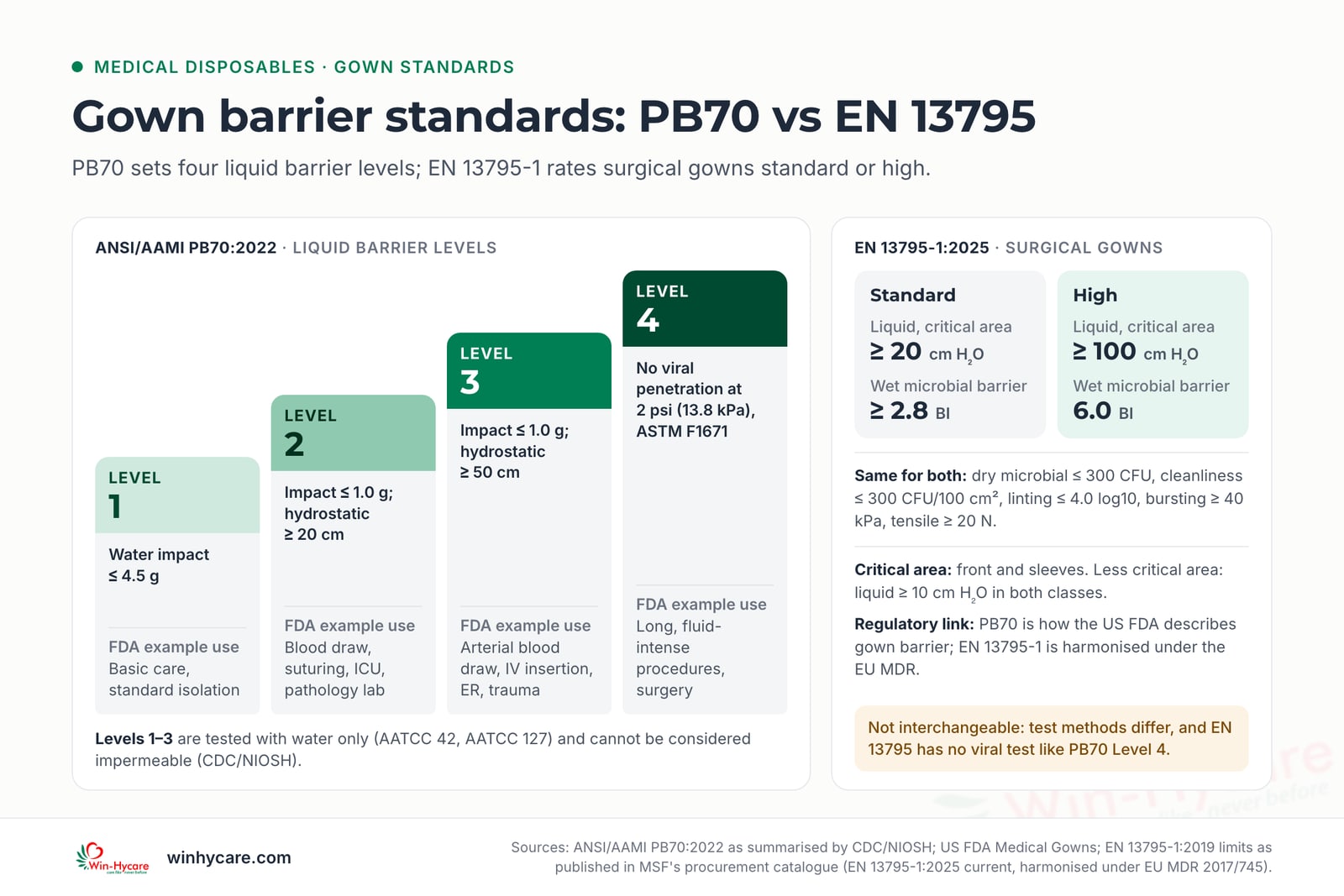
- ANSI/AAMI PB70 grades liquid barrier performance in four levels. Levels 1 to 3 are tested with water (impact penetration and hydrostatic pressure); Level 4 must stop synthetic blood or a virus surrogate at 2 psi (13.8 kPa).
- The current editions are ANSI/AAMI PB70:2022, which extended the scheme to aprons, sleeves, shoe covers and non-surgical gowns, and EN 13795-1:2025, which replaced EN 13795-1:2019 and is harmonised under the EU Medical Device Regulation.
- EN 13795-1 has two classes, standard and high performance, tested for microbial penetration (dry and wet), cleanliness, linting, liquid penetration, bursting and tensile strength, with tougher limits in the critical areas (the front and sleeves of a gown).
- In the US, surgical gowns and surgical isolation gowns are Class II devices needing 510(k) clearance; non-surgical isolation gowns are Class I and exempt.
- A barrier level belongs to a tested gown design, not to a fabric type. Ask for the test report for the exact product, including seams in the critical zone.
Short answer: two standards dominate gown specifications. ANSI/AAMI PB70 grades liquid barrier performance in four levels, from Level 1 (minimal) to Level 4 (stops blood and a virus surrogate under pressure), and is the scheme the US FDA uses to describe gown protection. EN 13795-1 grades surgical gowns and drapes as standard performance or high performance using microbial, cleanliness, liquid and strength tests, and is the harmonised European standard under the Medical Device Regulation. A tender should name the standard, the level or class, and the zones of the gown that must meet it.
ANSI/AAMI PB70: four liquid barrier levels
The current edition is ANSI/AAMI PB70:2022, released by AAMI in January 2023. The previous edition covered surgical gowns, surgical drapes and isolation gowns; the 2022 edition adds extended-coverage surgical gowns, non-surgical protective gowns such as procedure and decontamination gowns, hoods and togas, and aprons, shoe covers and sleeves, and requires labelling of the protected area (full coverage, non-protective back or open back). Gloves, masks and goggles are outside its scope.
The levels, as summarised by CDC/NIOSH:
| Level | Test | Requirement | FDA example uses |
|---|---|---|---|
| 1 | AATCC 42 water impact penetration | ≤ 4.5 g | Basic care, standard isolation |
| 2 | AATCC 42 impact; AATCC 127 hydrostatic pressure | ≤ 1.0 g; ≥ 20 cm | Blood draw, suturing, ICU, pathology lab |
| 3 | AATCC 42 impact; AATCC 127 hydrostatic pressure | ≤ 1.0 g; ≥ 50 cm | Arterial blood draw, IV insertion, ER, trauma |
| 4 | ASTM F1671 viral penetration (gowns); ASTM F1670 synthetic blood (drapes) | No penetration at 2 psi (13.8 kPa) | Long, fluid-intense procedures, surgery |
Two points are easy to miss. First, Levels 1 to 3 use water as the only challenge, and CDC/NIOSH states that gowns at these levels cannot be considered impermeable. Second, Level 4 is pass/fail at a single pressure, so a “Level 4” claim tells you the critical zone stopped a viral surrogate at 13.8 kPa in the test, not that the gown is impervious in every condition.
For non-sterile isolation gowns, ASTM F3352 is the companion specification and references the PB70 levels.
Critical zones and US classification
A level applies to the critical zones of the gown, not necessarily the whole garment. On its Medical Gowns page the FDA defines them:
- Surgical gown: the front of the body from the top of the shoulders to the knees, and the arms from the wrist cuff to above the elbow. The whole front must be at least Level 1; the back may be non-protective.
- Surgical isolation gown: every area except bindings, cuffs and hems is a critical zone and must meet the highest level the gown is rated for.
For a task-by-task comparison of the two gown types, see isolation gown vs surgical gown.
Classification follows the same split. Surgical gowns and surgical isolation gowns are Class II medical devices that need 510(k) premarket notification; non-surgical isolation gowns are Class I and exempt from premarket review (21 CFR 878.4040). Non-surgical, non-isolation gowns with moderate or high barrier claims are Class II, and those with minimal or low claims are Class I.
Quality varies in practice. In a NIOSH assessment of stockpiled PPE reported by AIHA in 2022, five of ten gown lots failed the PB70 hydrostatic requirement. Material choice matters too: a NIOSH-authored review notes that gowns offer varying resistance to blood and body fluids depending on the material. Testing the finished gown, including sleeve seams and tie attachments, is what makes a claim credible.
EN 13795-1: standard and high performance
EN 13795-1 sets requirements for surgical gowns and drapes. EN 13795-1:2025 replaced the 2019 edition (BSI lists BS EN 13795-1:2019 as withdrawn in February 2025), and the European Commission listed EN 13795-1:2025 as a harmonised standard under Regulation (EU) 2017/745 in Implementing Decision (EU) 2025/2078, which gives conforming products a presumption of conformity. DIN’s summary of the 2025 changes lists clarified test specifications and reporting, wet bursting specimen preparation to EN ISO 13938-1:2019, an expanded annex on environmental impact, and alignment with the MDR. Clean air suits are covered separately in EN 13795-2.
The standard distinguishes the critical product area (where there is a greater probability of transferring infective agents to or from the wound; for a gown, the front and sleeves) from the less critical product area, and sets two performance classes. The requirements for gowns in the 2019 edition, as published in MSF’s procurement catalogue, were:
| Property | Test method | Standard performance | High performance |
|---|---|---|---|
| Microbial penetration, dry | EN ISO 22612 | ≤ 300 CFU (less critical area) | ≤ 300 CFU (less critical area) |
| Microbial penetration, wet | EN ISO 22610 | Barrier index ≥ 2.8 (critical area) | Barrier index 6.0 (critical area) |
| Microbial cleanliness | EN ISO 11737-1 | ≤ 300 CFU/100 cm² | ≤ 300 CFU/100 cm² |
| Linting | EN ISO 9073-10 | ≤ 4.0 log10 lint count | ≤ 4.0 log10 lint count |
| Liquid penetration | EN ISO 811 | ≥ 20 cm H₂O critical; ≥ 10 cm less critical | ≥ 100 cm H₂O critical; ≥ 10 cm less critical |
| Bursting strength, dry and wet | EN ISO 13938-1 | ≥ 40 kPa (wet: critical area) | ≥ 40 kPa (wet: critical area) |
| Tensile strength, dry and wet | EN 29073-3 | ≥ 20 N (wet: critical area) | ≥ 20 N (wet: critical area) |
The 2025 change list does not indicate new limits, but confirm the values against the current standard when you write a specification. The NHS Wales Surgical Materials Testing Laboratory lists the same set of test methods for surgical textiles, and test programmes should include weak points such as seams within the critical area.
How PB70 and EN 13795 differ
| ANSI/AAMI PB70:2022 | EN 13795-1:2025 | |
|---|---|---|
| Grades | Levels 1 to 4 | Standard and high performance |
| What is tested | Liquid barrier (water; blood and virus surrogate at Level 4) | Microbial penetration, cleanliness, linting, liquid penetration, strength |
| Zones | Critical zones defined by product type | Critical and less critical product areas |
| Regulatory link | Used by the US FDA to describe gown barrier levels | Harmonised under EU MDR 2017/745 |
| Typical market | US and markets referencing FDA practice | EU and markets referencing CE marking |
Neither maps exactly onto the other. A high-performance EN 13795 gown must reach 100 cm H₂O in the critical area under EN ISO 811, while PB70 Level 3 requires 50 cm under AATCC 127; the methods differ, so the numbers are not interchangeable. EN 13795 also has no viral-penetration test equivalent to PB70 Level 4. If a tender references one standard, ask for test evidence against that standard rather than a conversion.
Isolation gowns as PPE: EN 14126
In Europe, protective clothing against infective agents that is not a surgical gown is generally assessed as personal protective equipment under Regulation (EU) 2016/425, where harmful biological agents are a Category III risk. The usual standard is EN 14126, which uses ISO 16603 (synthetic blood), ISO 16604 (viral penetration, classes 1 to 6 up to 20 kPa), ISO 22610 (wet bacterial penetration), ISO 22611 (biological aerosols) and ISO 22612 (dry particles). CEN-CENELEC guidance is that a product marketed as both a medical device and PPE must meet the requirements of both regulations.
Writing a gown specification
- State the standard and the level or class: for example “ANSI/AAMI PB70 Level 3, critical zones per FDA” or “EN 13795-1:2025 high performance”.
- Define the coverage: surgical gown (front and sleeves) or surgical isolation gown (all areas except bindings, cuffs and hems).
- Specify sterile or non-sterile, sterilisation method, sizes, and fabric type and weight as secondary information, not as a proxy for barrier level (our non-woven fabrics guide explains SMS, SMMS and GSM).
- Require test reports for the finished gown from an accredited laboratory, covering seams in the critical zone.
- For EU-referenced tenders, ask whether the gown is placed on the market as a medical device, PPE, or both.
Where WinHyCare’s gowns fit
Our range covers four constructions: the SMS surgical gown (SMS, SMMS, SMMMS or spunlace, 30 to 70 gsm, reinforced or standard, EO sterile or non-sterile), the PP non-woven isolation gown (16 to 50 gsm, breathable, for low-to-moderate splash risk), the PE-coated isolation gown (PP laminated with PE film to block liquid strike-through) and the CPE gown with thumb loops (fully waterproof film).
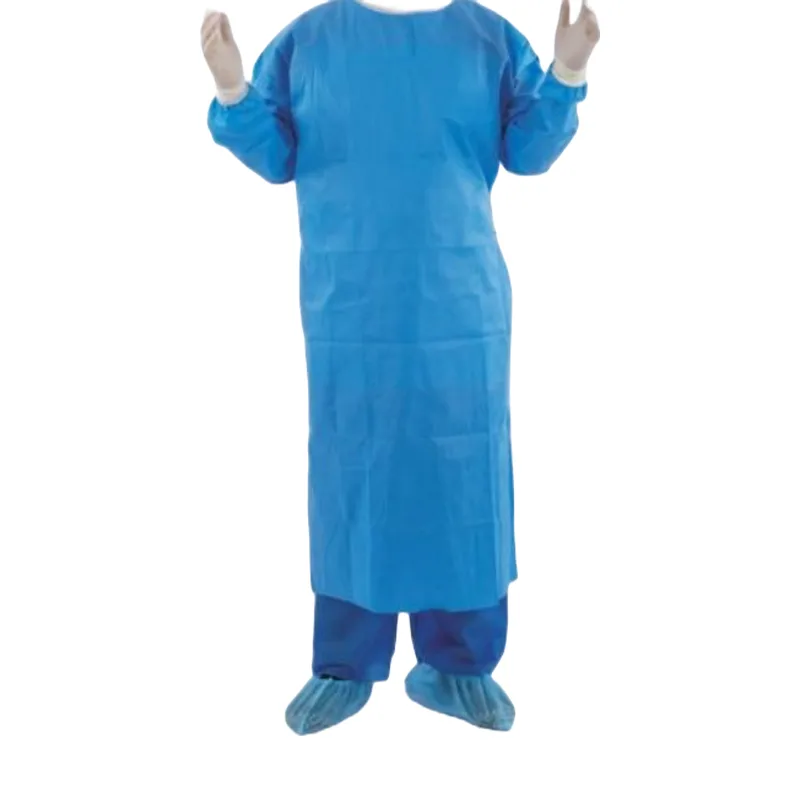
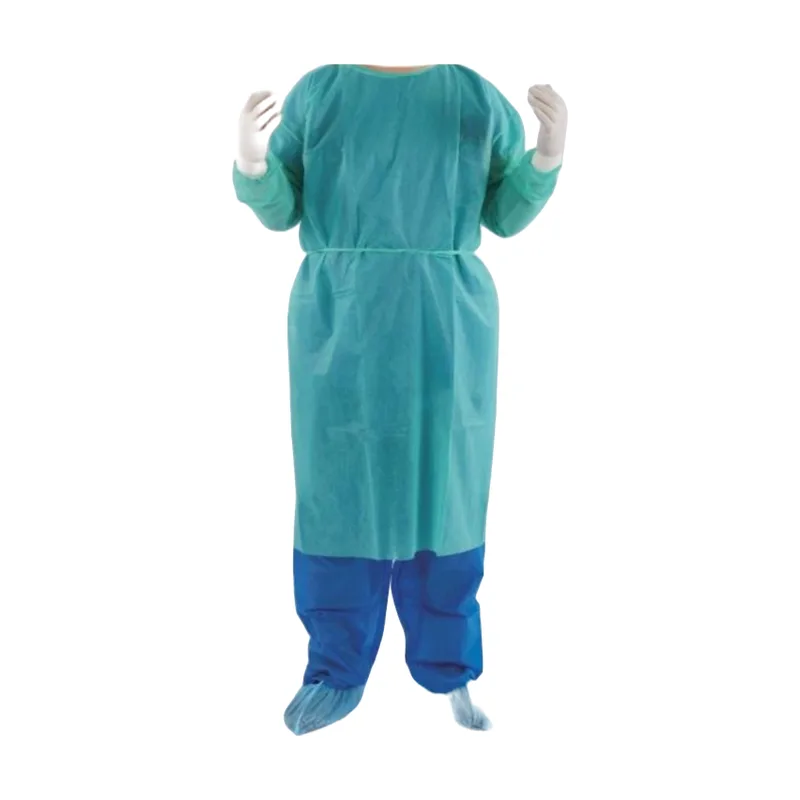
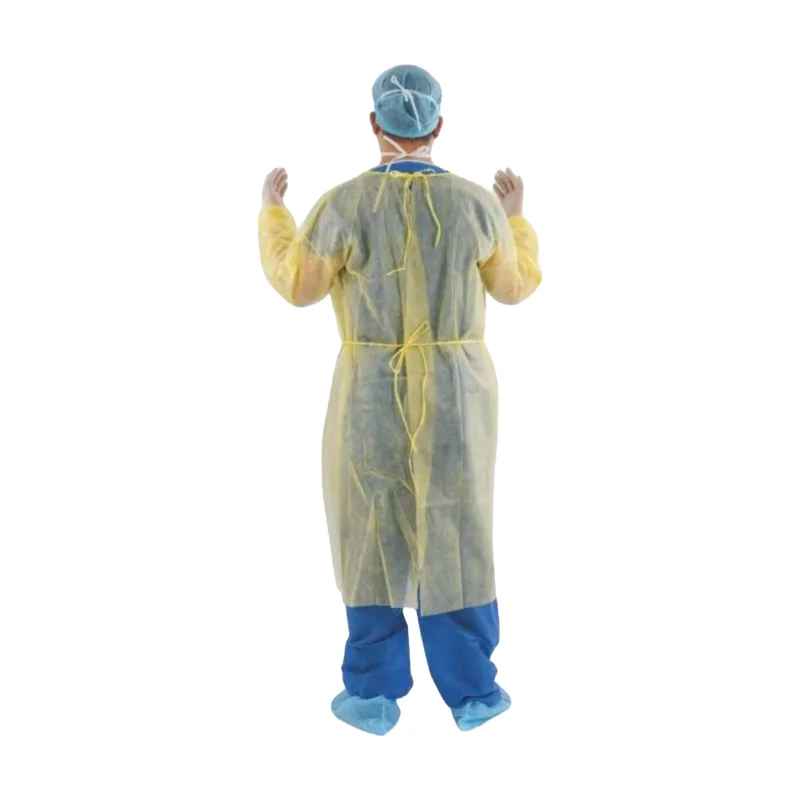
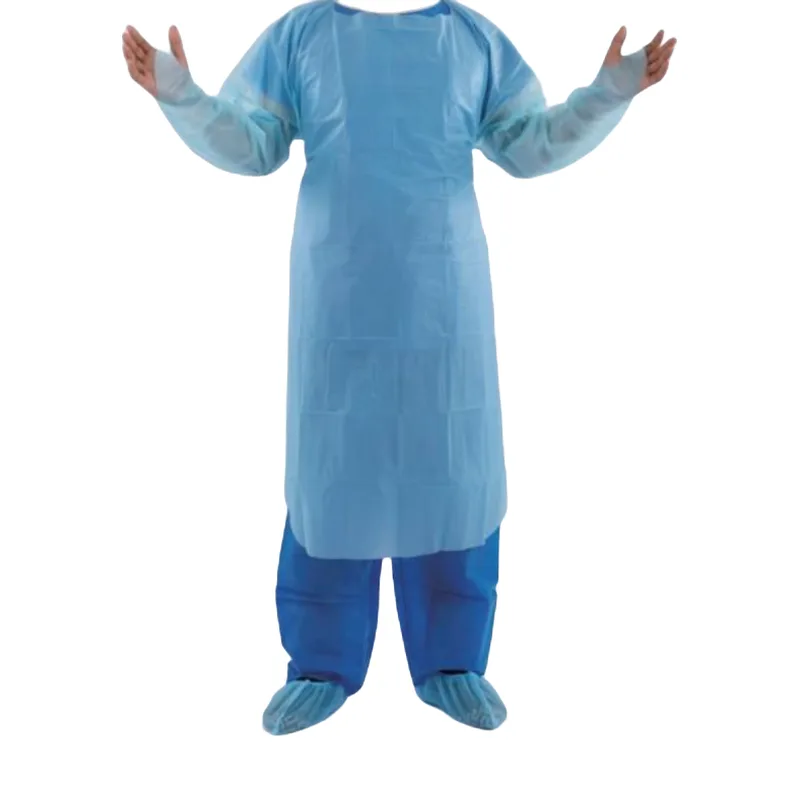
We do not assign a PB70 level or EN 13795 class to these gowns as a range, because barrier performance belongs to a tested design. Before you bid, ask for the documents we hold for the exact item and fabric weight; we will tell you what has been tested and what has not. Buyers in Saudi Arabia and the GCC can see how we ship and document orders on our GCC supply page, or browse all surgical and isolation gowns.
Frequently asked questions
What is the difference between a surgical gown and an isolation gown?+
A surgical gown is worn by the sterile team during surgery; under the FDA approach its critical zones are the front from shoulders to knees and the sleeves from cuff to above the elbow, and the back may be non-protective. A surgical isolation gown is used where the risk is moderate to high and a larger critical zone is needed: every area except bindings, cuffs and hems must meet the gown's rated level. Non-surgical isolation gowns are for low-risk care.
Is an AAMI Level 3 gown waterproof?+
No. CDC/NIOSH notes that gowns at Levels 1 to 3 cannot be considered impermeable; they are tested with water only. Only Level 4 is tested against synthetic blood and a viral surrogate at 2 psi.
Which AAMI level do I need for a blood draw?+
The FDA gives blood draws, suturing, ICU and pathology lab work as examples for Level 2, and arterial blood draws, IV insertion, emergency room and trauma as examples for Level 3. Your infection-prevention team should set the level against your own risk assessment.
Is EN 13795 the same as EN 14126?+
No. EN 13795-1 covers surgical gowns and drapes as medical devices. EN 14126 covers protective clothing against infective agents as personal protective equipment under Regulation (EU) 2016/425, with its own tests and classes. A product sold as both must meet both regimes.
Are WinHyCare gowns certified to AAMI PB70 or EN 13795?+
We do not claim a PB70 level or EN 13795 class for our gowns as a range. Barrier performance depends on the specific design, fabric weight and seams. Ask for the documents we hold for the exact item you plan to order and we will tell you what has and has not been tested.
Sources
- Medical Gowns, U.S. Food and Drug Administration
- ANSI/AAMI PB70 Class 4 (PPE-Info standard summary), CDC / NIOSH National Personal Protective Technology Laboratory
- AAMI updates PPE standard (ANSI/AAMI PB70:2022), Perioperative Leader
- Disposable versus reusable medical gowns: A performance comparison (McQuerry, Easter and Cao, 2021), American Journal of Infection Control / PMC
- 21 CFR 878.4040: Surgical apparel, Code of Federal Regulations (Cornell LII)
- A review of isolation gowns in healthcare: fabric and gown properties (Kilinc, 2015), Journal of Engineered Fibers and Fabrics / CDC Stacks
- Assessment of stockpiled PPE identifies potential quality problems with surgical gowns, AIHA
- DIN EN 13795-1:2025-03 Surgical clothing and drapes, Part 1, DIN Media
- BS EN 13795-1:2019 Surgical clothing and drapes: surgical drapes and gowns (status), BSI
- Commission Implementing Decision (EU) 2025/2078 on harmonised standards for medical devices, EUR-Lex
- Surgical clothing and drapes EN 13795, Médecins Sans Frontières (MSF) Unicat
- Surgical textiles testing, Surgical Materials Testing Laboratory, NHS Wales
- Evaluating PPE against infectious diseases according to EN 14126, Centexbel
- Regulation (EU) 2016/425 on personal protective equipment, EUR-Lex
- Q&A report: PPE and medical device dual-use products webinar, CEN-CENELEC