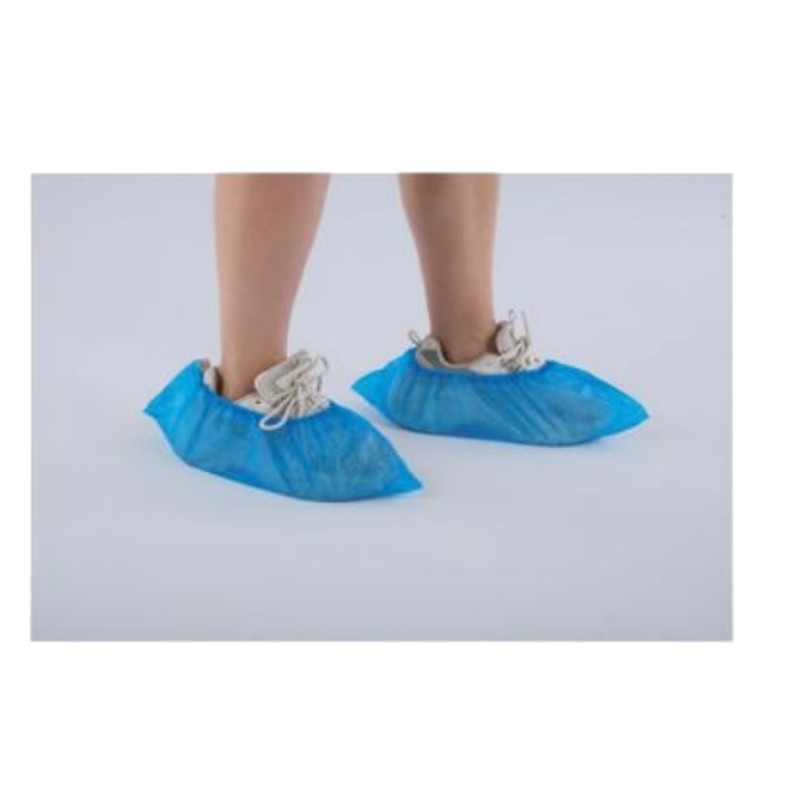
Vinyl vs Nitrile vs TPE vs PE Disposable Gloves: How to Choose for Food and Medical Use
How vinyl, nitrile, TPE and PE disposable gloves compare on barrier performance, fit, standards and food-contact rules, for medical and food procurement.
Published · 8 min read
Key facts
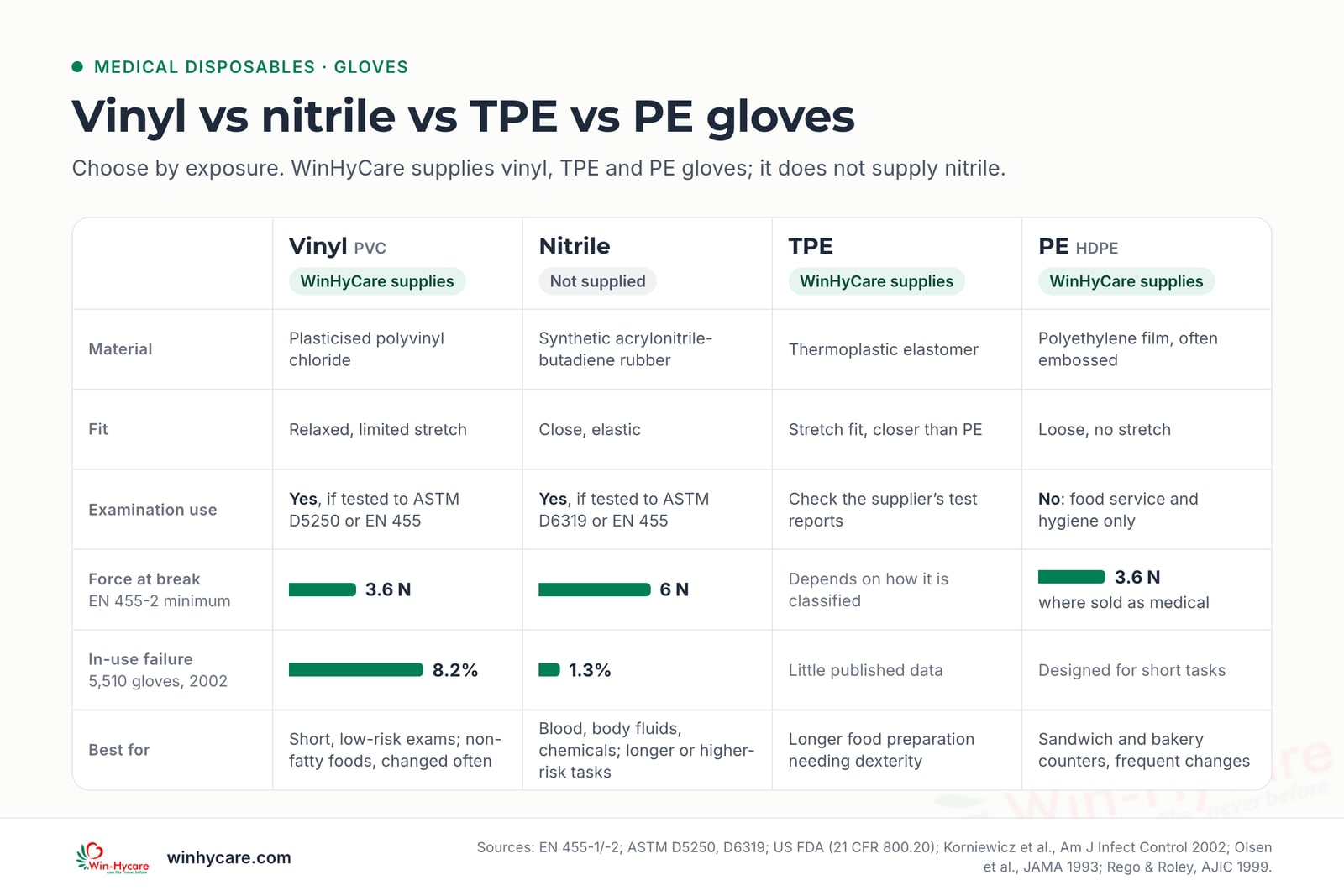
- For tasks with blood or body-fluid exposure, nitrile has the strongest in-use barrier record of the four; in a 2002 study of 5,510 gloves, nitrile failed 1.3% of the time and vinyl 8.2%.
- Vinyl (PVC) is acceptable for short, low-risk examination and non-fatty food tasks, changed often. It meets the lower EN 455-2 strength class for thermoplastic gloves (3.6 N versus 6 N for nitrile).
- PE gloves are loose, low-cost food-service gloves for very short tasks; they are not examination gloves. TPE gloves stretch for a closer fit and suit longer food preparation.
- For food contact in the EU, PVC and PE gloves fall under Regulation (EU) 10/2011, which keeps the phthalates DEHP and DBP out of single-use articles. Ask for the plasticiser and a food-contact declaration before using vinyl on fatty foods.
- In the US, all medical gloves are 510(k) devices, examination gloves must meet a 2.5 AQL for leaks, and powdered medical gloves have been banned since 18 January 2017.
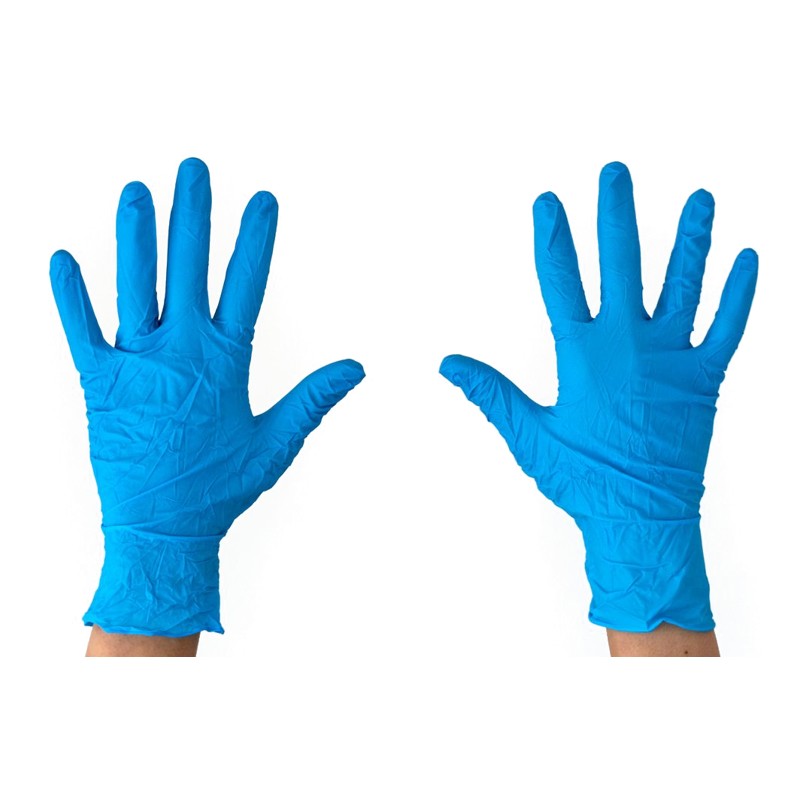
Short answer: choose by exposure. Where hands may meet blood, body fluids or chemicals, nitrile gives the most reliable barrier of the four materials and is the default examination glove. Vinyl (PVC) is acceptable for short, low-risk clinical tasks and for non-fatty foods, provided gloves are changed often and, for food, the plasticiser is documented. TPE is a stretchier, closer-fitting option for longer food preparation and light tasks. PE (polyethylene) gloves are loose, single-task food-service gloves and are not examination gloves.
The rest of this guide sets out the evidence and the standards behind that answer, so the specification you issue matches the risk.
The four materials at a glance
| Vinyl (PVC) | Nitrile | TPE | PE / HDPE | |
|---|---|---|---|---|
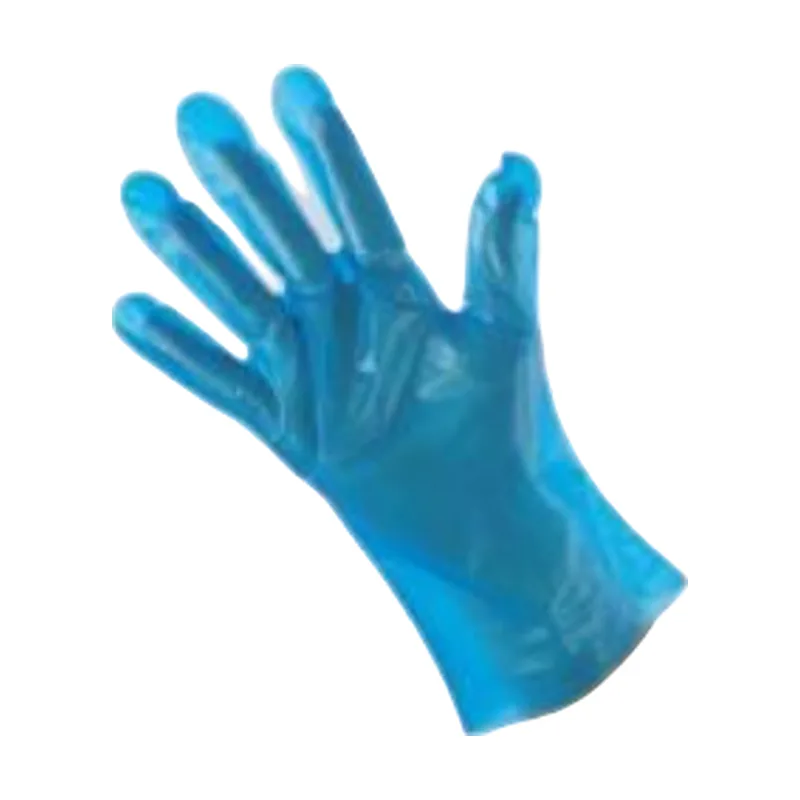
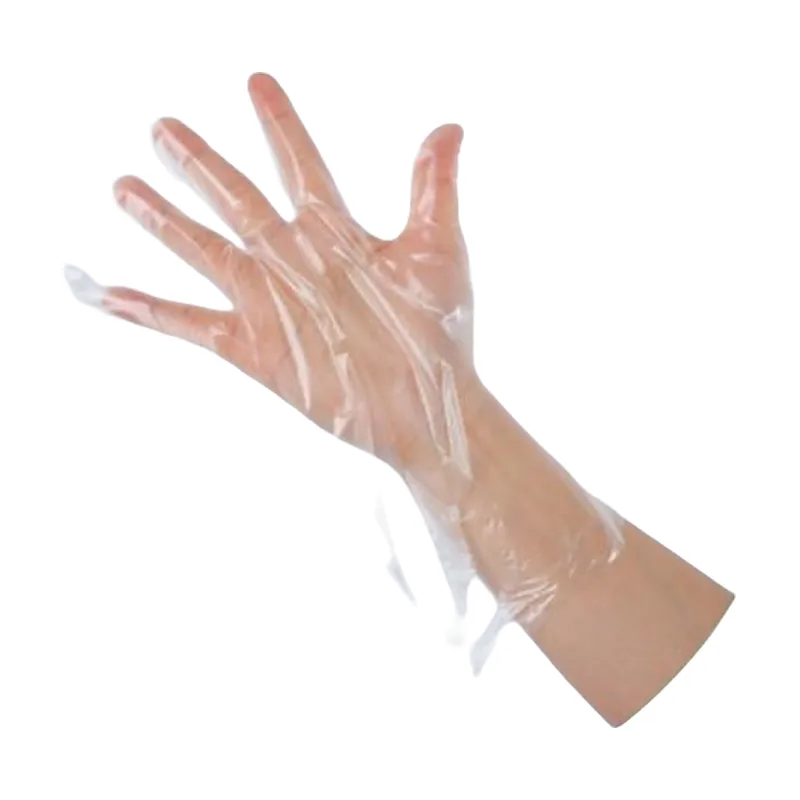
| What it is | Plasticised polyvinyl chloride | Synthetic acrylonitrile-butadiene rubber | Thermoplastic elastomer | Polyethylene film, often embossed |
| Fit | Relaxed, limited stretch | Close, elastic | Stretch fit, closer than PE | Loose, no stretch |
| Medical examination use | Yes, if tested to ASTM D5250 or EN 455 | Yes, if tested to ASTM D6319 or EN 455 | Check the supplier’s claims and test reports | No; food-service and hygiene only |
| EN 455-2 minimum force at break | 3.6 N (thermoplastic class) | 6 N | Depends on how it is classified | 3.6 N where sold as a medical glove |
| In-use barrier evidence | Higher failure rates in published studies | Lowest failure rates | Little published data | Designed for short tasks |
| EU food-contact regime | Regulation 10/2011 (plastics) | Outside 10/2011 (rubber) | Ask for a 10/2011 declaration | Regulation 10/2011 |
| Latex-free | Yes | Yes | Yes | Yes |
All four are latex-free, which matters because natural rubber latex can cause allergic reactions; OSHA estimates that 8 to 12% of health care workers are latex sensitive, and US law requires latex products to carry an allergy caution.
What the barrier studies show
Three peer-reviewed studies, all in clinical or simulated-use conditions, point the same way.
- Olsen et al., JAMA, 1993. In clinical practice, vinyl examination gloves leaked in 26 of 61 tests against 6 of 70 for latex, and hand contamination occurred in 10 of 42 vinyl events against 1 of 44 for latex.
- Rego and Roley, American Journal of Infection Control, 1999. Of 2,000 gloves tested, there were no significant differences straight out of the box (except one vinyl brand at 12%), but after simulated use vinyl gloves failed 12% to 61% of the time, latex 0% to 4% and nitrile 1% to 3%.
- Korniewicz et al., American Journal of Infection Control, 2002. Across 5,510 gloves in simulated use, failure rates were 1.3% for nitrile, 2.2% for latex, 8.2% for vinyl and 8.2% for a copolymer glove.
The practical reading: new vinyl gloves can pass a leak test, but they lose integrity faster once they are flexed and stretched in use. That is why vinyl suits short tasks with frequent changes and nitrile suits longer or higher-risk ones. We found no comparable peer-reviewed data for TPE gloves, so treat TPE barrier claims with the same caution and ask for test reports.
Standards to write into the specification
United States. The FDA classes medical gloves as Class I reserved devices that need 510(k) clearance, and lists PVC, nitrile and polyurethane as the synthetic alternatives to latex. Under 21 CFR 800.20 the FDA treats a 1.5 AQL as the minimum acceptable quality for surgeons’ gloves and 2.5 AQL for patient examination gloves in its water-leak test. The physical specifications are ASTM D5250 for PVC gloves and ASTM D6319 for nitrile examination gloves (current versions are the 2019 standards reapproved in 2023); ASTM D6978 covers permeation testing with chemotherapy drugs. Powdered surgeon’s and examination gloves have been banned in the US since 18 January 2017.
Europe and markets that reference EN standards. EN 455 has four parts:
- EN 455-1 freedom from holes: examination gloves must meet AQL 1.5; surgical gloves AQL 0.65.
- EN 455-2 physical properties: median force at break of at least 3.6 N for thermoplastic examination gloves such as vinyl and polyethylene, 6 N for other examination gloves such as nitrile and latex, and 9 N for surgical gloves.
- EN 455-3 biological evaluation, including the definition of powder-free as no more than 2 mg of powder per glove.
- EN 455-4 shelf-life determination.
For chemical or micro-organism protection outside the clinical device route (cleaning, laboratories), gloves are assessed against EN ISO 374-1 and EN ISO 374-5.
A usable glove specification therefore names the material, the standard (ASTM D5250, ASTM D6319 or EN 455), the AQL, powder-free status, size range and pack count, and asks for the test report behind each claim.

Food handling: material and contact rules
For food businesses the question is less about pinholes and more about what migrates from the glove into the food.
Phthalates in PVC. Vinyl gloves are softened with plasticisers. In a 2001 study, Japanese researchers found DEHP at 0.80 to 11.8 mg/kg in retail packed lunches; the gloves used in the factory contained 22% or 41% DEHP, and chicken rose from 0.08 mg/kg uncooked to 16.9 mg/kg after packing. The authors concluded that disposable PVC gloves used in preparation were the apparent source.
EU rules. Regulation (EC) 1935/2004 requires any food-contact material not to endanger health or change the food’s composition, taste or odour, and to be labelled “for food contact” or with the glass-and-fork symbol. Regulation (EU) 10/2011 adds specific rules for plastics, which covers PVC and PE gloves; it does not apply to rubber, so nitrile and latex gloves fall outside it. Under 10/2011, DEHP and DBP are authorised only as plasticisers in repeated-use articles contacting non-fatty foods, so they cannot be used in single-use food gloves, and BBP is allowed in single-use articles only for non-fatty foods. Regulation (EU) 2023/1442 tightened the migration limits further (DEHP 0.6 mg/kg, DBP 0.12 mg/kg, BBP 6 mg/kg) and introduced a combined limit for these phthalates.
US rules. Polyethylene is listed for food contact under 21 CFR 177.1520, and DEHP is prior-sanctioned as a plasticiser only for foods of high water content (21 CFR 181.27).
Local hygiene rules. In the GCC, municipal food codes set how gloves are used rather than what they are made of. Dubai Municipality’s Food Code, for example, requires disposable gloves used for one task only and discarded when damaged or soiled, and states that gloves are not an alternative to handwashing. For material compliance in Saudi Arabia and the other GCC states, confirm the applicable food-contact requirements with your importer or food-safety authority, and at minimum ask the supplier for a declaration against a recognised regime such as EU 10/2011 or US 21 CFR.
Choosing by task
| Task | Suitable glove |
|---|---|
| Surgery | Sterile surgical gloves (EN 455 AQL 0.65 / FDA AQL 1.5), not examination gloves |
| Blood draw, wound care, contact with body fluids | Nitrile (or latex) examination gloves |
| Handling chemotherapy drugs | Gloves tested to ASTM D6978 |
| Short, non-invasive patient contact with no expected blood | Vinyl examination gloves, changed between patients and tasks |
| Fatty foods: meat, cheese, oils, fried food | Nitrile, or PE / TPE with a food-contact declaration; vinyl only with a documented compliant plasticiser |
| Sandwich and bakery counters, frequent glove changes | PE / HDPE food-service gloves |
| Longer food preparation needing dexterity | TPE gloves |
| Cleaning with chemicals | Nitrile gloves rated to EN ISO 374-1 |
Where WinHyCare’s gloves fit
We do not supply nitrile gloves. Our range is:
- Vinyl (PVC) examination gloves: examination grade, ambidextrous, powdered or powder-free, sizes S to XL, 3 g to 6 g per glove, 100 per box.
- TPE gloves: latex-free, powder-free stretch fit, sizes S to XL, 100 or 200 per box.
- PE / HDPE gloves: embossed food-service gloves, loose fit, 100 per bag; not for examination.
That makes them a fit for food-service, hospitality and low-risk clinical tasks, not for procedures where the evidence points to nitrile. If you plan to use our vinyl gloves with fatty foods, ask us which plasticiser and food-contact documents are available for the batch before you order. For GCC buyers, see how we supply Saudi Arabia and the GCC or browse the disposable gloves range.
Procurement checklist
- Define the exposure: blood and body fluids, chemicals, fatty food, or none.
- Pick the material from the task table, then the standard: ASTM D5250, ASTM D6319 or EN 455.
- Specify AQL (2.5 or better for examination gloves under FDA; 1.5 under EN 455-1), powder-free, sizes and pack counts.
- For food use, require a declaration of compliance naming the regulation and, for PVC, the plasticiser.
- Ask for test reports and certificates of analysis for the lot, not only a brochure.
- Check shelf life on delivery against EN 455-4 data or the manufacturer’s stated expiry.
Frequently asked questions
Are vinyl gloves safe for handling food?+
They can be, for non-fatty foods and short tasks, if the plasticiser and food-contact compliance are documented. Phthalate plasticisers migrate into fatty foods; Japanese researchers traced DEHP in packed lunches to PVC gloves used in preparation. Under EU Regulation 10/2011, DEHP and DBP are not permitted in single-use food-contact plastics.
Is nitrile always better than vinyl?+
For barrier protection, published in-use studies favour nitrile. For a quick, low-risk task with no blood exposure, a vinyl glove that is changed often can be adequate and is less costly. Match the glove to the exposure, not the other way round.
Can PE gloves be used for patient examination?+
PE food-service gloves are loose-fitting hygiene gloves for short tasks. They are not sold as examination gloves and should not replace a glove tested to ASTM D5250, ASTM D6319 or EN 455 for clinical use.
What does powder-free mean?+
Under EN 455-3, a powder-free glove carries no more than 2 mg of powder per glove. In the US, powdered surgeon's and examination gloves have been banned since 18 January 2017.
Does WinHyCare supply nitrile gloves?+
No. We supply vinyl (PVC) examination gloves, stretch TPE gloves and PE/HDPE food-service gloves, all latex-free. If your task needs nitrile, buy nitrile.
Sources
- Medical Gloves, U.S. Food and Drug Administration
- 21 CFR 800.20: Patient examination gloves and surgeons' gloves; sample plans and test method for leakage defects, Code of Federal Regulations (Cornell LII)
- Medical Glove Guidance Manual, U.S. Food and Drug Administration
- Banned Devices; Powdered Surgeon's Gloves, Powdered Patient Examination Gloves, and Absorbable Powder for Lubricating a Surgeon's Glove (81 FR 91722), Federal Register
- ASTM D5250: Standard Specification for Poly(vinyl chloride) Gloves for Medical Application, ASTM International
- ASTM D6319: Standard Specification for Nitrile Examination Gloves for Medical Application, ASTM International
- Medical gloves testing (EN 455 parts 1 to 4), Surgical Materials Testing Laboratory, NHS Wales
- In-use barrier integrity of gloves: latex and nitrile superior to vinyl (Rego and Roley, 1999), American Journal of Infection Control / PubMed
- Performance of latex and nonlatex medical examination gloves during simulated use (Korniewicz et al., 2002), American Journal of Infection Control / PubMed
- Examination gloves as barriers to hand contamination in clinical practice (Olsen et al., 1993), JAMA / PubMed
- Regulation (EC) No 1935/2004 on materials and articles intended to come into contact with food, EUR-Lex
- Regulation (EU) No 10/2011 on plastic materials and articles intended to come into contact with food, EUR-Lex
- Commission Regulation (EU) 2023/1442 amending Annex I to Regulation (EU) No 10/2011, EUR-Lex
- Di(2-ethylhexyl) phthalate contamination of retail packed lunches caused by PVC gloves (Tsumura et al., 2001), Food Additives and Contaminants / PubMed
- 21 CFR 177.1520: Olefin polymers, Code of Federal Regulations (Cornell LII)
- 21 CFR 181.27: Plasticizers, Code of Federal Regulations (Cornell LII)
- Latex Allergy, Occupational Safety and Health Administration
- Food Code (English), Dubai Municipality