What is a peptide API? API vs drug substance explained
A peptide API is the active ingredient of a peptide medicine. How ICH, FDA and EU law define API, drug substance and active substance, and where peptides fit.
By Kareem Ahmed Basha · Reviewed by Nisar Mohammed
Published · 9 min read
Key facts
- A peptide API (active pharmaceutical ingredient) is the purified peptide that gives a medicine its pharmacological effect, before it is formulated, filled and packed as a drug product.
- API and drug substance mean the same thing. ICH Q7 defines them together; US regulations say drug substance and EU law says active substance.
- In the US, an amino acid polymer of 40 or fewer amino acids is a peptide and is regulated as a drug; above 40 it is a protein and falls under the biological product definition.
- Peptide APIs are excluded from ICH Q3A, so EU impurity limits come from the Ph. Eur. general monograph 2034: report above 0.1%, identify above 0.5%, qualify above 1.0%.
- A peptide API can be made by chemical synthesis, recombinant expression or a semi-synthetic route; the route changes which impurities a buyer must look for.
Short answer: a peptide API (active pharmaceutical ingredient) is the purified peptide that gives a medicine its pharmacological effect, supplied to a manufacturer before it is formulated, filled and packed. “API” and “drug substance” are the same thing. ICH Q7 defines them as one term, US regulations say drug substance and EU law says active substance.
That definition sounds tidy, but buyers trip over the edges: when a peptide stops being a peptide, why the usual small-molecule impurity guideline doesn’t apply, and which document a regulator actually expects to see. At Winhycare Pharma, the peptide API division of WinHyCare, those edge questions come up in almost every first conversation, so this guide answers them with the regulators’ own wording.
What is a peptide API?
A peptide API is a chain of amino acids, usually modified, that is manufactured and purified to a specification and sold as the active ingredient for a finished medicine. It is a raw material for pharmaceutical manufacturing and R&D, not a product for patients.
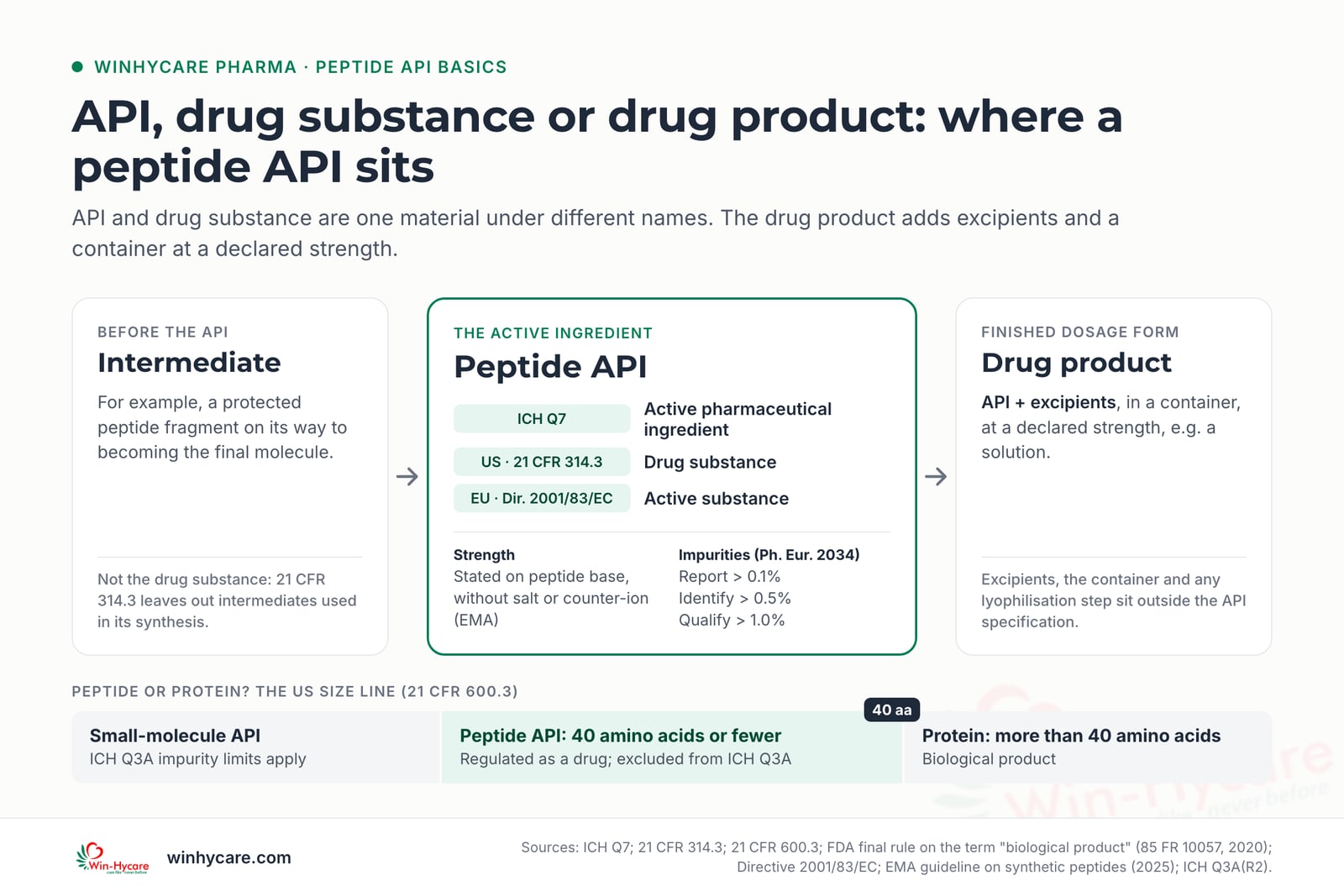
The word “peptide” has a regulatory meaning in the US. Under 21 CFR 600.3(h)(6), “a protein is any alpha amino acid polymer with a specific, defined sequence that is greater than 40 amino acids in size.” FDA’s 2020 final rule on the term “biological product” reads that line the other way round: a polymer of 40 or fewer amino acids is a peptide, sits outside the statutory term “protein”, and is regulated as a drug unless it otherwise meets the biological product definition.
EMA puts it more loosely. Its synthetic peptides guideline, in force since 1 June 2026, describes synthetic peptides as being “at the interface of small molecules and proteins”, which is why they need their own rules.
| Small-molecule API | Peptide API | Protein (biologic) | |
|---|---|---|---|
| US size threshold | None | 40 amino acids or fewer | More than 40 amino acids |
| Typical route | Chemical synthesis | Chemical synthesis, recombinant expression or semi-synthesis | Recombinant expression |
| ICH Q3A impurity limits | Apply | Do not apply (peptides excluded) | Do not apply |
| Impurity thresholds | ICH Q3A | Ph. Eur. 2034 (EU): 0.1% / 0.5% / 1.0% | ICH Q6B and biologics guidelines |
| US status | Drug | Drug (unless it meets the biological product definition) | Biological product |
Semaglutide is a useful example. FDA’s prescribing information for the reference semaglutide injection gives a molecular formula of C187H291N45O59 and a molecular weight of 4113.58 g/mol, and describes a peptide backbone “produced by yeast fermentation” with a fatty di-acid attached at lysine 26 (FDA label, NDA 209637). It is a peptide by size and a drug by US regulatory status, yet its reference version starts life in a fermenter.
Is API the same as drug substance?
Yes. The terms are interchangeable, and the regulators say so directly.
ICH Q7, the international GMP guide for APIs, has a single glossary entry, “Active Pharmaceutical Ingredient (API) (or Drug Substance)”, defined as “any substance or mixture of substances intended to be used in the manufacture of a drug (medicinal) product and that, when used in the production of a drug, becomes an active ingredient of the drug product.” Its entry for “Drug Substance” simply says “See Active Pharmaceutical Ingredient.”
The US and EU legal texts use their own word for the same material:
| Term | Where it is used | Definition (abridged) |
|---|---|---|
| Active pharmaceutical ingredient (API) | ICH Q7 | Substance used in manufacture of a drug product that becomes its active ingredient |
| Drug substance | US, 21 CFR 314.3; ICH quality guidelines | ”An active ingredient that is intended to furnish pharmacological activity”; excludes synthesis intermediates |
| Active substance | EU, Directive 2001/83/EC, Art. 1(3a) | Substance used in manufacture of a medicinal product that becomes its active ingredient, exerting a pharmacological, immunological or metabolic action |
| Drug product / medicinal product | 21 CFR 314.3; ICH Q7 | ”A finished dosage form, e.g., tablet, capsule, or solution, that contains a drug substance” |
One distinction is worth keeping. 21 CFR 314.3 defines “active ingredient” more broadly, as “any component that is intended to furnish pharmacological activity”, while “drug substance” explicitly leaves out intermediates used in its synthesis. So a protected peptide fragment on its way to becoming semaglutide is an intermediate, not the drug substance, even though it will end up inside it.
How is a peptide API different from the finished drug product?
The API is the active ingredient on its own. The drug product is the API plus excipients, in a container, at a declared strength, ready for marketing.
Three practical differences matter to a buyer:
- Strength is defined on the peptide, not the powder. EMA’s guideline says the strength of a peptide medicine “should be defined with respect to the mass of peptide base (not including salt or counter-ion)”, and that LC assay limits are expressed “in terms of the counter-ion free, anhydrous substance, unless otherwise justified” (EMA, 2025). A kilogram of API powder is never a kilogram of peptide.
- Counter-ion and water travel with the API. The same guideline notes that acetate is the usual counter-ion for synthetic peptides, with trifluoroacetate or chloride possible, and expects the counter-ion to be controlled “with a justified upper limit”.
- The drug product adds its own controls. The reference liraglutide injection, for instance, combines the peptide with disodium phosphate dihydrate, propylene glycol, phenol and water for injection (FDA label, NDA 022341). Those excipients, the container and any lyophilisation step are drug-product matters, outside the API specification.
If your product is a freeze-dried peptide, the step between API and drug product is where most stability is won or lost. Our peptide lyophilisation guide covers that stage, and Winhycare Pharma’s lyophilisation CMO service runs it under contract.
How are peptide APIs made?
There are three broad routes, and FDA’s July 2026 product-specific guidance for semaglutide names all three when it says impurities “may result from the manufacturing of a peptide by recombinant, synthetic or semi-synthetic processes.”

- Chemical synthesis. Solid-phase synthesis, liquid- (solution-) phase synthesis and fragment condensation are all within the scope of EMA’s synthetic peptides guideline. Our SPPS vs LPPS guide compares them.
- Recombinant expression. The liraglutide precursor in the reference product is “produced by a process that includes expression of recombinant DNA in Saccharomyces cerevisiae” before a C-16 fatty acid is attached (FDA, NDA 022341). EMA’s synthetic peptides guideline does not apply to products made by recombinant technology.
- Semi-synthesis. A recombinant backbone is chemically modified afterwards, as with the reference semaglutide described above.
The route matters for more than cost. FDA notes that recombinant peptides “may also contain impurities, such as host cell proteins and residual DNA, from the host cell”, which synthetic peptides do not, while synthetic routes bring their own deletion, insertion and stereoisomer impurities (FDA PSG, 2026; EMA, 2025). Same molecule, different things to test for.
Which rules apply to a peptide API?
Peptides fall between rulebooks, so it helps to know which ones apply and which don’t.
GMP. ICH Q7 covers API manufacture, including contract manufacturers and laboratories. In the EU, Article 46b of Directive 2001/83/EC adds that imported active substances must be made to GMP “at least equivalent” to EU standards and must arrive with a written confirmation from the competent authority of the exporting country. The written confirmation is not needed when the exporting country is on the Commission’s equivalence list under Article 111b, or when a Member State grants a time-limited waiver after its own GMP inspection (EUR-Lex).
Impurities. This is the trap for teams used to small molecules. ICH Q3A(R2) lists peptides among the substances “not covered”, and ICH Q6A says it “is not sufficient to adequately describe specifications of higher molecular weight peptides and polypeptides.” In the EU, EMA points instead to the Ph. Eur. general monograph Substances for Pharmaceutical Use (2034): peptide-related impurities are reported above 0.1%, identified above 0.5% and qualified above 1.0%. Our guide to peptide API impurities and specifications goes through those thresholds in detail.
Dossier route. Who files what depends on the market:
| Market | Document for the API | Key point |
|---|---|---|
| EU | Active Substance Master File (ASMF) | API maker can send process and control details “directly to the competent authorities” (Directive 2001/83/EC, Annex I) |
| EU | Certificate of suitability (CEP) | Only where the active substance is the subject of a Ph. Eur. monograph (Annex I) |
| US | Drug Master File (DMF), Type II for an API | ”Not required by statute or regulation” and “neither approved nor disapproved” (FDA) |
| US generics | Type II API DMF referenced in an ANDA | Requires a GDUFA DMF fee and an FDA completeness assessment (FDA, 2017) |
What should a buyer check before choosing a peptide API?
Start with the molecule and the market, then work backwards. Which reference product will your medicine be compared against, which route made it, and which impurity thresholds will your regulator apply? Those three answers decide what the API specification must contain.
Then look at the supplier. Ask for a representative certificate of analysis, the specification it was tested against, the counter-ion and how it is controlled, retest period and storage conditions, and which regulatory documents exist for the material in your market. Our checklist on how to qualify a peptide API supplier sets out the full audit trail.
Winhycare Pharma supplies semaglutide as API for pharmaceutical manufacturing and R&D, and the documents available for a given batch and market are confirmed case by case during qualification. Our wider peptide range and custom peptide synthesis are for research use only: that material is research grade, not GMP API, and cannot be used in a medicinal product.
Frequently asked questions
What is a peptide API?+
It is the purified peptide that provides the pharmacological activity of a medicine, supplied to a pharmaceutical manufacturer as a raw material before formulation. ICH Q7 calls it an active pharmaceutical ingredient (API) or drug substance.
Is API the same as drug substance?+
Yes. ICH Q7 defines 'Active Pharmaceutical Ingredient (API) (or Drug Substance)' as one term. US regulations at 21 CFR 314.3 use 'drug substance', and Directive 2001/83/EC uses 'active substance' for the same material.
How many amino acids make a peptide rather than a protein?+
Under US regulations, a protein is an alpha amino acid polymer with a specific, defined sequence of more than 40 amino acids. Anything of 40 or fewer is treated as a peptide and regulated as a drug unless it otherwise meets the biological product definition.
Is a peptide API a biologic?+
Usually not, in regulatory terms. In the US, peptides of 40 amino acids or fewer fall outside the statutory term 'protein'. In the EU, EMA states that the biosimilar pathway is not possible for chemically synthesised peptides because they fall outside the definition of a biological substance.
Does Winhycare Pharma supply peptide APIs other than semaglutide?+
Not as API. Semaglutide is the peptide Winhycare Pharma supplies as API to pharmaceutical manufacturers and R&D teams. The rest of our peptide range, including custom peptides, is supplied for research use only (not for human or veterinary use), which is research-grade material rather than GMP API. We also offer peptide lyophilisation and CRDMO services.
Sources
- ICH Q7: Good Manufacturing Practice Guide for Active Pharmaceutical Ingredients, International Council for Harmonisation (ICH)
- 21 CFR 314.3: Definitions (drug substance, drug product, active ingredient), Code of Federal Regulations (Cornell LII)
- 21 CFR 600.3: Definitions (protein, more than 40 amino acids), Code of Federal Regulations (Cornell LII)
- Definition of the Term 'Biological Product' (final rule, 85 FR 10057, 21 February 2020), Federal Register
- Directive 2001/83/EC on the Community code relating to medicinal products for human use (consolidated text), EUR-Lex
- Guideline on the Development and Manufacture of Synthetic Peptides (EMA/CHMP/CVMP/QWP/367182/2025), European Medicines Agency
- ICH Q3A(R2): Impurities in New Drug Substances, International Council for Harmonisation (ICH)
- ICH Q6A: Specifications for New Drug Substances and Products: Chemical Substances, International Council for Harmonisation (ICH)
- Semaglutide injection prescribing information (NDA 209637), section 11, US Food and Drug Administration
- Liraglutide injection prescribing information (NDA 022341), section 11, US Food and Drug Administration
- Draft Guidance on Semaglutide (product-specific guidance, NDA 209637), revised July 2026, US Food and Drug Administration
- Drug Master Files (DMFs), US Food and Drug Administration
- Completeness Assessments for Type II API DMFs Under GDUFA: Guidance for Industry (October 2017), US Food and Drug Administration