Generic semaglutide: EU and US regulatory pathways, and what API makers must show
How generic semaglutide is filed in the EU and US: generic vs hybrid, 8+2+1 protection, ANDA vs 505(b)(2), synthetic vs recombinant API, API maker duties.
By Kareem Ahmed Basha · Reviewed by Nisar Mohammed
Published · 10 min read

Key facts
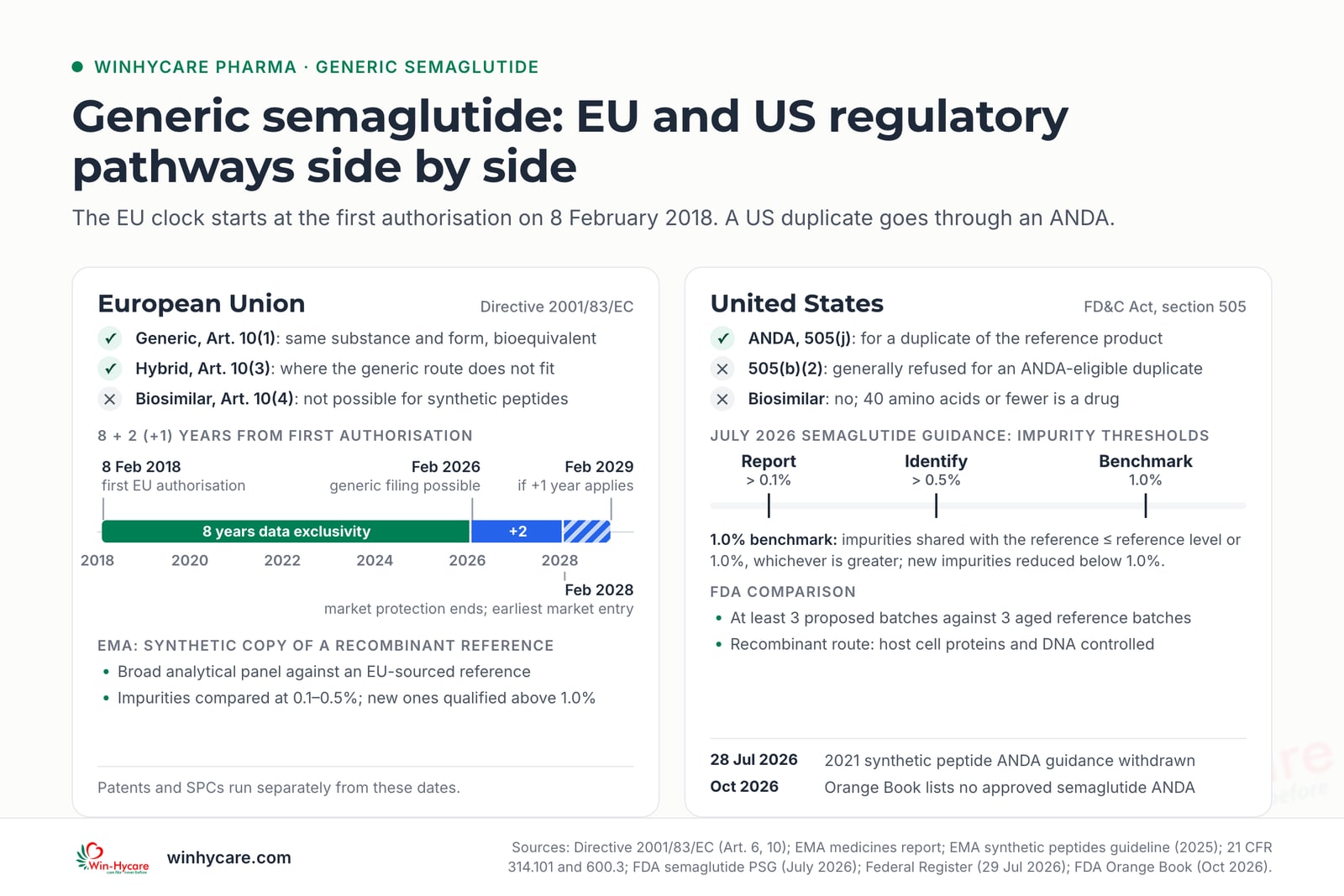
- In the EU, a generic semaglutide is filed under Article 10(1) of Directive 2001/83/EC, or as a hybrid under Article 10(3) where the generic definition or bioavailability-based bioequivalence does not fit.
- The first EU reference semaglutide medicine was authorised on 8 February 2018. Under the 8+2(+1) rule, generic applications could be filed from February 2026 but products cannot be marketed before February 2028, or 2029 if the extra year applies; patents and SPCs are separate.
- In the US, a duplicate of the reference semaglutide product goes through an ANDA; FDA generally refuses to file a 505(b)(2) application for a duplicate eligible for an ANDA.
- FDA withdrew its 2021 guidance on synthetic peptide ANDAs on 28 July 2026 (Federal Register notice published 29 July) and revised its semaglutide product-specific guidance the same month to cover recombinant, synthetic and semi-synthetic generics.
- FDA's Orange Book data files, downloaded in October 2026, list no approved ANDA for semaglutide; they list approved ANDAs for liraglutide from December 2024.
Short answer: in the EU, generic semaglutide is filed under Article 10(1) of Directive 2001/83/EC, or as a hybrid under Article 10(3), and cannot be marketed until ten years after the reference product’s first authorisation in February 2018. In the US it goes through an ANDA, with FDA’s July 2026 product-specific guidance setting the comparison against the reference semaglutide medicines.
The rules have moved this year. EMA’s synthetic peptides guideline took effect on 1 June 2026, and FDA withdrew its 2021 synthetic peptide guidance in July while revising its semaglutide recommendations. For developers sourcing semaglutide API from Winhycare Pharma or anyone else, the API specification now has to be written against those new texts. This guide covers both regions, the synthetic-versus-recombinant question, and what the API maker has to supply.
What are the EU regulatory pathways for generic semaglutide?
Two routes under Article 10 of Directive 2001/83/EC, with a third ruled out.
Generic, Article 10(1). The applicant does not provide pre-clinical or clinical results if it can show the product is a generic of a reference medicine authorised for at least eight years. Article 10(2)(b) defines a generic as having “the same qualitative and quantitative composition in active substances and the same pharmaceutical form as the reference medicinal product”, with bioequivalence “demonstrated by appropriate bioavailability studies”. Different salts, esters or derivatives count as the same active substance unless they differ significantly in safety or efficacy.
Hybrid, Article 10(3). Where the product “does not fall within the definition of a generic medicinal product”, where bioequivalence “cannot be demonstrated through bioavailability studies”, or where the active substance, indications, strength, form or route change, “the results of the appropriate pre-clinical tests or clinical trials shall be provided.” A product that differs from the reference in strength, pharmaceutical form or route falls here.
Biosimilar, Article 10(4): not available for synthetic semaglutide. EMA’s synthetic peptides guideline states that “the biosimilar regulatory pathway is not possible for chemically synthesised peptides since these fall outside the definition of a biological substance.” It still expects the “basic principles to demonstrate biosimilarity” to guide a synthetic peptide that references a biological medicine. That matters here, because the reference semaglutide backbone is “produced by yeast fermentation” (FDA label, NDA 209637).
When does EU regulatory protection for semaglutide end?
Article 10(1) sets the clock at 8+2(+1) years from the initial authorisation of the reference product:
- 8 years before a generic application can rely on the reference dossier;
- 10 years before the generic “shall not be placed on the market”;
- up to 11 years if, in the first eight years, the holder gained a new indication judged to bring “a significant clinical benefit in comparison with existing therapies.”
EMA’s medicines data shows the first centrally authorised semaglutide medicine (EMEA/H/C/004174) received its marketing authorisation on 8 February 2018 (EMA medicines report). On the Article 10 arithmetic, that gives:
| Milestone | Date for the 2018 reference product |
|---|---|
| Data exclusivity ends; generic applications can be filed | February 2026 |
| Market protection ends; generics can be placed on the market | February 2028 |
| Latest date if the one-year extension applies | February 2029 |
Three caveats. First, Article 6(1) groups later strengths, forms, routes, presentations and extensions of a product into the same “global marketing authorisation” for Article 10(1) purposes, so the date depends on which reference product you cite and how it was authorised. Other semaglutide medicines were authorised in April 2020 and January 2022. Second, Article 10 applies “without prejudice to the law relating to the protection of industrial and commercial property”: patents and supplementary protection certificates run separately, and our guide to semaglutide patent expiry by country covers them. Third, the EU’s general pharmaceutical legislation is being replaced. The Commission proposed a new directive and regulation on 26 April 2023 and reports a provisional agreement in December 2025 (European Commission). Check which version and transitional rules apply on your filing date.
What does EMA expect from a synthetic semaglutide that references a biological medicine?
Section 6 of EMA’s guideline sets out the comparability package. The main expectations:
- A broad analytical panel comparing the synthetic product with the recombinant reference, covering primary structure, higher-order structure (CD, FTIR, 2D NMR, fluorescence, DSC) and, where relevant, oligomeric state.
- Reference product sourced from the European market, tested at several points before expiry after ageing under labelled conditions.
- Orthogonal purity methods (size, charge and hydrophobicity based), with “a full evaluation of the peptide-related impurity profile at levels 0.1-0.5%” compared to the reference and a quantification limit of 0.1%.
- New impurities shown not to raise immunogenicity concerns and “qualified if above 1.0%”; in silico or in vitro T-cell assays may support this.
- Functional assays, such as cell-based assays, and comparative forced degradation.
- Own stability data: “Stability and shelf-life claims cannot be derived from the reference product without their own data.”
Host cell proteins and DNA from the reference product’s expression system “do not need to be part of the comparability studies” for a synthetic version, but residual solvents, reagents, elemental and potentially mutagenic impurities do.
What are the US pathways: ANDA or 505(b)(2)?
FDA’s August 2026 draft guidance restates the two abbreviated routes. An ANDA, under section 505(j), is for “a drug product that is a duplicate of a previously approved drug product” and relies on FDA’s finding that the reference listed drug is safe and effective. A 505(b)(2) application is an NDA in which “at least some of the information required for approval comes from studies not conducted by or for the applicant.”
The choice is not free. FDA “generally will refuse to file a 505(b)(2) application for a drug product that is a duplicate of a listed drug and eligible for approval under section 505(j)”, citing 21 CFR 314.101(d)(9). So a semaglutide injection that matches the reference product’s active ingredient, dosage form, strength, route and conditions of use belongs in an ANDA. A product that changes one of those may need a 505(b)(2).
Semaglutide also stays on the drug side of the drug/biologic line. Under 21 CFR 600.3(h)(6) a protein has more than 40 amino acids, and FDA’s 2020 rule on the term “biological product” treats a polymer of 40 or fewer as a peptide, regulated as a drug. That puts semaglutide outside the US biosimilar route.
What changed at FDA in 2026?
Two things, announced in the same Federal Register notice on 29 July 2026.
The 2021 synthetic peptide guidance was withdrawn. FDA’s May 2021 guidance, “ANDAs for Certain Highly Purified Synthetic Peptide Drug Products That Refer to Listed Drugs of rDNA Origin”, covered only five peptides: glucagon, liraglutide, nesiritide, teriparatide and teduglutide. It allowed new peptide-related impurities up to 0.5% of the drug substance, required identification of those at 0.10% or more, and stated that FDA did not expect an ANDA could support “a proposed peptide of rDNA origin at this time” (FDA, 2021). FDA withdrew it because it “no longer reflects FDA’s current scientific thinking” and said it plans to revise and reissue it this year. No replacement had appeared in the Federal Register when this guide was published.
The semaglutide product-specific guidance was revised. FDA’s draft guidance on semaglutide (first recommended March 2020, revised November 2023 and July 2026) now applies to generics made by “recombinant, synthetic or semi-synthetic processes.” It recommends:
| Topic | July 2026 recommendation |
|---|---|
| Batches compared | At least 3 batches of the proposed product (at release and end of shelf life) and at least 3 aged reference batches |
| Structure and activity | Higher-order structure and aggregates where applicable; biological activity where appropriate |
| Impurity reporting / identification | Above 0.1% / above 0.5% of the drug substance |
| Impurities shared with the reference | Not greater than the reference level or 1.0%, whichever is greater |
| New impurities | Efforts to reduce below 1.0%; total not greater than the reference |
| Recombinant generics | Show host cell proteins and residual DNA are well controlled |
| In vivo bioequivalence waiver | Formulation qualitatively (Q1) and quantitatively (Q2, within ±5%) the same as the reference |
| Device | Compare the pen injector’s design and user interface with the reference |
Levels outside those figures do not rule out an ANDA, but the applicant must justify them and FDA may ask for reductions.
Synthetic or recombinant semaglutide API: does the route matter?
For the active ingredient, no; for the impurity file, very much.
| Recombinant API (including a recombinant backbone modified chemically) | Synthetic API | |
|---|---|---|
| How the backbone is made | Expression in a host organism, then chemical modification | Solid-phase, solution-phase or hybrid chemical synthesis |
| Route-specific impurities | Host cell proteins, residual DNA | Deletion, insertion and truncated sequences; stereoisomers; reagents and solvents |
| EU guidance | EMA’s synthetic peptides guideline does not apply to recombinant products | EMA synthetic peptides guideline, including section 6 comparability |
| US expectation (July 2026 PSG) | Same impurity thresholds plus host cell impurity control | Same impurity thresholds |
Our guide to SPPS vs LPPS explains how the synthetic routes differ.
What must a semaglutide API manufacturer provide?
The finished-product applicant carries the filing, but much of it depends on the API maker.
For the EU:
- GMP evidence that the API is made to standards at least equivalent to the EU’s, and for imported API a written confirmation from the exporting country’s competent authority, unless the country is on the Article 111b equivalence list or a waiver applies (Directive 2001/83/EC, Article 46b).
- A dossier route: an Active Substance Master File sent “directly to the competent authorities” by the API maker, or a certificate of suitability where the substance is the subject of a Ph. Eur. monograph (Annex I).
- A specification built on Ph. Eur. general monograph 2034 thresholds and EMA’s peptide guideline, plus the characterisation data the comparability exercise needs.
For the US:
- A Type II API DMF that the ANDA can reference. FDA says DMFs “are not required by statute or regulation” and are “neither approved nor disapproved” (FDA), but once referenced in a generic submission the holder must pay a GDUFA DMF fee and the DMF must pass an FDA completeness assessment (FDA, 2017).
- An impurity profile that lets the applicant meet the product-specific guidance comparison, including identification of every impurity above 0.5% and data down to 0.1%.
- Host cell impurity data if the route is recombinant or semi-synthetic.
Our checklist on how to qualify a peptide API supplier turns these points into audit questions. Buyers can find region-specific contacts on the peptide API supplier pages for Europe and the USA; which regulatory documents exist for a given batch and market is confirmed during qualification.
Where does generic semaglutide stand today?
In the US, FDA’s Orange Book data files available in October 2026 list semaglutide products only under the originator’s NDAs; there is no approved semaglutide ANDA. The same files list approved ANDAs for liraglutide, the first dated 23 December 2024, which shows the ANDA route for a GLP-1 peptide is open in practice. In the EU, the data-exclusivity period for the 2018 reference product has ended, and the market-protection period runs to February 2028 at the earliest.
Frequently asked questions
Is generic semaglutide approved in the US?+
Not as of FDA's Orange Book data files available in October 2026, which list semaglutide products only under NDAs held by the originator. Generic liraglutide ANDAs have been approved since 23 December 2024. Check the current Orange Book before relying on this, as it is updated monthly.
When can generic semaglutide be marketed in the EU?+
Regulatory protection runs from the first EU authorisation of the reference product on 8 February 2018. A generic cannot be placed on the market until ten years have passed, so February 2028, or up to eleven years if a qualifying new indication earned the extra year. Patents and supplementary protection certificates can delay launch further.
Should a generic semaglutide be filed as an ANDA or a 505(b)(2) application in the US?+
If the product is a duplicate of the reference semaglutide product (same active ingredient, dosage form, strength, route and conditions of use) and eligible for approval under section 505(j), FDA expects an ANDA and generally refuses to file it as a 505(b)(2). A product that differs in a way an ANDA cannot cover needs a 505(b)(2) application.
Is synthetic semaglutide the same as recombinant semaglutide?+
The active ingredient can be the same, but the impurity profiles differ. Recombinant material can carry host cell proteins and DNA; synthetic material carries its own process impurities. FDA's July 2026 product-specific guidance applies the same impurity thresholds whatever the route, and asks recombinant generics to show host cell impurities are well controlled.
Is a generic semaglutide a biosimilar?+
No. In the US, a peptide of 40 or fewer amino acids is regulated as a drug, not a biological product. In the EU, EMA states that the biosimilar pathway is not possible for chemically synthesised peptides, although it expects biosimilarity principles to be applied when a synthetic peptide references a biological medicine.
Does the API manufacturer need a DMF or ASMF?+
A US DMF is not required by statute, but a Type II API DMF referenced in an ANDA triggers a GDUFA fee and a completeness assessment. In the EU, the API maker can submit an Active Substance Master File, or a certificate of suitability where a Ph. Eur. monograph covers the substance.
Sources
- Directive 2001/83/EC on the Community code relating to medicinal products for human use (consolidated text), Articles 6, 10, 46b and Annex I, EUR-Lex
- Medicines output: medicines report (EPAR data download, accessed October 2026), European Medicines Agency
- Reform of the EU pharmaceutical legislation, European Commission
- Guideline on the Development and Manufacture of Synthetic Peptides (EMA/CHMP/CVMP/QWP/367182/2025), European Medicines Agency
- ANDAs for Certain Highly Purified Synthetic Peptide Drug Products That Refer to Listed Drugs of rDNA Origin: Guidance for Industry (May 2021, withdrawn July 2026), US Food and Drug Administration (via Regulations.gov, docket FDA-2017-D-5767)
- Notice of availability of the final guidance on synthetic peptide ANDAs (86 FR 27446, 20 May 2021), Federal Register
- Product-Specific Guidances; Revised Draft Guidances for Industry; Availability (FR Doc. 2026-15285, 29 July 2026), including withdrawal of the May 2021 peptide guidance, Federal Register
- Draft Guidance on Semaglutide (product-specific guidance, NDA 209637), revised July 2026, US Food and Drug Administration
- Determining Whether to Submit an ANDA or a 505(b)(2) Application: Draft Guidance for Industry (August 2026 revision), US Food and Drug Administration
- Orange Book Data Files (products file, downloaded October 2026), US Food and Drug Administration
- Semaglutide injection prescribing information (NDA 209637), section 11, US Food and Drug Administration
- Definition of the Term 'Biological Product' (final rule, 85 FR 10057, 21 February 2020), Federal Register
- 21 CFR 600.3: Definitions (protein, more than 40 amino acids), Code of Federal Regulations (Cornell LII)
- Completeness Assessments for Type II API DMFs Under GDUFA: Guidance for Industry (October 2017), US Food and Drug Administration
- Drug Master Files (DMFs), US Food and Drug Administration