SPPS vs LPPS vs hybrid: how peptide APIs are manufactured, and why the route matters to buyers
Solid-phase, liquid-phase and hybrid peptide synthesis compared for API buyers: chemistry, length limits, impurities, scale, solvent use and regulatory impact.
By Kareem Ahmed Basha · Reviewed by Nisar Mohammed
Published · 9 min read

Key facts
- Solid-phase peptide synthesis (SPPS) builds the chain on a resin bead and is the dominant route for peptide APIs; Fmoc chemistry has largely replaced Boc.
- Liquid-phase peptide synthesis (LPPS) builds the chain in solution and isolates intermediates; an industry analysis notes advantages for shorter peptides of about 5–10 amino acids.
- Hybrid processes make fragments by SPPS and join them in solution; enfuvirtide is an early production-scale example and tirzepatide a recent one.
- SPPS is solvent-intensive: an ACS Green Chemistry Institute analysis of 40 processes put its average process mass intensity at about 13,000 kg of input per kg of API.
- The route sets the impurity profile, so it shapes the regulatory file, and changing it later is a regulated change.
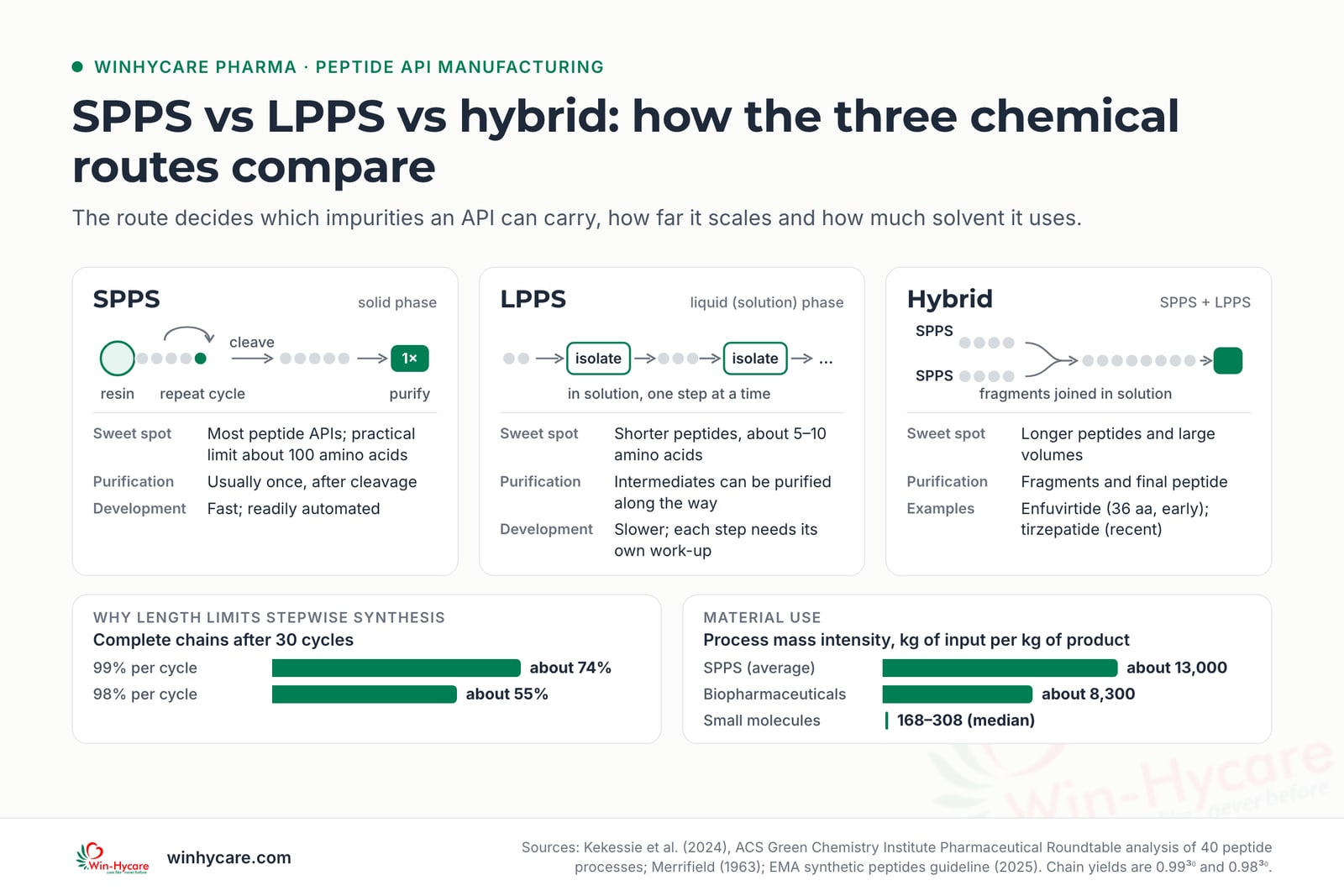
Peptide APIs are made by one of three chemical routes: solid-phase synthesis (SPPS), liquid-phase synthesis (LPPS), or a hybrid that combines them. Some are also made by recombinant expression, or by expression followed by chemical modification. For a buyer, the route is not a detail of the supplier’s process. It determines which impurities the API can contain, how far the process can scale, how much solvent it consumes and what the regulatory file has to explain.
This article compares the three chemical routes, sets out where each is used, and explains what to ask a supplier about its route.
The three routes at a glance
| SPPS | LPPS | Hybrid (SPPS + LPPS) | |
|---|---|---|---|
| Principle | Chain built on an insoluble resin; excess reagents washed away after each step | Chain built in solution; intermediates isolated | Fragments made by SPPS, then joined in solution |
| Purification | Usually once, after cleavage from the resin | Intermediates can be purified along the way | Fragments and final peptide purified |
| Development speed | Fast; readily automated | Slower; step-specific development | Moderate; more steps to develop |
| Typical sweet spot | Most peptide APIs; practical limit around 100 amino acids | Shorter peptides, about 5–10 amino acids | Longer peptides and large volumes |
| Material use | High: average PMI about 13,000 | Lower per amino acid | Mostly driven by the SPPS steps |
| Examples | Most synthetic peptide APIs | Short peptides at large scale | Enfuvirtide (early); tirzepatide (recent) |
The length ranges and examples are from the 2024 ACS Green Chemistry Institute Pharmaceutical Roundtable analysis by Kekessie and colleagues, which pooled data on 40 peptide processes from 14 member companies.
Solid-phase peptide synthesis (SPPS)
Bruce Merrifield described solid-phase synthesis in 1963 (Merrifield, 1963) and received the 1984 Nobel Prize in Chemistry “for his development of methodology for chemical synthesis on a solid matrix” (NobelPrize.org). The idea is simple: anchor the first amino acid to an insoluble resin, then repeat a cycle of deprotection, washing, coupling and washing until the sequence is complete. Because the peptide stays on the resin, excess reagents can be used to push each coupling to completion and then simply washed away. The finished peptide is cleaved from the resin, side-chain protecting groups are removed, and the crude peptide is purified, usually by preparative reversed-phase chromatography.

Fmoc versus Boc
Two protection strategies dominate. Boc chemistry needs anhydrous hydrogen fluoride for final cleavage; Fmoc chemistry uses a base to remove the temporary protecting group and acid for final cleavage, giving an orthogonal scheme. A 2016 review states that “the majority of synthetic peptides are now prepared by Fmoc” SPPS and that Boc is “now generally only used for specialist applications”, partly because many modifications are not stable to HF cleavage (Behrendt et al., 2016).
Why length is the limiting factor
Every coupling and deprotection must go almost to completion, because small losses compound. If each of 30 cycles achieves 99%, about 74% of chains are complete (0.9930); at 98% per cycle the figure falls to about 55%. The incomplete chains become impurities that are similar to the product and difficult to separate. EMA’s synthetic peptides guideline lists the typical classes:
- Deletion sequences, missing one or more residues after incomplete coupling or deprotection, often limited by repeating couplings and by capping unreacted sites.
- Truncated sequences, the acetylated fragments produced by that capping.
- Insertion sequences, where an amino acid is coupled twice.
- Diastereomers, from epimerisation during activation and coupling.
- Cleavage by-products, where reactive species released from protecting groups modify sensitive residues such as Trp, Tyr and Met unless scavenged.
The guideline also notes tools used to reduce aggregation on the resin, such as pseudoproline dipeptides and Dmb-glycine (EMA, 2025). The Kekessie analysis puts the practical limit for efficient SPPS manufacture at approximately 100 amino acids, and notes that approved synthetic peptides range up to about 60.
Liquid-phase peptide synthesis (LPPS)
LPPS, the classical approach, builds the peptide in solution. Each intermediate is isolated, and can be purified and characterised before the next step, so impurities can be removed early rather than carried to the end. It uses smaller excesses of reagents, and it allows different protecting-group strategies, such as Boc and Cbz, for complex targets. The cost is development time: each step needs its own work-up and isolation conditions.
The Kekessie analysis notes that LPPS “for the manufacture of shorter peptides, containing 5–10 AAs for example, offers some advantages”, and its small LPPS data set showed lower material use per amino acid than SPPS.
Tag-assisted LPPS
Newer LPPS variants attach the growing chain to a soluble tag that makes it easy to precipitate or extract after each step, combining solution-phase chemistry with simple isolation. A 2022 review describes tags based on polyethylene glycol, fluorous groups, ionic liquids, hydrophobic polymers and group-assisted purification (GAP) chemistry (Sharma et al., 2022; An et al., 2015). The Kekessie analysis reports lipophilic-tag LPPS being applied at 15–20 kg scale.
Hybrid processes: fragments plus solution-phase coupling
For longer peptides and large volumes, the sequence can be divided into fragments that are made separately by SPPS and then joined in solution. The Kekessie analysis describes this convergent approach, with fragments produced in parallel, and cites enfuvirtide, a 36-amino-acid peptide, as an early production-scale example and tirzepatide as a recent one. Bray’s 2003 review describes the route selection behind enfuvirtide’s large-scale chemical manufacture (Bray, 2003).
Hybrid routes add steps, and fragment condensation is itself a source of process impurities that EMA expects to be characterised and controlled. EMA also distinguishes between short peptide fragments, which may be accepted as starting materials when justified, and longer or modified fragments, which are treated as intermediates made under GMP.
Recombinant and semi-synthetic routes
Chemical synthesis is not the only option. The US prescribing information for the reference semaglutide product states that its peptide backbone “is produced by yeast fermentation” and then chemically modified (DailyMed). By contrast, a generic liraglutide injection approved in the US states that its liraglutide “is manufactured by chemical synthesis” (DailyMed).
That difference has regulatory consequences. FDA’s July 2026 draft guidance for semaglutide injection applies to products made by “recombinant, synthetic or semi-synthetic processes” and sets impurity comparisons against the reference product (FDA). In the EU, the biosimilar pathway is not available for chemically synthesised peptides, so a synthetic version of a recombinant reference product needs a full analytical comparison, including the peptide-related impurity profile at 0.1–0.5% (EMA, 2025).
Solvents and sustainability
Peptide synthesis uses far more material per kilogram of product than small-molecule manufacture. The ACS Green Chemistry Institute analysis found:
| Measure | Value |
|---|---|
| Average process mass intensity (PMI), SPPS | About 13,000 kg input per kg API |
| Commercial and Phase 3 SPPS processes | PMI 1,684 to 34,585 (average 13,063) for 6–43-mers |
| Small molecules, for comparison | Median PMI 168–308 |
| Biopharmaceuticals, for comparison | PMI about 8,300 |
| Largest organic solvent in SPPS | DMF, 39% of solvent use |
Source: Kekessie et al., 2024. The ACS Roundtable had earlier identified greener peptide processes as a critical need (Isidro-Llobet et al., 2019).
Regulation is adding pressure. Since 12 December 2023, REACH Annex XVII entry 76 has restricted DMF in the EU: it may only be placed on the market or used at 0.3% or more if worker exposure is kept below derived no-effect levels of 6 mg/m³ by inhalation and 1.1 mg/kg/day by skin contact (Regulation (EU) 2021/2030). The Kekessie analysis also flags safety concerns with common coupling chemistry, including hydrogen cyanide formation from DIC/Oxyma under normal reaction conditions and reports of anaphylaxis linked to some coupling reagents.
How the choice is usually made
| Factor | Points towards |
|---|---|
| Short sequence, very large volume | LPPS or tag-assisted LPPS |
| Typical therapeutic length (the commercial and Phase 3 SPPS processes in the Kekessie data set ran from 6 to 43 residues) | SPPS |
| Long sequence or very large volume of a long peptide | Hybrid, or recombinant for natural L-amino-acid sequences |
| Lipidation, unnatural amino acids, D-amino acids | Chemical synthesis (SPPS or hybrid), possibly with semi-synthetic steps |
| Generic of a recombinant reference product | Any route, but expect a demanding impurity comparison with the reference product |
What to ask a peptide API supplier about its route
- Which route, and where is it run? SPPS, LPPS, hybrid or recombinant, and the manufacturing site for each stage.
- What are the registered starting materials? EMA applies ICH Q11 principles; protected L-amino acid derivatives are generally acceptable, longer fragments are usually intermediates.
- How are route-specific impurities controlled? Ask for the impurity profile above 0.1%, with identified deletion, insertion and diastereomeric impurities.
- Which counter-ion is delivered? Reversed-phase purification often uses TFA; EMA expects counter-ion and residual TFA to be controlled in the specification.
- Is the route fixed for your filing? A change of route after registration is a regulated variation or supplement and can require new comparability data.
Our article on peptide API impurities and specifications covers the analytical side in detail, and how to qualify a peptide API supplier covers documents and audits.
Winhycare Pharma
Winhycare Pharma supplies Semaglutide API on a B2B basis and offers peptide CRDMO services, including process and analytical development and technology transfer, from Hyderabad, India. After synthesis and purification, our lyophilisation CMO service can take client-supplied peptide API into vials for research and development applications. For research-grade material, we also offer custom peptide synthesis, for research use only. For the regulatory side of sourcing, see our buyer guides for Europe and the USA.
Frequently asked questions
What is the difference between SPPS and LPPS?+
In SPPS the growing peptide is anchored to an insoluble resin, so excess reagents are washed away after each step and the peptide is purified once at the end. In LPPS the peptide is built in solution and intermediates are isolated and often purified along the way. SPPS is faster to develop and automate; LPPS can use less material per amino acid for short peptides at scale.
What is the practical length limit for SPPS?+
An ACS Green Chemistry Institute Pharmaceutical Roundtable analysis describes a practical limit of approximately 100 amino acids for efficient SPPS manufacture, with longer chains prone to inefficient couplings, low yield and more impurities. Approved synthetic peptides so far range up to about 60 amino acids.
Why is Fmoc chemistry preferred over Boc?+
Fmoc SPPS avoids the anhydrous hydrogen fluoride needed for final cleavage in Boc chemistry and gives an orthogonal protection scheme. A 2016 review notes that most synthetic peptides are now made by Fmoc SPPS and that Boc is generally kept for specialist applications.
Is semaglutide made by synthesis or fermentation?+
The reference semaglutide product's peptide backbone is produced by yeast fermentation and then chemically modified, according to its US prescribing information. Generic semaglutide APIs may be recombinant, synthetic or semi-synthetic; FDA's July 2026 draft product-specific guidance covers all three.
Sources
- Solid phase peptide synthesis. I. The synthesis of a tetrapeptide (Merrifield RB. J Am Chem Soc 1963;85:2149–2154), Journal of the American Chemical Society
- The Nobel Prize in Chemistry 1984, NobelPrize.org
- Advances in Fmoc solid-phase peptide synthesis (Behrendt R, White P, Offer J. J Pept Sci 2016;22:4–27), Journal of Peptide Science (open access)
- Process mass intensity (PMI): a holistic analysis of current peptide manufacturing processes informs sustainability in peptide synthesis (Kekessie I et al. J Org Chem 2024;89:4261–4282), The Journal of Organic Chemistry (open access)
- Sustainability challenges in peptide synthesis and purification: from R&D to production (Isidro-Llobet A et al. J Org Chem 2019;84:4615–4628), The Journal of Organic Chemistry
- Large-scale manufacture of peptide therapeutics by chemical synthesis (Bray BL. Nat Rev Drug Discov 2003;2:587–593), Nature Reviews Drug Discovery
- Liquid-phase peptide synthesis (LPPS): a third wave for the preparation of peptides (Sharma A et al. Chem Rev 2022;122:13516–13546), Chemical Reviews
- N-Phosphonyl/phosphinyl imines and group-assisted purification (GAP) chemistry/technology (An G, Seifert C, Li G. Org Biomol Chem 2015), Organic & Biomolecular Chemistry
- Guideline on the development and manufacture of synthetic peptides (EMA/CHMP/CVMP/QWP/367182/2025), European Medicines Agency
- Draft product-specific guidance: semaglutide subcutaneous solution (revised July 2026), US Food and Drug Administration
- Prescribing information for the semaglutide injection reference product (section 11), DailyMed, US National Library of Medicine
- Prescribing information for a generic liraglutide injection (section 11), DailyMed, US National Library of Medicine
- Commission Regulation (EU) 2021/2030, REACH Annex XVII entry 76 (N,N-dimethylformamide), EUR-Lex