How to read a semaglutide API certificate of analysis (COA)
A test-by-test guide to a semaglutide API COA: identity, assay, purity, peptide content, water, acetate, residual solvents, endotoxin and the specs behind them.
By Kareem Ahmed Basha · Reviewed by Nisar Mohammed
Published · 9 min read
Key facts
- Under ICH Q7, a COA should name the API and batch, give the release date and retest or expiry date, list every test with its acceptance limit and numerical result, be signed by the quality unit and identify the original manufacturer.
- Purity, assay and peptide content are three different numbers. Purity is the share of peptide-related species that is semaglutide; assay is measured against a reference standard on an anhydrous, counter-ion-free basis; peptide content is how much of the powder is peptide.
- In the EU, peptide-related impurities follow Ph. Eur. general monograph 2034: report above 0.1%, identify above 0.5%, qualify above 1.0%.
- FDA's July 2026 draft guidance for generic semaglutide asks for comparison with the reference product: impurities reported above 0.1%, identified above 0.5%, and common impurities no higher than the reference product or 1.0%, whichever is greater.
- Residual solvents are judged against ICH Q3C limits, for example acetonitrile 410 ppm, DMF 880 ppm and dichloromethane 600 ppm; endotoxin and microbial tests appear where the end use needs them.
Short answer: to read a semaglutide API certificate of analysis, check the header first (manufacturer, batch, release and retest dates, quality-unit signature), then confirm identity by two orthogonal methods, then read assay, purity and peptide content as three separate numbers. Finish with the non-peptide tests: water, acetate, residual solvents, elemental impurities and, for injectable use, endotoxin and microbial limits.
A certificate is only as useful as the specification behind it, so the steps below pair each result with the rule it should be judged against. They apply to any batch of semaglutide API from Winhycare Pharma or any other source.
- Check the header against ICH Q7 section 11.4.
- Confirm identity by at least two orthogonal methods.
- Read assay, purity and peptide content separately.
- Judge related substances against the right thresholds.
- Check counter-ion, residual TFA and water.
- Check residual solvents against ICH Q3C.
- Check elemental impurities, endotoxin and microbial limits.
What should a semaglutide API certificate of analysis contain?
ICH Q7 sets out what an API certificate needs, in five short clauses (11.40 to 11.44):
| Element | ICH Q7 expectation | Red flag |
|---|---|---|
| Identity of material | Name of the API, grade where appropriate, batch number, date of release | Generic name with no batch number |
| Dating | Expiry date, or retest date, on the label and/or COA | No date, or a date with no storage condition |
| Results | ”Each test performed… including the acceptance limits, and the numerical results obtained" | "Complies” or “Passes” where a number exists |
| Authorisation | ”Dated and signed by authorised personnel of the quality unit(s)“ | Unsigned, or signed by sales staff |
| Origin | Name, address and telephone number of the original manufacturer | Only a trader’s letterhead |
The last row matters most when the material passes through intermediaries. ICH Q7 says certificates issued by repackers, agents or brokers should show the laboratory that performed the analysis and refer to the original manufacturer and its original batch certificate, “a copy of which should be attached.” If the original certificate can’t be produced, the chain of custody can’t be verified either.
Which tests appear on a semaglutide API COA?
EMA’s synthetic peptides guideline, in force since 1 June 2026, gives a non-exhaustive list of tests for a peptide active substance specification. Mapped onto a typical certificate:
| COA test | Typical method | What it tells you |
|---|---|---|
| Appearance | Visual | Gross contamination or degradation |
| Identification | At least two orthogonal methods: mass / LC-MS, relative retention time, peptide mapping, amino acid analysis, NMR | The sequence is semaglutide, not an analogue |
| Assay | LC against a reference standard; alternatives include amino acid analysis, Kjeldahl nitrogen, qNMR | Quantity of semaglutide |
| Related substances | LC (individual specified, unspecified and total impurities) | Peptide-related impurity profile |
| High-molecular-weight impurities | SEC-LC or similar, named (dimers, trimers, aggregates) | Aggregation |
| Counter-ion content | e.g. acetic acid (Ph. Eur. 2.5.34) | Salt contribution to mass |
| Residual TFA | Validated method for the ion | Leftover cleavage or purification acid |
| Water content | Karl Fischer titration | Moisture, which affects both mass and stability |
| Residual solvents | GC | Process solvents, judged against ICH Q3C |
| Elemental impurities | Risk-based, per ICH Q3D | Metals, e.g. where catalysts are used |
| Bacterial endotoxins; microbiological purity | Compendial methods | Suitability for parenteral manufacture |
Two details from the guideline are worth enforcing. EMA says a parameter labelled only “high molecular weight impurities” is “not acceptable”; the species should be named. And it recommends at least two orthogonal identity methods that together “unambiguously confirm the sequence.”
Semaglutide’s own numbers help with the identity check. FDA’s prescribing information for the reference product gives a molecular formula of C187H291N45O59 and a molecular weight of 4113.58 g/mol (FDA, NDA 209637), and PubChem lists a monoisotopic mass of 4111.12 Da. A mass result should match the expected value, average or monoisotopic as the method reports, within the method’s stated accuracy.
What is the difference between purity, assay and peptide content?
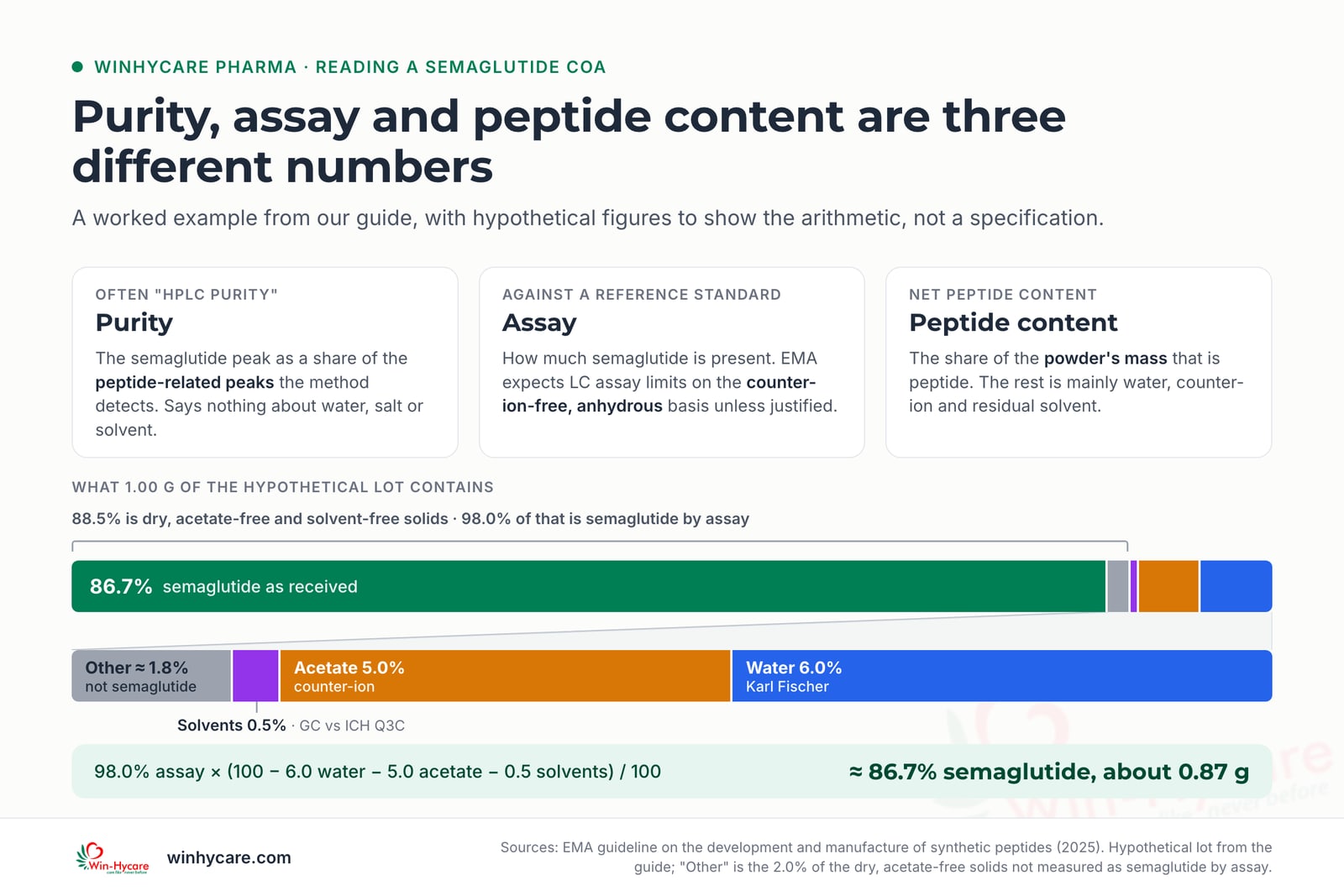
This is where most COA misreadings happen. A batch can show 99% purity and still contain well under 99% peptide by weight.
- Purity (often “HPLC purity”) is the semaglutide peak as a share of the peptide-related peaks the method detects. It says nothing about water, salt or solvent.
- Assay measures semaglutide against a reference standard. EMA says LC assay limits “are expressed in terms of the counter-ion free, anhydrous substance, unless otherwise justified.” Check which basis your certificate uses.
- Peptide content (net peptide content) is the share of the powder’s mass that is peptide. The rest is mainly water, counter-ion and residual solvent.
A hypothetical example, to show the arithmetic rather than a real specification: a lot with 98.0% assay on the anhydrous, acetate-free basis, 6.0% water, 5.0% acetate and 0.5% residual solvents contains roughly 98.0 × (100 − 6.0 − 5.0 − 0.5) / 100 ≈ 86.7% semaglutide as received. Weigh out 1.00 g and you have about 0.87 g of peptide.
That is why EMA requires manufacturers who apply correction factors at dispensing, “based on assay, purity, moisture content, residual solvent content, and/or salt content”, to describe them in the dossier. It is also why the reference standard matters: EMA expects its origin and qualification to be explained, including “measures that will be taken to prevent drift in peptide content.”
How do you judge the related-substances results?
Not against ICH Q3A. ICH Q3A(R2) lists peptides among the substances it does not cover. Two other frameworks apply instead.
EU: Ph. Eur. general monograph 2034. EMA restates its thresholds for peptide-related impurities: reported above 0.1%, identified above 0.5% and qualified above 1.0%. Methods must be able to meet the 0.1% reporting threshold, and where impurities co-elute as one peak, “the qualification threshold of 1.0% applies unless otherwise justified.” Grouping separable impurities, for example as pre- and post-eluting groups, “is not recommended.”
US generics: FDA’s semaglutide product-specific guidance. FDA revised its draft guidance on semaglutide in July 2026. It recommends comparing the proposed generic with the reference product on at least three batches each, and sets these thresholds for active-ingredient-related impurities:
| FDA recommendation (July 2026 draft) | Threshold |
|---|---|
| Report | Above 0.1% of the drug substance |
| Identify | Above 0.5% of the drug substance |
| Impurities also in the reference product | Not greater than the reference level or 1.0%, whichever is greater |
| New impurities | Efforts to reduce below 1.0% |
| Total related impurities | Not greater than the reference product |
These figures apply to the finished generic, but they flow straight back into the API specification. A semaglutide API whose individual impurities sit near 1.0% leaves no room for degradation during formulation and shelf life. Our guide to peptide API impurities and specifications covers how those limits are set and justified.
Which residual solvents should a semaglutide COA list?
The ones the process actually uses, each with its result and an ICH Q3C-based limit. A 2024 analysis of peptide manufacturing processes by member companies of the ACS Green Chemistry Institute Pharmaceutical Roundtable names DMF, DMAc and NMP as problematic synthesis solvents, alongside TFA, dichloromethane, diethyl ether and tert-butyl methyl ether, and describes purification waste as mainly water, acetonitrile and ethanol (Kekessie et al., 2024). The ICH Q3C limits for those solvents:
| Solvent | ICH Q3C class | Concentration limit (Option 1) |
|---|---|---|
| Acetonitrile | 2 | 410 ppm |
| N,N-Dimethylformamide (DMF) | 2 | 880 ppm |
| N,N-Dimethylacetamide (DMAc) | 2 | 1,090 ppm |
| N-Methylpyrrolidone (NMP) | 2 | 530 ppm |
| Dichloromethane | 2 | 600 ppm |
| Diethyl ether, tert-butyl methyl ether, ethanol | 3 | 5,000 ppm (0.5%) as a general limit |
Source: ICH Q3C Tables and List.
TFA is not a Q3C solvent, which is why EMA lists “residual ion content (TFA)” as its own specification test. If your supplier’s route uses a solvent that doesn’t appear on the certificate, ask why.
Where do endotoxin, microbial and elemental impurity limits come from?
From the intended use. EMA lists “bacterial endotoxins” and “microbiological purity” as possible specification tests and calls for elemental impurity testing “in case of use of metal catalysts.” For injectables, FDA’s semaglutide guidance expects microbial contaminants in the finished product to “meet compendial acceptance criteria and toxicological limits”, so it makes sense to write endotoxin and bioburden limits into the API purchase specification and to see them reported as numbers against limits.
Recombinant or semi-synthetic material adds one more line. FDA notes that recombinant peptides “may also contain impurities, such as host cell proteins and residual DNA, from the host cell”, and expects applicants to show these are well controlled (FDA PSG, 2026). A synthetic semaglutide API doesn’t need those tests; a recombinant one does.
Where does the specification come from?
A certificate reports results against a specification, so check the specification’s source as carefully as the numbers. In practice it is built from four inputs:
- Pharmacopoeia. Ph. Eur. general monograph 2034 applies to peptides in the EU. If a Ph. Eur. or USP monograph for semaglutide applies in your market when you write the specification, the certificate should cite its edition.
- Regulatory guidance. EMA’s synthetic peptides guideline for EU dossiers; FDA’s product-specific guidance for US generics.
- The reference product. For generic development, impurity levels in aged batches of the reference medicine set the comparison point.
- Your formulation. Water and counter-ion limits feed your dispensing calculations; endotoxin limits follow the dose and route.
When you review a supplier, ask for the specification document and a representative certificate together. Our checklist on how to qualify a peptide API supplier explains what else to request, and buyers in the EU can see how Winhycare Pharma handles enquiries on its peptide API supplier page for Europe.
Frequently asked questions
What is the difference between purity and assay on a peptide COA?+
Purity, usually by HPLC, is the main peak as a share of the peptide-related peaks. Assay measures how much semaglutide is present against a reference standard. EMA expects LC assay limits to be expressed on an anhydrous, counter-ion-free basis unless justified, so a high purity does not by itself tell you how much peptide is in the powder.
Why does a semaglutide COA report acetate?+
Synthetic peptides are usually isolated as salts, and acetate is the usual counter-ion. EMA expects the counter-ion to be defined and controlled in the specification with a justified upper limit, because it adds to the powder mass and can affect the peptide's properties.
Which impurity limits apply to semaglutide API?+
Peptides are excluded from ICH Q3A. In the EU, the Ph. Eur. general monograph 2034 thresholds apply: report above 0.1%, identify above 0.5%, qualify above 1.0%. For a US generic, FDA's product-specific guidance compares impurities with the reference product.
Should a semaglutide API COA include bacterial endotoxins?+
EMA lists bacterial endotoxins and microbiological purity among the tests a peptide active substance specification may include. Whether they appear depends on the intended drug product. For injectable use, FDA expects microbial contaminants in the finished product to meet compendial criteria, so buyers have good reason to specify them for the API.
Who should sign a certificate of analysis?+
ICH Q7 says COAs should be dated and signed by authorised personnel of the quality unit and show the name, address and telephone number of the original manufacturer. If a broker or repacker issues its own certificate, the original manufacturer's certificate should be attached.
Sources
- ICH Q7: Good Manufacturing Practice Guide for Active Pharmaceutical Ingredients (section 11.4, Certificates of Analysis), International Council for Harmonisation (ICH)
- Guideline on the Development and Manufacture of Synthetic Peptides (EMA/CHMP/CVMP/QWP/367182/2025), European Medicines Agency
- Draft Guidance on Semaglutide (product-specific guidance, NDA 209637), revised July 2026, US Food and Drug Administration
- Q3C: Tables and List, Revision 4 (August 2018), US Food and Drug Administration / ICH
- ICH Q3A(R2): Impurities in New Drug Substances, International Council for Harmonisation (ICH)
- Semaglutide injection prescribing information (NDA 209637), section 11, US Food and Drug Administration
- Semaglutide (CID 56843331), PubChem, US National Library of Medicine
- Process mass intensity (PMI): a holistic analysis of current peptide manufacturing processes (Kekessie I et al. J Org Chem 2024), The Journal of Organic Chemistry (open access)