Peptide lyophilisation: a practical guide to freeze-drying peptide APIs
How peptide freeze-drying works: freezing, primary and secondary drying, Tg′ and collapse temperature, excipients, cycle development and vial and stopper choices.
By Kareem Ahmed Basha · Reviewed by Nisar Mohammed
Published · 11 min read

Key facts
- Lyophilisation (freeze-drying) removes water from a frozen peptide solution by sublimation under vacuum, then by desorption, leaving a dry cake that is usually more stable than the solution.
- A cycle has three stages: freezing, primary drying (ice sublimes) and secondary drying (bound water desorbs). Primary drying is normally the longest.
- The critical number is the formulation's collapse temperature, which sits close to Tg′ for amorphous systems. Product temperature during primary drying is kept a few degrees below it.
- Most peptide formulations pair a crystalline bulking agent such as mannitol or glycine with an amorphous lyoprotectant such as sucrose or trehalose.
- Vial type, stopper design and stopper moisture all affect the finished cake, its residual moisture and its shelf life.
Lyophilisation, or freeze-drying, turns a peptide solution into a dry, porous cake by freezing it and then removing the water under vacuum. For peptides that are unstable in solution, it is the usual way to reach a product that can be stored, shipped and reconstituted. The process has three stages, and almost every development decision comes back to one number: the temperature at which the frozen formulation stops holding its structure.
This guide covers how the stages work, which formulation and equipment choices matter for peptides, and what a sound cycle-development programme looks like. It draws on the freeze-drying literature cited at the end, particularly Tang and Pikal’s 2004 practical advice and its 2023 update.
How freeze-drying works: the three stages
| Stage | What happens | Main control lever | Main risk |
|---|---|---|---|
| Freezing | Water crystallises as ice; solutes concentrate between ice crystals | Shelf temperature, cooling rate, optional annealing | Incomplete solidification; uncontrolled crystallisation of buffer or excipient |
| Primary drying | Ice sublimes under vacuum | Shelf temperature and chamber pressure, which set product temperature | Collapse or melt-back if product temperature exceeds the critical temperature |
| Secondary drying | Unfrozen, bound water desorbs from the solid | Shelf temperature and time | Residual moisture above specification |
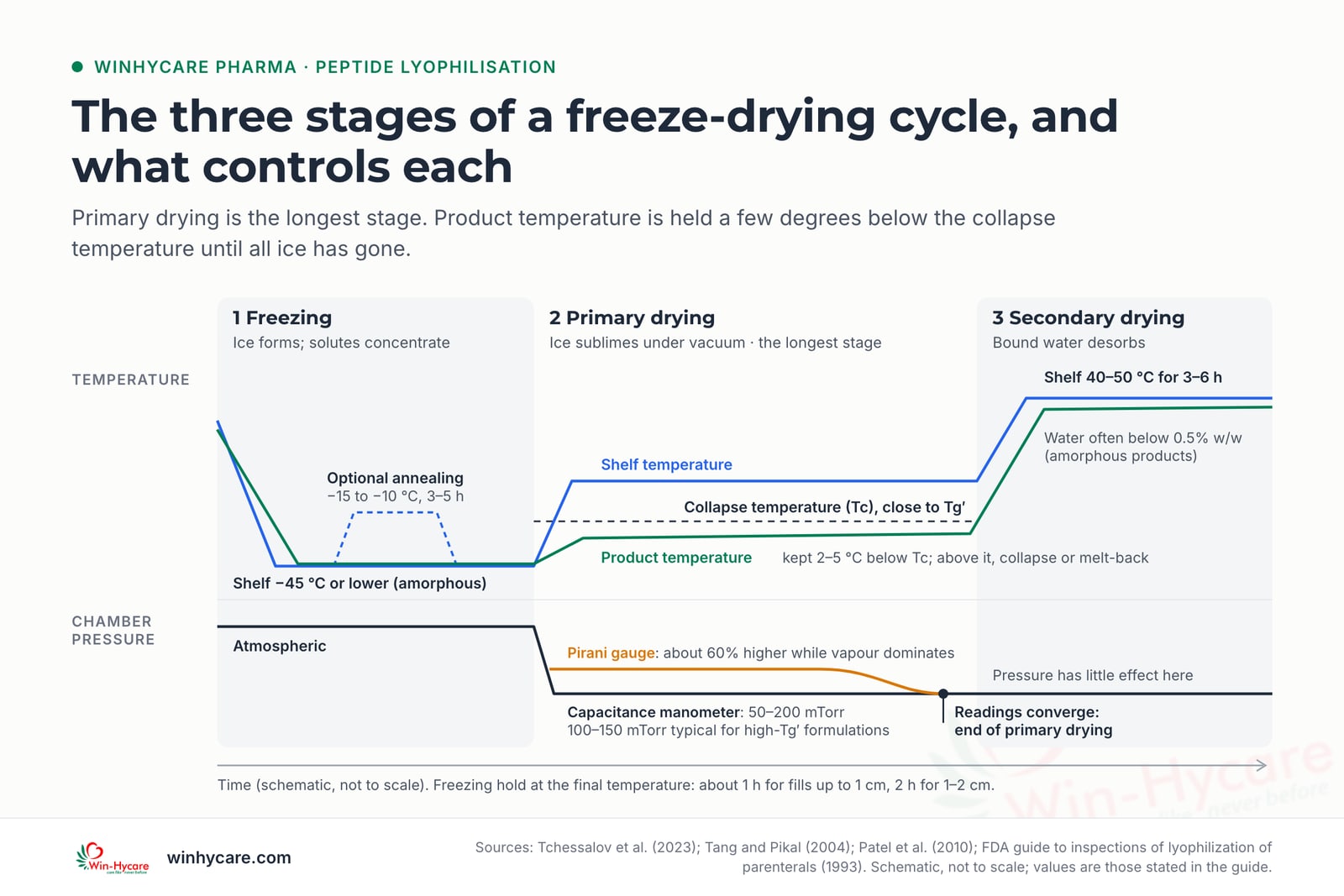
Primary drying is the longest of the three stages (Patel et al., 2010; Tchessalov et al., 2023). That is why most cycle optimisation is about running primary drying as warm and as fast as the formulation safely allows.
Freezing
During freezing, the shelf is cooled until the solution in each vial is fully solid. For amorphous formulations, the 2023 update notes that the shelf may need to go to −45 °C or lower so that vials at the edge of the shelf, which receive extra radiant heat, still fall below the formulation’s glass transition. It repeats Tang and Pikal’s guidance on hold time at the final freezing temperature: about one hour for fill depths up to 1 cm and two hours for 1–2 cm, with fills deeper than 2 cm described as undesirable (Tchessalov et al., 2023).
Two optional steps can change the ice structure:
- Annealing. Holding the frozen product above its glass transition, typically between −15 °C and −10 °C for three to five hours, grows larger ice crystals and shortens primary drying. The trade-off is a smaller specific surface area, which can slow water removal in secondary drying. The 2023 update notes that annealing may not help when the formulation’s Tg′ is already relatively high (Tchessalov et al., 2023).
- Controlled ice nucleation. Forcing ice to form at a set temperature makes vials more uniform. The same review reports that it can favour anhydrous mannitol over the less desirable hemihydrate, but notes limited commercial use because few production dryers have the capability.
Primary drying
Once frozen, the chamber is evacuated and the shelves are warmed to supply the heat of sublimation. Ice leaves through the dried layer above it, so the dried cake itself resists vapour flow and that resistance grows as drying proceeds.
Chamber pressure is “almost universally maintained between 50 and 200 mTorr”, with 100–150 mTorr typical for formulations with a high Tg′ (Tchessalov et al., 2023). The same review warns that very low pressure can contaminate product with volatile stopper components or pump oil and widen vial-to-vial temperature differences.
Before the shelf is warmed for secondary drying, all ice must be gone. Raising shelf temperature too early “will likely cause collapse or eutectic melt” (Patel et al., 2010).
Secondary drying
After the ice has sublimed, the cake still holds water that never froze. Secondary drying removes it by desorption. Shelf temperature is the dominant factor; chamber pressure has little effect. For amorphous products, the 2023 update reports secondary drying of three to six hours at 40 °C or 50 °C, with water content below 0.5% by weight commonly achieved (Tchessalov et al., 2023). The right target for a given peptide is set by its stability data, not by a generic rule.
The critical temperature: Tg′, collapse and eutectic melting
Three thermal properties define how warm the product can safely run during primary drying:
| Property | Applies to | Meaning |
|---|---|---|
| Tg′ | Amorphous solutes (sucrose, trehalose, most peptides) | Glass transition of the maximally freeze-concentrated solute |
| Collapse temperature (Tc) | Amorphous systems | Temperature at which the dried structure loses rigidity during drying; usually close to, and slightly above, Tg′ |
| Eutectic temperature (Teu) | Crystallising solutes (mannitol, glycine) | Melting point of the crystalline solute–ice mixture |
Tang and Pikal’s advice, carried into the 2023 update, is that product temperature “should always be several degrees below Tc”. The target product temperature is commonly set 2 °C below the critical temperature, with a larger margin for short cycles: about 5 °C if drying takes under ten hours, 3 °C in between, and 2 °C when drying runs longer than two days (Tchessalov et al., 2023). The FDA’s inspection guide makes the same point for crystalline systems, advising that product temperature be held “at least 4–5° below the eutectic point” and stressing that product temperature monitoring “is particularly important” (FDA, 1993).
Exceeding Tc can compromise reconstitution time, residual water content and potency recovery (Tchessalov et al., 2023). Collapse is not always a stability failure, but it is a deviation that has to be investigated and justified.
Excipients for lyophilised peptides
Most peptide formulations combine a crystalline bulking agent, which gives the cake its structure, with an amorphous lyoprotectant, which protects the peptide.
| Role | Common choices | What to watch |
|---|---|---|
| Crystalline bulking agent | Mannitol, glycine | Must crystallise fully; mannitol can form a metastable hemihydrate and can break vials if cooled too fast |
| Amorphous lyoprotectant | Sucrose, trehalose | Must stay amorphous; crystallisation of the lyoprotectant should be avoided |
| Buffer | Chosen per peptide | Some buffers shift pH sharply as they crystallise during freezing |
Because mannitol and glycine have high eutectic temperatures, formulations built on them can run primary drying well above Tg′ without visible collapse. The 2023 update is explicit that crystallisation is wanted for bulking agents “whereas crystallization of buffer and lyoprotector should be avoided”, and that a secondary drying temperature around 40 °C helps remove mannitol hemihydrate (Tchessalov et al., 2023).
Sodium phosphate is the standard example of a buffer to handle with care: its disodium salt can crystallise during freezing and change the pH of the freeze-concentrate considerably, depending on the starting composition (Gomez et al., 2001).
Peptide-specific concerns
- Counter-ions. Most approved peptide drugs are acetate salts, while Fmoc solid-phase synthesis followed by reversed-phase purification usually gives trifluoroacetate salts. A review of peptide counter-ions notes that the common volatile acids, acetic acid and TFA among them, can be removed by lyophilisation, phosphoric acid being the exception (Sikora et al., 2020). In practice, that means counter-ion content should be measured on the finished cake rather than assumed from the solution.
- Aggregation. Freezing and drying are recognised stressors for peptide aggregation, through freeze-concentration, ice–liquid interfaces and dehydration (Zapadka et al., 2017).
- Chemical degradation. The same review describes deamidation of asparagine and glutamine, which proceeds by different mechanisms at low and neutral-to-high pH, and identifies oxidation of methionine, cysteine, histidine, tyrosine and tryptophan as a major cause of chemical instability. Formulation pH and headspace oxygen therefore matter for the dried product too.
Cycle development, step by step
A cycle-development programme usually moves through the following steps. The order matters, because each one feeds the next.

- Characterise the formulation. Measure Tg′ (by DSC) and collapse temperature (by freeze-drying microscopy) on the actual formulation, not on the excipients alone. Peptide concentration and counter-ion both shift these values.
- Choose the target product temperature a safe margin below the critical temperature, using the margins described above.
- Select shelf temperature and chamber pressure that deliver that product temperature at a practical sublimation rate. Models based on the vial heat transfer coefficient and dry-layer resistance can narrow the options before any run (Tchessalov et al., 2023).
- Confirm the end of primary drying. Patel and colleagues compared Pirani gauges, dew point, plasma emission, TDLAS, pressure-rise tests and thermocouples, and concluded that the Pirani gauge was “by far” the best practical choice. A Pirani reads about 60% higher than a capacitance manometer while water vapour dominates, and the two readings converge as sublimation ends (Patel et al., 2010).
- Set secondary drying to reach the moisture target supported by stability data, measuring residual moisture by Karl Fischer titration.
- Run engineering or pilot batches at the intended fill and load, then confirm the cycle at scale. The FDA guide cautions that a single cycle used for several strengths of a product “probably has done a poor job” of development, and that data from filed cycles is of little value in supporting shorter or abnormal cycles (FDA, 1993).
Critical process parameters and quality attributes
| Critical process parameters | Quality attributes typically tested |
|---|---|
| Freezing ramp and final temperature; annealing (if used) | Cake appearance |
| Shelf temperature in primary and secondary drying | Residual moisture (Karl Fischer) |
| Chamber pressure | Reconstitution time |
| Primary drying end point | Assay, purity and related substances |
| Secondary drying time and temperature | Counter-ion content |
| Chamber leak rate | Container closure integrity |
The FDA guide expects leak rate to be monitored periodically against the value accepted at validation (FDA, 1993). EU GMP Annex 1 goes further for sterile products: maximum permitted air leakage “should be specified and checked at the start of every cycle” (clause 8.124) (European Commission, 2022).
Vials, stoppers and aseptic handling
Lyophilised product is usually filled into vials, partially stoppered with stoppers that leave a vent path, dried, and fully stoppered inside the chamber at the end of the cycle; the FDA guide notes that the process “typically” includes stoppering in the chamber (FDA, 1993). Points to settle early:
- Fill depth. Deeper fills lengthen freezing and drying; fill heights above 2 cm are described as undesirable (Tchessalov et al., 2023).
- Vial position and heat transfer. Edge vials run warmer than centre vials because of radiant heat, so cycle margins should be set for the warmest vials, not the average.
- Stopper volatiles and moisture. Very low chamber pressures can draw volatile stopper components into the product. Closures are part of the moisture budget and should be specified with that in mind.
- Aseptic transfer. Under EU GMP Annex 1, lyophilisation is “a critical process step” treated as an extension of aseptic processing (8.121). Partially stoppered containers must be transferred “under grade A conditions at all times” (8.126), loading a lyophiliser is listed as a Grade A operation, and manually loaded lyophilisers without barrier separation should be sterilised before each load (8.123). Containers sealed under vacuum must be tested for maintenance of vacuum (8.24) (European Commission, 2022).
Lyophilising peptide API versus finished vials
Freeze-drying turns up twice in peptide manufacturing. Peptide APIs themselves are commonly isolated as lyophilised powders after purification, and a 2024 industry analysis notes that tray lyophilisers can be used to isolate API batches below about 50 kg (Kekessie et al., 2024). Vial lyophilisation is a different problem. The material is filled into individual containers, closed in the chamber, and every vial has to meet its quality attributes. The cycle-development principles are the same; the equipment, aseptic controls and specifications are not.

Working with a lyophilisation partner
A partner should be able to discuss the formulation’s thermal data, show how the cycle margins were chosen, and run an engineering or pilot batch on your material before batch manufacturing. Winhycare Pharma offers peptide API lyophilisation CMO services from Hyderabad, India. You supply the peptide API; we develop the cycle, fill, stopper and crimp-seal the vials, and provide GMP batch records, starting with a pilot. The service is intended for research and development applications and is not intended for human or veterinary use unless separately authorised and appropriately regulated.
For sourcing context, see our buyer guides for Europe and the USA, or the Winhycare Pharma overview.
Frequently asked questions
What is the difference between primary and secondary drying?+
Primary drying removes ice by sublimation at low chamber pressure, with product temperature held below the collapse temperature. Secondary drying raises the shelf temperature to desorb the water that did not freeze and is bound to the solid, bringing residual moisture down to the level set in the specification.
Why does a lyophilised cake collapse?+
If the product temperature at the sublimation front rises above the formulation's collapse temperature during primary drying, the amorphous phase loses its rigidity and the dried structure shrinks or melts back. Collapsed cakes can have higher residual moisture, longer reconstitution times and poorer stability.
Which excipients are used for lyophilised peptides?+
Common choices are mannitol or glycine as crystalline bulking agents, sucrose or trehalose as amorphous lyoprotectants, and a buffer chosen to avoid large pH shifts during freezing. The final choice depends on the peptide's stability profile and the target product.
How long does a peptide lyophilisation cycle take?+
It depends on fill depth, formulation, vial type and freeze-dryer. Primary drying usually dominates the cycle time, which is why cycle development focuses on running primary drying as warm as the formulation safely allows.
Sources
- Design of freeze-drying processes for pharmaceuticals: practical advice (Tang X, Pikal MJ. Pharm Res 2004;21:191–200), Pharmaceutical Research
- Practical advice on scientific design of freeze-drying process: 2023 update (Tchessalov S et al. Pharm Res 2023;40:2433–2455), Pharmaceutical Research (open access)
- Determination of end point of primary drying in freeze-drying process control (Patel SM, Doen T, Pikal MJ. AAPS PharmSciTech 2010), AAPS PharmSciTech
- Lyophilization of Parenteral (7/93), Guide to Inspections, US Food and Drug Administration
- EudraLex Volume 4, Annex 1: Manufacture of Sterile Medicinal Products, C(2022) 5938 final, European Commission
- The role of counter-ions in peptides: an overview (Sikora K et al. Pharmaceuticals 2020;13:442), Pharmaceuticals (MDPI)
- Factors affecting the physical stability (aggregation) of peptide therapeutics (Zapadka KL et al. Interface Focus 2017), Interface Focus, Royal Society
- Effect of initial buffer composition on pH changes during far-from-equilibrium freezing of sodium phosphate buffer solutions (Gomez G et al. Pharm Res 2001), Pharmaceutical Research
- Process mass intensity (PMI): a holistic analysis of current peptide manufacturing processes (Kekessie I et al. J Org Chem 2024), The Journal of Organic Chemistry (open access)