Peptide API impurities and specifications: thresholds, tests and what regulators expect in 2026
How peptide API impurities are classified and controlled: why ICH Q3A does not apply, Ph. Eur. 0.1/0.5/1.0% thresholds, FDA's 2026 peptide guidance and what a specification covers.
By Kareem Ahmed Basha · Reviewed by Nisar Mohammed
Published · 8 min read

Key facts
- ICH Q3A explicitly excludes peptides, and ICH Q6A is not sufficient for higher molecular weight peptides, so peptide APIs follow peptide-specific rules.
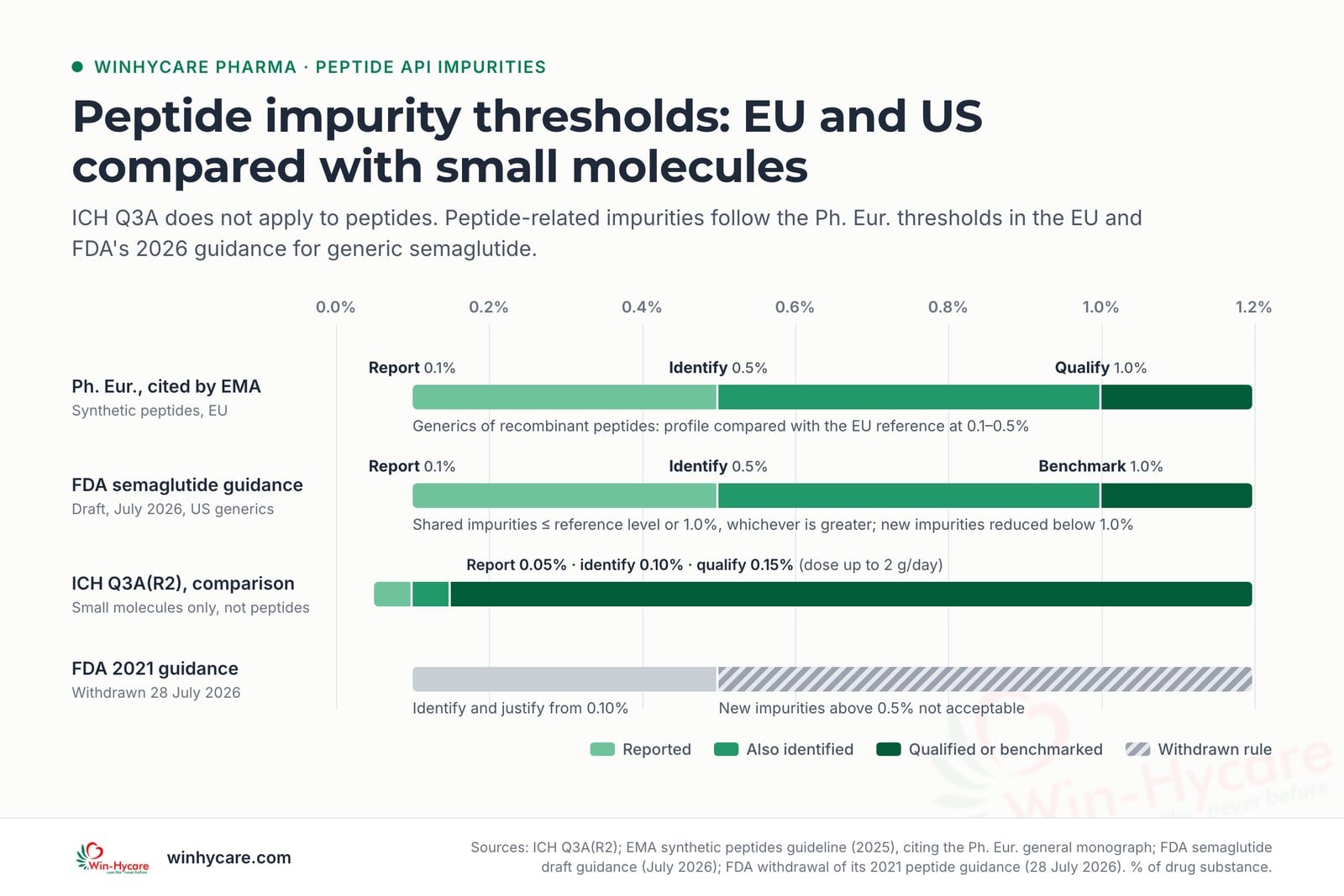
- In the EU, the Ph. Eur. general monograph thresholds apply to synthetic peptides: report peptide-related impurities above 0.1%, identify above 0.5% and qualify above 1.0%.
- In the US, FDA withdrew its 2021 synthetic peptide ANDA guidance on 28 July 2026; the revised semaglutide draft guidance uses 0.1% reporting, 0.5% identification and a 1.0% benchmark.
- A peptide API specification typically covers identity, purity, aggregates, assay, counter-ion and residual TFA, water, residual solvents, elemental impurities, endotoxins and microbiological purity.
- Chromatographic purity is not the same as peptide content: water and counter-ion can make up a significant part of the powder's mass.
Peptide APIs sit between small molecules and proteins, and the impurity rules reflect that. The ICH guidelines most quality teams use for small molecules do not apply, or apply only partly, so peptide specifications rest on pharmacopoeial thresholds, an EMA guideline that came into effect in June 2026, and FDA product-specific guidance that was rewritten in July 2026. This article sets out what counts as a peptide impurity, which thresholds apply in the EU and US, what a peptide API specification should contain, and what to check before accepting one.
Why small-molecule impurity rules do not apply
ICH Q3A(R2), the standard guideline on impurities in new drug substances, is explicit: “The following types of drug substances are not covered in this guideline: biological/biotechnological, peptide, oligonucleotide…” (ICH Q3A(R2)). ICH Q6A on specifications says it “may be applicable to… synthetic peptides of low molecular weight” but is “not sufficient to adequately describe specifications of higher molecular weight peptides and polypeptides” (ICH Q6A).
EMA’s guideline on the development and manufacture of synthetic peptides (EMA/CHMP/CVMP/QWP/367182/2025), adopted in December 2025 and in effect from 1 June 2026, confirms that synthetic peptides “are fully or partially excluded from the scope of ICH Q3A/B… ICH Q6A/B… and ICH M7”, and fills the gap with peptide-specific expectations.

What counts as a peptide impurity
EMA divides impurities into peptide-related impurities, which contain structural elements of the peptide sequence, and non-peptide impurities. The guideline lists the main sources:
| Category | Source | Examples |
|---|---|---|
| Peptide-related, from starting materials | Impurities in amino acid derivatives carried into the sequence | Wrong enantiomers or diastereomers, wrong amino acids (Ile for Leu), β-alanine residues, dipeptides, incorrectly protected amino acids |
| Peptide-related, from the process | Incomplete or unwanted reactions during SPPS, LPPS, fragment condensation and cleavage | Deletion, truncated and insertion sequences; diastereomers from epimerisation; adducts on Trp, Tyr or Met from cleavage; incomplete side-chain deprotection |
| Peptide-related, from degradation | During manufacture or storage | Oxidation, hydrolysis, isomerisation, deamidation, aspartimide formation, diketopiperazine and pyroglutamic acid formation, β-elimination, dehydropeptides, disulfide exchange, acetylation |
| High molecular weight | Association of peptide chains | Dimers, trimers, oligomers, aggregates |
| Non-peptide | Process reagents and materials | Reagents and their by-products, residual solvents, elemental impurities, potential mutagenic impurities, residual TFA |
The route of synthesis determines which of these can appear; our comparison of SPPS, LPPS and hybrid manufacturing explains why. Aggregation and chemical degradation are also influenced by formulation and processing, including lyophilisation (Zapadka et al., 2017).
Thresholds: EU and US compared
| Framework | Reporting | Identification | Qualification / limit | Applies to |
|---|---|---|---|---|
| ICH Q3A(R2), for comparison only | 0.05% | 0.10% (or 1.0 mg/day) | 0.15% (or 1.0 mg/day) | Small-molecule drug substances, maximum daily dose up to 2 g; not peptides |
| Ph. Eur. general monograph, cited by EMA | 0.1% | 0.5% | 1.0% (qualification) | Peptide-related impurities in synthetic peptides, EU |
| EMA, synthetic version of a recombinant reference | Quantification limit 0.1% | Full profile comparison at 0.1–0.5% | Compared impurity by impurity with the EU reference product | Generics of recombinant peptides, EU |
| FDA draft PSG, semaglutide injection (July 2026) | 0.1% | 0.5% | Common impurities ≤ reference level or 1.0%, whichever is greater; new impurities reduced below 1.0%; total ≤ reference | Recombinant, synthetic or semi-synthetic generic semaglutide, US |
Sources: ICH Q3A(R2); EMA, 2025; FDA draft PSG.
FDA’s change of course in 2026
In May 2021, FDA issued guidance on ANDAs for certain highly purified synthetic peptides that refer to listed drugs of rDNA origin. It covered glucagon, liraglutide, nesiritide, teriparatide and teduglutide, treated new impurities above 0.5% as not acceptable, and required impurities between 0.10% and 0.5% to be identified, characterised and justified with comparative immunogenicity risk assessment (FDA presentation).
On 28 July 2026, FDA withdrew that guidance because it “no longer reflects FDA’s current scientific thinking”, published 17 revised draft product-specific guidances, and said it plans to revise the general guidance (FDA). The revised semaglutide guidance is more permissive on numbers but asks for more comparison. Higher impurity levels “do not preclude an application from being submitted as an ANDA” but are subject to scientific review, and the guidance recommends assessing aggregates and non-peptide impurities as part of the immunogenicity evaluation.
What a peptide API specification contains
EMA’s guideline gives a non-exhaustive list of specification tests for synthetic peptide active substances. The table adds what each test tells a buyer.
| Test | Method (as listed by EMA where it names one) | Why it matters |
|---|---|---|
| Appearance | Visual | Gross quality and consistency |
| Identification | Validated method chosen by the manufacturer | Confirms the right sequence and modifications |
| Purity: total, specified and unspecified impurities | LC, with a method able to support the 0.1% reporting threshold | Core measure of peptide-related impurities |
| High molecular weight impurities | SEC-LC or other techniques | Aggregates and oligomers; EMA requires them to be named, not just “HMW impurities” |
| Assay / content | LC, elemental analysis, amino acid analysis, Kjeldahl nitrogen or qNMR | How much of the powder is actually peptide |
| Counter-ion identity and content | For example, acetic acid | Defines the salt form; EMA requires a justified upper limit |
| Residual TFA | Validated method chosen by the manufacturer | TFA often remains from purification |
| Water content | Validated method, commonly Karl Fischer titration | Peptides are often hygroscopic |
| Residual solvents | GC, per ICH Q3C | Process solvents such as DMF and acetonitrile |
| Elemental impurities | Per ICH Q3D | Relevant where metal catalysts are used |
| Bacterial endotoxins | Per pharmacopoeia | Relevant for APIs used in parenteral products |
| Microbiological purity | Per pharmacopoeia | Bioburden control |
EMA also mentions process-specific tests where relevant, such as residual fluoride when HF is used for deprotection.
Purity is not content
Chromatographic purity is the share of the peptide signal that belongs to the main peak. It says nothing about water, counter-ion or other non-peptide mass in the powder. A peptide can be highly pure by HPLC and still contain substantially less than 100% peptide by weight. That is why the specification needs both purity and assay, and why counter-ion and water are controlled. Most approved peptide APIs are acetate salts, while reversed-phase purification often leaves TFA, which is exchanged or reduced during processing (Sikora et al., 2020).
EMA adds two practical points: peptide reference standards need a defined qualification approach that prevents drift in their assigned peptide content, and because peptides are often very hygroscopic, moisture uptake by the reference standard should be controlled and, where appropriate, its moisture content confirmed before use.
Pharmacopoeial monographs
Where a Ph. Eur. monograph exists, it sets the specification and enables a Certificate of Suitability. Older synthetic peptides such as octreotide have monographs and CEPs listed in the EDQM database. For semaglutide, the same database returned no record on 11 October 2026, and we could not confirm a Ph. Eur. or USP monograph when writing this article. Until one exists, the specification is justified in the dossier on the basis of the guidelines above and, for generics, comparison with the reference product.
Semaglutide: what the 2026 guidance adds
The reference semaglutide product’s peptide backbone is made by yeast fermentation and then chemically modified (DailyMed), while many generic APIs are synthetic. Both regulators now ask generic applicants to show sameness with the reference product before anything else:
- FDA’s draft PSG recommends comparative characterisation to support active-ingredient sameness and the impurity comparison in the table above.
- EMA’s draft product-specific bioequivalence guidance for semaglutide (EMA/106257/2026, consultation open until 31 October 2026) states that semaglutide substance sameness should be demonstrated before a bioequivalence study (EMA).
- EMA’s synthetic peptides guideline expects comparative forced degradation studies, including shear and mechanical stress, when a synthetic product is compared with a recombinant reference.
A buyer’s checklist for an impurity package
- An impurity table for at least three batches, listing each impurity above 0.1% by relative retention time, identity (where known) and level.
- Identification of every impurity above 0.5%, with the evidence (typically LC-MS).
- Method validation summaries showing the purity method separates closely related sequences and diastereomers, with a quantification limit that supports 0.1%; additional orthogonal methods where one method is not enough.
- Aggregate data, with the aggregate species named.
- Assay, counter-ion, residual TFA and water results on the same batches, so the mass balance can be checked.
- Stability data showing how degradation impurities develop under the proposed storage condition.
- For generics, a comparison with the reference product, aged as the guidance describes.
See how to qualify a peptide API supplier for the wider document and audit checklist, and our buyer guides for Europe and the USA.
Winhycare Pharma
Winhycare Pharma supplies Semaglutide API on a B2B basis from Hyderabad, India; the product page sets out its specification targets, and each batch is supplied with a Certificate of Analysis. Our CRDMO services include analytical method development and impurity profiling for clients’ own peptide programmes, and our lyophilisation CMO service takes client-supplied API into vials for research and development. Our research peptide range and custom peptide synthesis are for research use only, not for human or veterinary use. More on the division: Winhycare Pharma.
Frequently asked questions
Does ICH Q3A apply to peptide APIs?+
No. ICH Q3A(R2) states that peptides are among the types of drug substance not covered by the guideline. EMA's synthetic peptides guideline confirms that synthetic peptides are fully or partially excluded from ICH Q3A/B, Q6A/B and M7, and points instead to the Ph. Eur. thresholds for peptide-related impurities.
What are the impurity thresholds for synthetic peptides in Europe?+
Under the Ph. Eur. general monograph Substances for Pharmaceutical Use, as cited in EMA's synthetic peptides guideline, peptide-related impurities are reported above 0.1%, identified above 0.5% and qualified above 1.0%. For a synthetic version of a recombinant reference product, EMA additionally expects a full impurity comparison at 0.1–0.5% with a quantification limit of 0.1%.
What impurity limits does FDA expect for generic semaglutide?+
FDA's July 2026 draft product-specific guidance for semaglutide injection recommends reporting impurities above 0.1% and identifying them above 0.5%. Impurities also present in the reference product should not exceed the reference level or 1.0%, whichever is greater, new impurities should be reduced below 1.0%, and total impurities should not exceed the reference product.
Why do peptide specifications include counter-ion and TFA?+
Most peptide APIs are salts, usually acetate, and purification often uses trifluoroacetic acid. EMA requires the counter-ion type to be defined and its amount controlled with a justified limit, and lists residual TFA as a specification test, because both affect the peptide's properties and the true peptide content.
Is there a European Pharmacopoeia monograph for semaglutide?+
We could not confirm one. A search of the EDQM certification database for semaglutide returned no record on 11 October 2026, and CEPs are only granted against Ph. Eur. monographs. Older peptides such as octreotide do have monographs and CEPs.
Sources
- ICH Q3A(R2): Impurities in New Drug Substances, ICH
- ICH Q6A: Specifications for New Drug Substances and Products (Chemical Substances), ICH
- ICH quality guidelines index (Q2, Q3C, Q3D, Q11, M7), ICH
- Guideline on the development and manufacture of synthetic peptides (EMA/CHMP/CVMP/QWP/367182/2025), in effect 1 June 2026, European Medicines Agency
- Product-specific bioequivalence guidance (including the 2026 draft for semaglutide, EMA/106257/2026), European Medicines Agency
- FDA publishes revised draft product-specific guidances for certain generic peptide products (28 July 2026), US Food and Drug Administration
- Draft product-specific guidance: semaglutide subcutaneous solution, RLD NDA 209637 (revised July 2026), US Food and Drug Administration
- FDA presentation on the 2021 guidance for synthetic peptide ANDAs referencing rDNA-origin products, US Food and Drug Administration
- EDQM certification database, search for “semaglutide” (no record found, 11 October 2026), EDQM
- EDQM certification database, search for “octreotide”, EDQM
- The role of counter-ions in peptides: an overview (Sikora K et al. Pharmaceuticals 2020;13:442), Pharmaceuticals (MDPI)
- Factors affecting the physical stability (aggregation) of peptide therapeutics (Zapadka KL et al. Interface Focus 2017), Interface Focus, Royal Society
- Prescribing information for the semaglutide injection reference product (section 11), DailyMed, US National Library of Medicine