CDMO vs CMO vs CRDMO: what is the difference, and which one does a pharma buyer need?
What CMO, CDMO and CRDMO mean in pharma, how their scope differs, what GMP rules apply to every contract manufacturer, and which model a buyer needs.
By Kareem Ahmed Basha · Reviewed by Nisar Mohammed
Published · 9 min read
Key facts
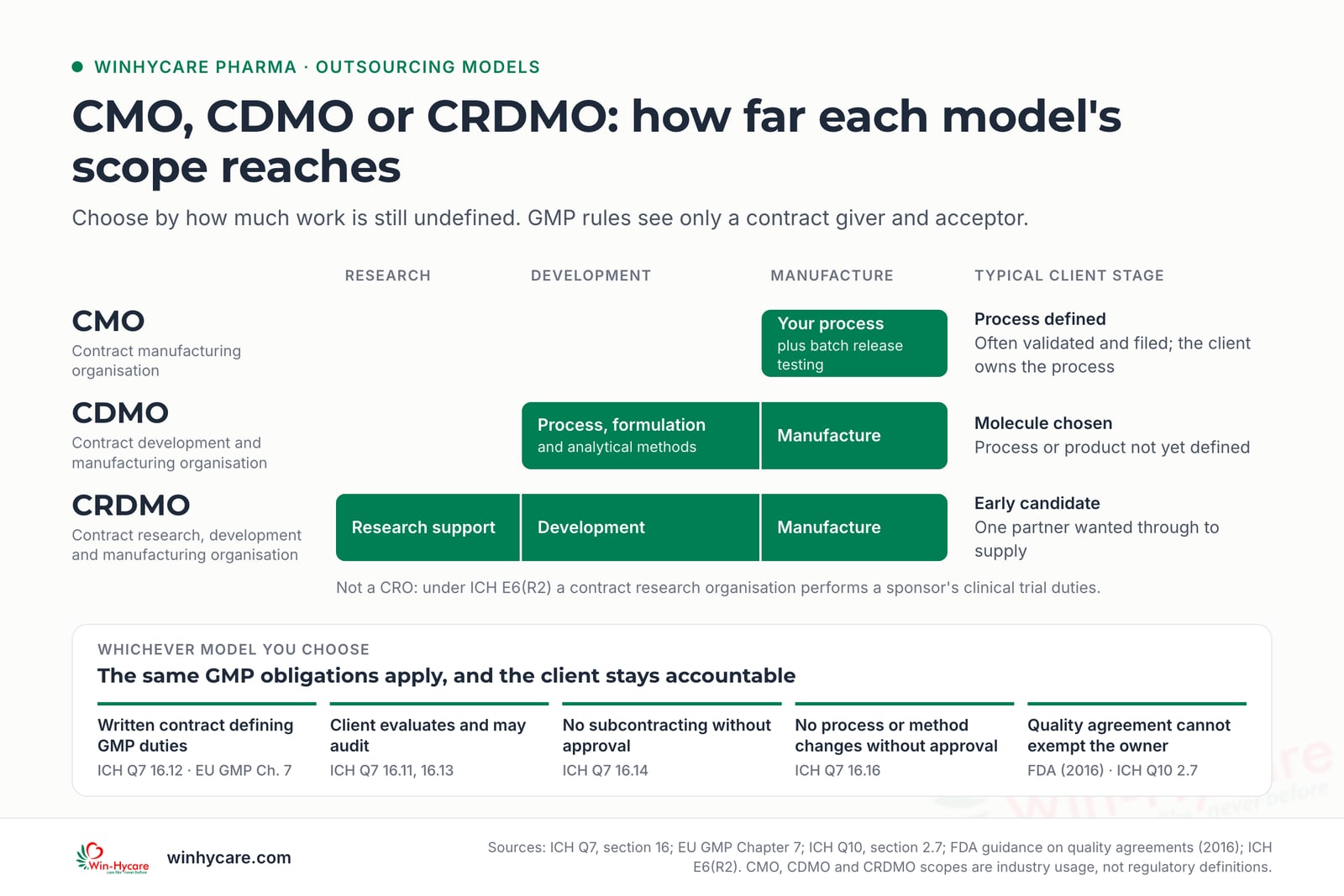
- A CMO (contract manufacturing organisation) makes product to a process the client already has. A CDMO (contract development and manufacturing organisation) also develops the process, formulation or methods. A CRDMO adds contract research before development.
- CMO, CDMO and CRDMO are commercial labels, not regulatory categories. ICH Q7 and EU GMP Chapter 7 speak of a contract giver and contract acceptor; FDA speaks of an owner and a contract facility.
- Whatever the label, ICH Q7 section 16 requires GMP compliance, evaluation by the client, a written contract defining GMP responsibilities, audit rights and client approval of subcontracting and changes.
- FDA states that a quality agreement cannot exempt either party from CGMP, and the owner remains responsible for its products.
- Pick the model by how much of the work is still undefined: a filed process needs a CMO, an unfinished process needs a CDMO, an early candidate may justify a CRDMO.
Short answer: a CMO (contract manufacturing organisation) makes your product to a process you already have. A CDMO (contract development and manufacturing organisation) also develops that process, the formulation or the analytical methods. A CRDMO (contract research, development and manufacturing organisation) adds early research on top. Choose by how much of the work is still undefined, not by the label.
One thing the acronyms hide: regulators don’t use them. GMP rules recognise a client and a contractor, and hold both to the same standard whatever the contractor calls itself. Winhycare Pharma’s peptide CRDMO and CDMO services sit alongside its lyophilisation CMO work and semaglutide API supply, so we see buyers wrestle with the choice from both sides. This guide sets out what each model covers, what the rules require, and how to decide.
What does CDMO stand for in pharmaceuticals?
CDMO stands for contract development and manufacturing organisation. It develops a manufacturing process, a formulation or the methods to test it, then manufactures the product for the client under contract. The other terms follow the same pattern:
| Acronym | Stands for | Typical scope | Typical client stage |
|---|---|---|---|
| CMO | Contract manufacturing organisation | Manufacture to the client’s defined process; batch release testing | Process defined, often validated and filed |
| CDMO | Contract development and manufacturing organisation | Process, formulation and analytical development, then manufacture | Molecule chosen; process or product not yet defined |
| CRDMO | Contract research, development and manufacturing organisation | Research support, then development and manufacture | Early candidate; client wants one partner through to supply |
| CRO | Contract research organisation | Clinical trial duties for a sponsor | Clinical development |
The first three definitions are industry usage; no regulator publishes them. The CRO entry is different. ICH E6(R2) defines a contract research organisation as “a person or an organization (commercial, academic, or other) contracted by the sponsor to perform one or more of a sponsor’s trial-related duties and functions.” That is clinical work, and it is a separate business from development and manufacture.
What is the difference between a CMO and a CDMO?
Ownership of the process.
With a CMO, you arrive with the process: batch records, specifications, analytical methods, often a validated and filed manufacturing route. The CMO’s job is to reproduce it reliably. Under ICH Q7, “changes in the process, equipment, test methods, specifications, or other contractual requirements should not be made unless the contract giver is informed and approves the changes.” The process is yours. The contractor runs it.
With a CDMO, the process doesn’t exist yet, or exists only at lab scale. The CDMO designs it, develops the methods to control it and then makes the material. That brings different risks. You are paying for development decisions you will later have to defend to a regulator, so you need the development data, not just the batches.
Take peptide lyophilisation. A client with a finished, validated freeze-drying cycle needs a CMO with suitable dryers and capacity. A client with a peptide formulation and no cycle needs development first: thermal characterisation, cycle design and engineering runs. Same equipment, very different contract. Our peptide lyophilisation guide describes what that development involves.
What is a CRDMO, and when is the extra “R” worth it?
A CRDMO adds research support to development and manufacturing. The appeal is continuity: the team that helped select or optimise a candidate also scales it up and supplies it, so knowledge isn’t lost at each hand-over.

The “R” earns its place when the molecule is early and the route is open, which is common with peptides. EMA’s synthetic peptides guideline expects, even for investigational products, details of the resin, coupling agents and capping, monitoring of individual impurities in amino acid building blocks “from an early-stage”, and investigation of aggregation and epimerisation. Decisions made at that stage shape the impurity profile you will live with commercially.
It is less useful if you already have a defined process, or if you want competing suppliers later. A single partner from research to supply is convenient; it also concentrates dependence. Settle data ownership and technology transfer terms in the first contract, not the last.
What do regulators require, whichever model you choose?
The same core obligations, written in slightly different words by each authority.
ICH Q7, section 16 applies to “contract manufacturers (including laboratories)”. EU GMP Chapter 7 requires “a written Contract between the Contract Giver and the Contract Acceptor which clearly establishes the duties of each party.” ICH Q10 says the pharmaceutical company “is ultimately responsible to ensure processes are in place to assure the control of outsourced activities.” And FDA’s quality agreements guidance defines “owners” as manufacturers of APIs, drug substances, in-process materials and finished products, and “contract facilities” as parties that perform manufacturing operations on their behalf.
| Obligation | Where it is stated |
|---|---|
| Contract manufacturer complies with GMP | ICH Q7 16.10 |
| Client evaluates the contractor before and during the relationship | ICH Q7 16.11; ICH Q10 2.7(a) and (c) |
| Written contract or agreement defining GMP responsibilities | ICH Q7 16.12; EU GMP Ch. 7; ICH Q10 2.7(b) |
| Client may audit the contractor | ICH Q7 16.13 |
| No subcontracting without the client’s prior evaluation and approval | ICH Q7 16.14 |
| Records kept where the work is done and readily available | ICH Q7 16.15 |
| No changes to process, methods or specifications without client approval | ICH Q7 16.16 |
| Incoming materials from approved sources via the agreed supply chain | ICH Q10 2.7(d) |
FDA adds a point that buyers sometimes miss. Describing two inspection cases, it concludes that “a quality agreement cannot exempt owners or contract facilities from statutory or regulatory responsibilities to comply with applicable CGMP”, and that “the owner remains responsible for ensuring its products are made in compliance with CGMP even when a quality agreement assigns a particular manufacturing activity” to the contractor. Outsourcing moves the work. It doesn’t move the accountability.
The same logic extends to logistics. Where storage or transport of an active substance is contracted out, the EU GDP guidelines call for a written contract and bar the contract acceptor from subcontracting without the contract giver’s written authorisation (2015/C 95/01, 6.12).
When does a pharma buyer need a CMO, a CDMO or a CRDMO?
Map your situation to the work that is still undone:
| Your situation | What you actually need | Model | Watch for |
|---|---|---|---|
| Validated process, filed dossier, need capacity or a second site | Faithful execution and tech transfer | CMO | Tech-transfer data; change control |
| Molecule chosen, process at lab scale | Process, formulation and method development, then clinical or commercial supply | CDMO | Ownership of development reports and methods |
| Early candidate, open route, small team | Research input through to supply with one partner | CRDMO | Data ownership; exit and transfer terms |
| Generic peptide referencing an existing medicine | API plus comparative analytics against the reference product | CDMO or CRDMO with strong analytics | Capability for orthogonal characterisation and impurity comparison |
| Need a single step, e.g. freeze-drying or testing | That operation only | CMO or contract laboratory | Scope boundaries in the quality agreement |
The generic row deserves a note. EMA expects a synthetic peptide that references a biological medicine to be compared using “a broad panel of analytical methods”, with the reference product “sourced from the European market”, and with peptide-related impurities between 0.1% and 0.5% evaluated against reference levels (EMA, 2025). A partner without that analytical depth is a CMO, whatever its brochure says.
What should the contract and quality agreement cover?
FDA’s guidance says most quality agreements contain five sections: purpose and scope, definitions, resolution of disagreements, manufacturing activities, and the life cycle of and revisions to the agreement. It calls manufacturing activities “the most important element”, with quality-unit responsibilities and change control “the most critical pieces”, and expects the agreement to explain how the contractor reports, investigates and resolves deviations (FDA, 2016).
Mapped onto the ICH Q7 obligations, a workable checklist looks like this:
- GMP responsibilities, party by party, including batch release and who holds which records (ICH Q7 16.12 and 16.15).
- Audit rights for you as the contract giver (ICH Q7 16.13).
- Subcontracting rules, including testing laboratories (ICH Q7 16.14).
- Change control: what the contractor must notify, and what needs your approval (ICH Q7 16.16).
- Deviation handling: how deviations are reported to you, investigated and closed.
- Ownership of development data, methods and reports, which is a commercial term but decides whether a later technology transfer is possible.
Then use it. One of FDA’s illustrative cases describes an owner whose own procedure required a site audit of its contract testing laboratory every two years; it had not audited the laboratory, which was reporting passing results when its analyses showed failures. FDA’s conclusion covers both sides: laboratories “are responsible for operating in compliance with CGMP regardless of quality agreements”, and the owner could be cited “for failing to evaluate, qualify, audit, and monitor” its contractors. A signed agreement in a drawer protects nobody.
Our checklist on how to qualify a peptide API supplier turns these points into audit questions.
Where does Winhycare Pharma fit?
Winhycare Pharma works in all three modes for peptides. It supplies one API, semaglutide, for pharmaceutical manufacturing and R&D. It runs peptide lyophilisation as a CMO, and it offers CRDMO services such as process and analytical development and dossier support. It does not supply other peptide APIs.
Which mode applies is set out in the contract and quality agreement for each project. Buyers in North America can start on the peptide API supplier page for the USA.
Frequently asked questions
What does CDMO stand for in pharmaceuticals?+
CDMO stands for contract development and manufacturing organisation: a company that develops a process, formulation or analytical methods for a client and then manufactures the product under contract.
What is the difference between a CMO and a CDMO?+
A CMO manufactures to a process the client already owns and has usually validated. A CDMO also does the development work, such as process, formulation and method development, before or alongside manufacture. Both are contract manufacturers under GMP.
What is a CRDMO?+
A contract research, development and manufacturing organisation: a provider that adds early research to development and manufacturing, so a client can stay with one partner from candidate selection to supply.
Is a CDMO responsible for GMP compliance, or is the client?+
Both. ICH Q7 says contract manufacturers should comply with GMP and be evaluated by the contract giver, while ICH Q10 and FDA guidance say the client remains ultimately responsible for outsourced activities. FDA adds that a quality agreement cannot exempt either party from CGMP.
Is a CRO the same as a CDMO?+
No. ICH E6 defines a contract research organisation (CRO) as a party contracted by a clinical trial sponsor to perform trial-related duties. A CDMO develops and manufactures product; it does not run clinical trials.
Sources
- ICH Q7: Good Manufacturing Practice Guide for Active Pharmaceutical Ingredients (section 16, Contract Manufacturers), International Council for Harmonisation (ICH)
- ICH Q10: Pharmaceutical Quality System (section 2.7, Management of Outsourced Activities), International Council for Harmonisation (ICH)
- EudraLex Volume 4, Chapter 7: Outsourced Activities, European Commission
- Contract Manufacturing Arrangements for Drugs: Quality Agreements, Guidance for Industry (November 2016), US Food and Drug Administration
- ICH E6(R2): Guideline for Good Clinical Practice (glossary 1.20, Contract Research Organization), International Council for Harmonisation (ICH)
- Guideline on the Development and Manufacture of Synthetic Peptides (EMA/CHMP/CVMP/QWP/367182/2025), European Medicines Agency
- Guidelines of 19 March 2015 on principles of Good Distribution Practice of active substances (2015/C 95/01), EUR-Lex