How to qualify a peptide API supplier: a documentation and audit checklist for EU and US buyers
A documentation and audit checklist for qualifying a peptide API supplier for EU and US filings: written confirmation, DMF/ASMF, GMP audit, impurities and agreements.
By Kareem Ahmed Basha · Reviewed by Nisar Mohammed
Published · 9 min read

Key facts
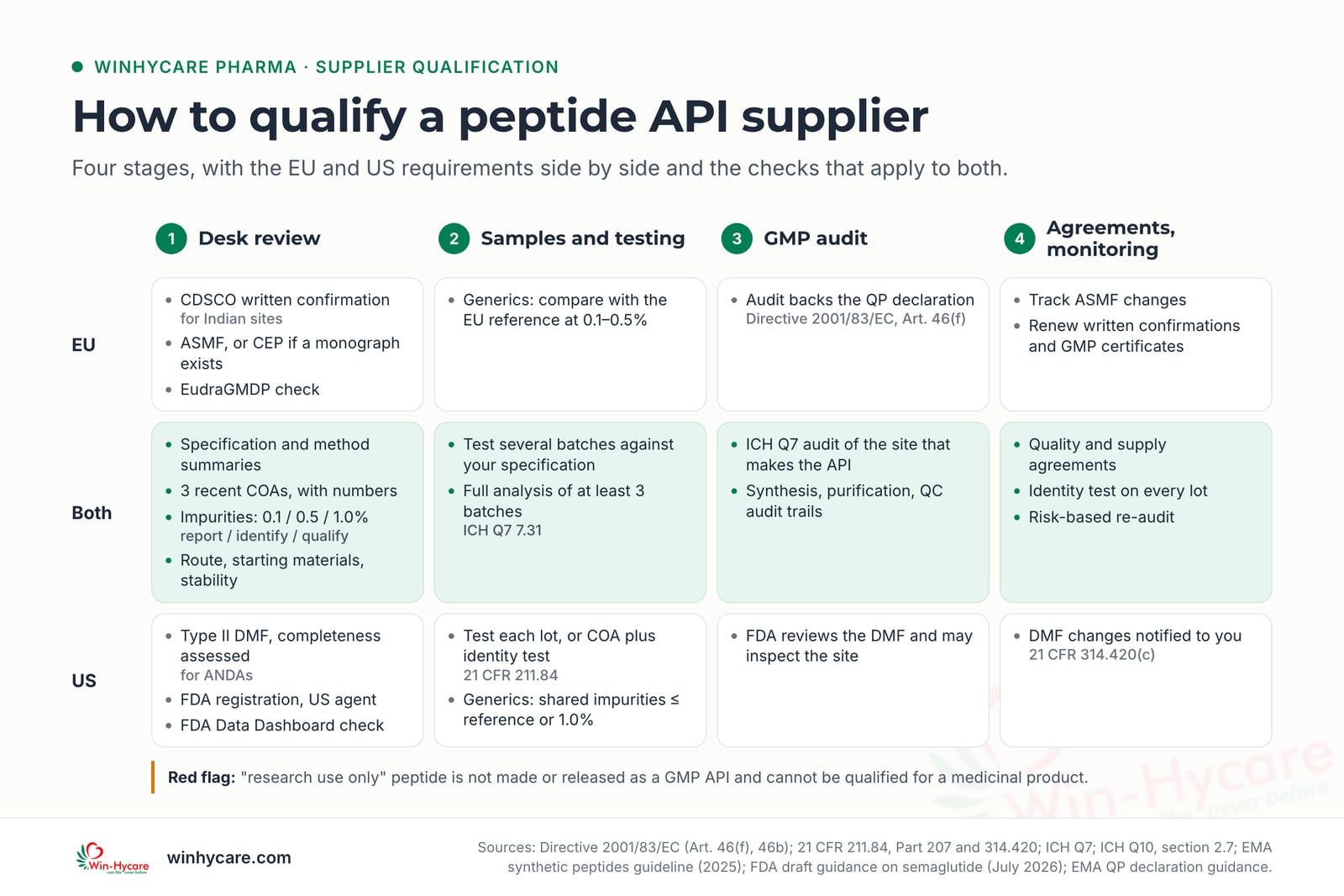
- Qualifying a peptide API supplier means showing, with documents and an audit, that the manufacturer can consistently deliver material meeting your specification under GMP, and that its regulatory files support your filing.
- EU buyers need a CDSCO written confirmation for Indian APIs, an ASMF or full dossier data, and an audit that supports the Qualified Person's declaration under Article 46(f) of Directive 2001/83/EC.
- US buyers need a Type II DMF that has passed FDA's completeness assessment (for ANDAs), FDA establishment registration, and incoming-testing controls under 21 CFR 211.84.
- Peptide-specific checks matter: starting-material designation, impurity profile at 0.1–0.5%, counter-ion and TFA content, aggregates, and peptide content.
- Research-grade or 'research use only' peptide is not a GMP API and cannot be qualified for a medicinal product.
Qualifying a peptide API supplier is the work of proving two things before you place the first commercial order. First, that the manufacturer can consistently make material that meets your specification under GMP. Second, that its regulatory documents will stand up in your filing. Both have to be true. An excellent batch from a site your Qualified Person or FDA cannot rely on is as unusable as a well-documented site that cannot hit the impurity profile.
This checklist follows the order most buyers work in: desk review, samples, audit, agreements and ongoing monitoring. It covers the EU and US requirements side by side, then the checks that are specific to peptides. Links to the underlying regulations are in the sources at the end.
Who carries the obligation
| Market | Legal obligation on the buyer | What it means in practice |
|---|---|---|
| EU | Article 46(f) of Directive 2001/83/EC: use only active substances made under GMP and distributed under GDP, verified by audits | An audit of the API site, and a QP declaration in the marketing authorisation dossier |
| US | 21 CFR 211.84: test each component, or rely on a supplier Certificate of Analysis with an identity test and periodic verification | A supplier qualification programme and incoming testing; FDA reviews the DMF and may inspect the API site |
| Both | ICH Q10, section 2.7: the pharmaceutical company remains responsible for the quality of purchased materials | Supplier oversight is part of your own quality system, not a one-off exercise |
Stage 1: desk review of documents
Request these before investing in samples or an audit. A supplier that cannot produce most of them quickly is not ready for a regulated filing.
Regulatory documents
| Document | EU | US | What to check |
|---|---|---|---|
| Written confirmation from CDSCO (for Indian sites) | Required unless an Article 46b(4) waiver applies | Not applicable | Names the specific site and active substance; in date |
| GMP certificates and inspection history | Look up the site in EudraGMDP | Search FDA’s Data Dashboard for inspections and compliance actions | Recent outcomes, open non-compliance reports, warning letters, import alerts |
| Dossier route | ASMF (Applicant’s Part and letter of access) or full 3.2.S data; CEP only if a Ph. Eur. monograph exists | Type II DMF number, completeness-assessment status for ANDAs, letter of authorisation | The file covers your molecule, grade and site |
| Establishment registration | EU importer registered under Article 52a | FDA registration and listing under 21 CFR Part 207, US agent named | Registration current for the manufacturing site |
Technical documents
- Specification and analytical method summaries, including how impurities are separated and quantified. For synthetic peptides, EMA requires LC purity methods with a quantification limit able to support the 0.1% reporting threshold.
- Certificates of Analysis for at least three recent batches, with actual numbers, not “complies”.
- Impurity profile, listing identified peptide-related impurities and their levels, against the Ph. Eur. thresholds (report above 0.1%, identify above 0.5%, qualify above 1.0%) or FDA’s product-specific guidance where one exists.
- Route of synthesis and starting materials. EMA’s synthetic peptides guideline applies ICH Q11 to starting material selection: protected L-amino acid derivatives are generally acceptable, short fragments only when justified.
- Stability data under ICH Q1A(R2) conditions, with the proposed retest period and storage condition.
- Residual solvents (ICH Q3C) and elemental impurities (ICH Q3D) assessments.
- Nitrosamine risk assessment, following FDA’s guidance on the control of nitrosamine impurities and the equivalent requirements of your target market.
- TSE/BSE statement where animal-derived materials could be involved.
Quality system documents
- Site master file and organisation chart, with a named quality unit independent of production.
- Change control procedure and a commitment to notify you of changes before implementation.
- Deviation, out-of-specification, complaint and recall procedures.
- Data integrity controls for chromatography data systems, in line with FDA’s data integrity Q&A and the MHRA GxP data integrity guidance.
Stage 2: samples and in-house testing
Test samples from several batches against your own specification, using your methods or methods transferred from the supplier. ICH Q7 sets the benchmark API manufacturers use for their own suppliers: full analysis of at least three batches before reducing in-house testing, and periodic full analysis afterwards to check the reliability of Certificates of Analysis (section 7.31).

For generic programmes, compare the supplier’s impurity profile with the reference product early. FDA’s draft guidance for semaglutide injection, for example, expects common impurities not to exceed the reference product level or 1.0%, whichever is greater, and EMA expects a full comparison at 0.1–0.5% against the EU reference product. An impurity that cannot be brought into line will stop a filing, whatever the price.
Stage 3: the GMP audit
The audit confirms what the documents claim. Under EMA’s QP declaration guidance, it can be carried out by your own auditors or a contracted third party, and the QP declaration records which. An ICH Q7-based audit of a peptide API site normally covers:
| Area | Peptide-specific points to examine |
|---|---|
| Quality management | Independence of the quality unit; batch release; annual product review |
| Materials management | Qualification of amino acid derivative and resin suppliers; specifications covering enantiomeric purity and dipeptide impurities |
| Production | Synthesis records (SPPS, LPPS or hybrid); cleavage conditions and scavengers; in-process controls; pooling strategy for purification fractions |
| Purification and isolation | Chromatography column use and cleaning between products; lyophilisation or other isolation steps |
| Cross-contamination | Cleaning validation in multi-product areas; EMA expects controls for purifying different peptides on the same column |
| Quality control | Method validation; system suitability; audit trails on chromatography systems; reference standard qualification, including peptide content and moisture |
| Storage and distribution | Temperature control and monitoring; traceability to the original manufacturer |
| Change control | Process changes since registration; how customers are notified |
If the material reaches you through a distributor, ICH Q7 section 17 requires the distributor to comply with GMP and keep full traceability, including the name and address of the original manufacturer. Your audit and your regulatory file must cover the site where the API is actually made.

Stage 4: agreements and ongoing monitoring
- Quality agreement. Define who does what: specifications, release, change notification, deviation and complaint handling, audit rights and regulatory support.
- Supply agreement. Volumes, lead times, safety stock and what happens if the supplier’s regulatory status changes.
- Routine controls. An identity test on every lot, periodic full testing against the Certificate of Analysis, and annual review of supplier performance.
- Requalification. Re-audit on a risk-based frequency, and whenever there is a significant change, a failed batch or a regulatory finding at the site.
Keeping the regulatory file aligned after approval
Qualification does not end with the first approval. The supplier’s regulatory file and your application have to move together for the life of the product.
- US DMF changes. Under 21 CFR 314.420(c), when a DMF holder adds, changes or deletes information in the file, it “shall notify in writing, each person authorized to reference that information”. Your quality agreement should go further and require notice before a change is implemented, so you can assess whether your own application needs a supplement.
- EU ASMF changes. Under the ASMF procedure, the Applicant’s Part comes to you and the Restricted Part goes only to the authority. Changes to either part have to be reflected in each marketing authorisation that relies on the ASMF, so agree in advance how the ASMF holder will inform you and supply updated documents.
- Written confirmations and GMP certificates. Both carry validity dates. Track them, and request the renewed documents before expiry rather than at the next import.
- Inspection outcomes. Check EudraGMDP and FDA’s Data Dashboard periodically for new findings at the site, not only at requalification.
- Product quality review. Include supplier performance, deviations and changes in your annual review, and use it to set the next audit date.
Peptide-specific red flags
Any of these should pause a qualification until resolved:
- “Research grade” or “research use only” material offered for a medicinal product. RUO material is not made or released as a GMP API and cannot be qualified for human medicines.
- No defined starting materials or a route that starts from undefined, purchased peptide fragments.
- A single HPLC method used for all impurities, without evidence that it separates closely related sequences, diastereomers and deletion variants.
- No counter-ion or residual TFA control. EMA expects counter-ion identity and content, and residual TFA, to be controlled in the specification.
- Purity reported without assay. Chromatographic purity is not peptide content; water, counter-ion and other non-peptide content must also be measured.
- No information on aggregates or other high-molecular-weight impurities.
- Reluctance to name the manufacturing site or to accept an audit.
Where Winhycare Pharma fits
Winhycare Pharma supplies Semaglutide API to pharmaceutical manufacturers and R&D organisations on a B2B basis, and offers peptide CRDMO services and peptide lyophilisation CMO services from Hyderabad, India. During qualification we will tell you which of the documents above are available today for your programme and target market, and which would need to be generated. Our lyophilisation CMO service is intended for research and development applications and is not intended for human or veterinary use unless separately authorised and appropriately regulated. Our wider peptide range and custom peptides are supplied for research use only and, as above, cannot be qualified as the API for a medicinal product.
For the market-specific rules, see our buyer guides for Europe and the USA, or the Winhycare Pharma overview.
Frequently asked questions
How long does it take to qualify a peptide API supplier?+
It depends on the completeness of the supplier's documentation and on audit scheduling. The steps that usually take longest are sample testing on several batches, the on-site audit and agreeing the quality agreement. Starting the regulatory document review early shortens the overall timeline.
Can we rely on the supplier's Certificate of Analysis?+
Only within limits. In the US, 21 CFR 211.84 allows a Certificate of Analysis to replace full testing if at least one specific identity test is performed on each lot and the reliability of the supplier's results is established and periodically verified. ICH Q7 applies similar logic, recommending full analysis of at least three batches before reducing in-house testing.
Can a third party audit the API manufacturer for us?+
Yes. EMA's QP declaration guidance allows audits by contracted third parties under defined conditions, and the QP declaration records who carried out the audit. US applicants likewise often use contracted auditors. The audit report must be adequate for your QP or quality unit to rely on.
What is the difference between a manufacturer and a trader of peptide API?+
The manufacturer makes the API. A trader or broker buys and resells it. ICH Q7 section 17 requires traders to comply with GMP and keep full traceability, including the identity and address of the original manufacturer. Your regulatory filing and audit must cover the original manufacturing site.
Sources
- Directive 2001/83/EC (Articles 46(f), 46b, 52a), EUR-Lex
- QP declaration concerning GMP compliance of active substance manufacture: template and guidance, European Medicines Agency
- EudraGMDP database (GMP certificates, non-compliance reports, active substance registrations), European Medicines Agency
- Guideline on Active Substance Master File procedure, European Medicines Agency
- Guideline on the development and manufacture of synthetic peptides (EMA/CHMP/CVMP/QWP/367182/2025), European Medicines Agency
- ICH Q7: Good Manufacturing Practice Guide for Active Pharmaceutical Ingredients, ICH
- ICH Q10: Pharmaceutical Quality System, ICH
- ICH Q1A(R2): Stability Testing of New Drug Substances and Products, ICH
- ICH quality guidelines index (Q3C residual solvents, Q3D elemental impurities, Q11), ICH
- 21 CFR Part 211, Current good manufacturing practice for finished pharmaceuticals (§211.84), eCFR
- 21 CFR Part 207, Registration of producers of drugs and listing of drugs, eCFR
- 21 CFR 314.420, Drug master files, eCFR
- Completeness Assessments for Type II API DMFs Under GDUFA, US Food and Drug Administration
- List of Drug Master Files (DMFs), US Food and Drug Administration
- FDA Data Dashboard (inspections, compliance actions), US Food and Drug Administration
- Data Integrity and Compliance With Drug CGMP: Questions and Answers, US Food and Drug Administration
- Guidance on GxP data integrity, MHRA, GOV.UK
- Control of Nitrosamine Impurities in Human Drugs, US Food and Drug Administration
- Draft product-specific guidance: semaglutide subcutaneous solution (revised July 2026), US Food and Drug Administration