Lyophilised peptide stability and storage: how long a peptide API lasts and how to keep it
How long a lyophilised peptide API lasts, what degrades it, which storage temperatures ICH Q1A(R2) defines, how stability is tested and how to ship it safely.
By Kareem Ahmed Basha · Reviewed by Nisar Mohammed
Published · 9 min read
Key facts
- There is no universal shelf life for a lyophilised peptide API. It lasts as long as its own real-time stability data supports, stated as a retest date (or expiry date) and a storage condition.
- EMA notes that peptides are generally stored refrigerated (5 °C ± 3 °C) or frozen (−20 °C ± 5 °C); ICH Q1A(R2) defines the long-term and accelerated conditions for each case.
- Peptide powders are often very hygroscopic, so water content belongs in the stability protocol and the container may need a desiccant or inert atmosphere.
- Main degradation routes are oxidation (Cys, Met), deamidation, hydrolysis, β-Asp formation and aggregation into high-molecular-weight impurities.
- For a freezer-stored API, ICH Q1A(R2) has no accelerated condition; a short study at 5 °C or 25 °C on one batch covers shipping and handling excursions.
Short answer: a lyophilised peptide API has no universal shelf life. It lasts as long as its own real-time stability data supports, expressed as a retest date (or expiry date) and a storage condition on the certificate of analysis. EMA notes that peptides are generally stored refrigerated at 5 °C ± 3 °C or frozen at −20 °C ± 5 °C, sealed against moisture.
That is less satisfying than a number, but it is the answer a regulator will give you. Buyers who source peptide API from Winhycare Pharma, which supplies semaglutide API and runs peptide lyophilisation under contract, usually want to know three things: what the retest date really means, what can go wrong between the manufacturer’s freezer and theirs, and what evidence to ask for. This guide takes them in that order. It deals with the dry API as a pharmaceutical raw material; handling of reconstituted solutions is a drug-product question and outside its scope.
How long does a lyophilised (lyophilized) peptide last?
Exactly as long as the data says, at the condition the data was generated under.
ICH Q7 is explicit that “an API expiry or retest date should be based on an evaluation of data derived from stability studies”, and adds that “common practice is to use a retest date, not an expiration date.” The two are different promises:
- Retest date: “the date when a material should be re-examined to ensure that it is still suitable for use.”
- Expiry date: the date after which the API “should not be used”, because it is no longer expected to stay within its shelf-life specification.
For an API kept in a freezer, ICH Q1A(R2) says the retest period “should be based on the real time data obtained at the long term storage condition”. There is no accelerated shortcut.
Two consequences follow. First, a retest period quoted for one peptide tells you nothing about another, even a close analogue. Second, you cannot borrow the innovator’s numbers. EMA’s synthetic peptides guideline says plainly that “stability and shelf-life claims cannot be derived from the reference product without their own data.”
So the practical answer to “how long will it last?” is: read the retest date and storage statement on the certificate, and ask for the stability summary behind them.
What makes a lyophilised peptide degrade?
Freeze-drying removes most of the water that drives degradation in solution, but it doesn’t stop chemistry. It slows it. EMA asks manufacturers to discuss degradation “taking into account the amino acids composition and sequence”, and names the usual suspects:
| Degradation route | Residues or structures at risk | What accelerates it | Typical control |
|---|---|---|---|
| Oxidation | Cysteine, methionine | Oxygen in headspace, light | Inert atmosphere, tight closure, light protection |
| Deamidation | Asparagine, glutamine | Moisture, temperature | Low water content, cold storage |
| Hydrolysis and β-Asp formation | Labile peptide bonds, aspartate-containing sequences | Moisture, temperature | Low water content, cold storage |
| Aggregation (high-molecular-weight impurities) | Whole molecule | Temperature, agitation, lyophilisation stress, impurities | Stability monitoring by SEC or similar; controlled handling |
The residue list and the requirement to monitor high-molecular-weight impurities come from EMA (2025). The aggregation drivers, including temperature, agitation, lyophilisation and impurities, are reviewed by Zapadka et al. (2017).
Why moisture is the variable to watch
Of everything in that table, water is the one most often lost control of after release. EMA notes that “peptides are often very hygroscopic powders”, expects water content to be “part of the stability protocols” for hygroscopic material, and says that for the container closure “appropriate desiccant or storage under inert atmosphere could be considered.”
Here is the scenario that causes trouble. A container comes out of a −20 °C freezer and is opened straight away on a warm, humid day. Moisture condenses on the cold powder, and a material that left the manufacturer at its specified water content is now wetter than anything the stability programme tested. Letting closed containers reach room temperature before opening, and resealing quickly, is the simple defence.
For a freeze-dried drug product the same logic applies to the cake. The 2023 update to the freeze-drying literature reports water content below 0.5% by weight as commonly achieved for amorphous products, while stressing that the right target comes from the product’s own stability data (Tchessalov et al., 2023). Our peptide lyophilisation guide covers how secondary drying sets that number.
What storage temperature does a peptide API need?
The temperature on the label, and the label comes from the stability programme. EMA’s guideline notes that “generally, to prevent or minimise degradation, peptides are stored under refrigerated (5°C ± 3°C) or frozen conditions (-20°C ± 5°C)”, while also expecting data at higher temperatures and humidities “to address short term excursions.”
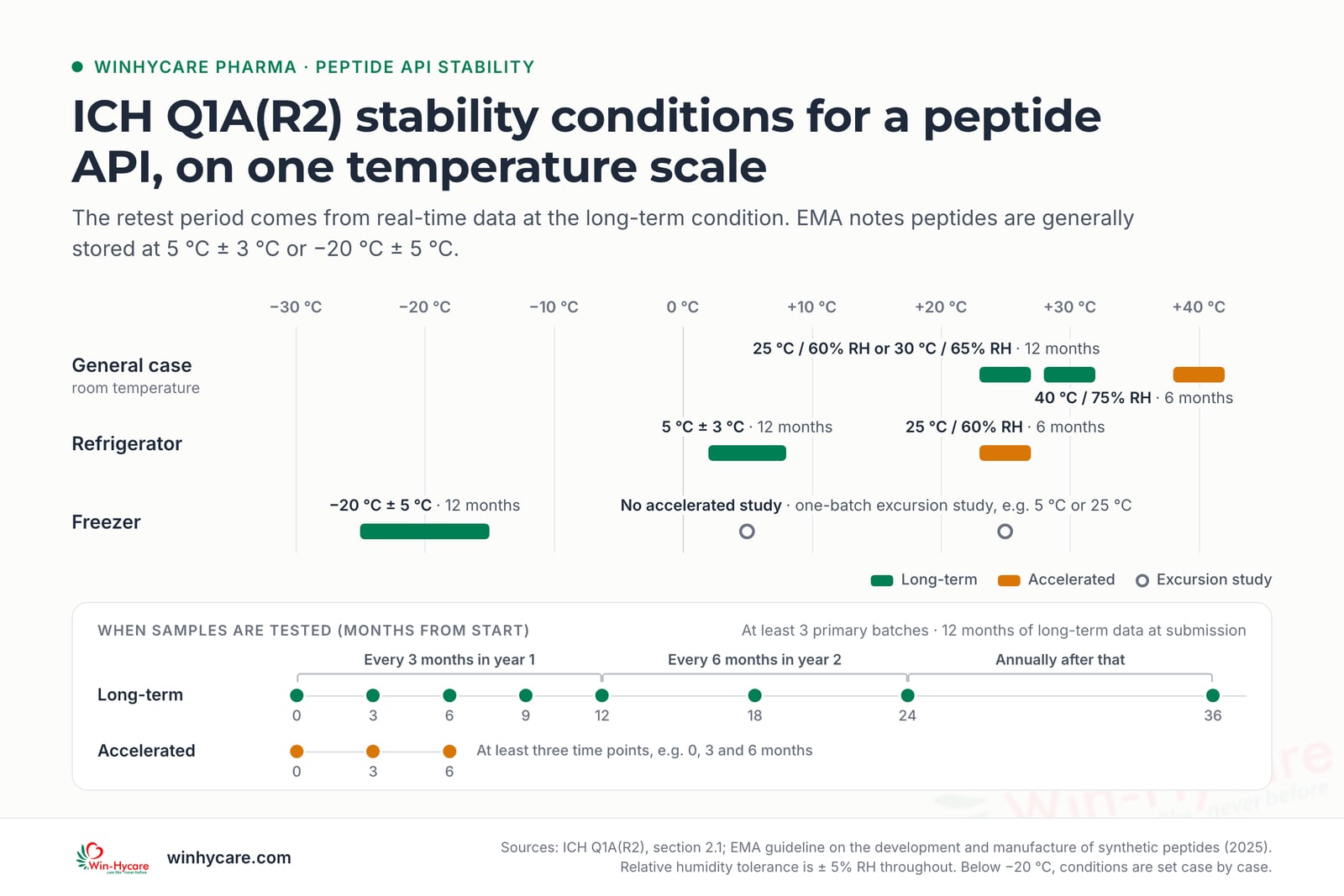
ICH Q1A(R2) sets the study conditions for each storage category of drug substance:
| Intended storage | Long-term condition | Minimum data at submission | Accelerated condition |
|---|---|---|---|
| General case | 25 °C ± 2 °C / 60% RH ± 5% RH, or 30 °C ± 2 °C / 65% RH ± 5% RH | 12 months | 40 °C ± 2 °C / 75% RH ± 5% RH, 6 months |
| Refrigerator | 5 °C ± 3 °C | 12 months | 25 °C ± 2 °C / 60% RH ± 5% RH, 6 months |
| Freezer | −20 °C ± 5 °C | 12 months | None; single-batch excursion study at e.g. 5 °C or 25 °C |
| Below −20 °C | Case by case | Case by case | Case by case |
Source: ICH Q1A(R2), section 2.1.7.
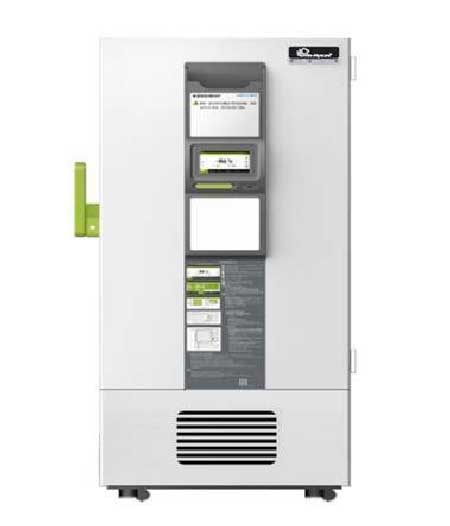
Whatever the condition, the store itself has to hold it. The EU Good Distribution Practice guidelines for active substances require active substances to be “stored under the conditions specified by the manufacturer”, with storage conditions “monitored and records maintained”, and where specific conditions are required, “the storage area should be qualified and operated within the specified limits.” If your stability programme, retained samples or long-term reserve stock call for −20 °C or colder, WinHyCare’s equipment division supplies −86 °C ultra-low temperature freezers designed for that kind of controlled storage.
How is peptide API stability tested under ICH Q1A(R2)?
In two layers: studies that set the retest period, and an ongoing programme that keeps confirming it.
1. Stress testing. Run on a single batch to find out how the molecule breaks down and to prove the analytical methods can see it. ICH Q1A(R2) lists temperature in 10 °C steps above the accelerated condition, humidity of 75% RH or more where appropriate, oxidation, photolysis and hydrolysis across a wide pH range. Photostability follows ICH Q1B, which calls for an overall illumination of not less than 1.2 million lux hours and near-UV energy of not less than 200 watt hours per square metre. EMA adds that forced degradation should test both the peptide and the methods.
2. Formal studies. Data on at least three primary batches, made at a minimum of pilot scale by the same synthetic route as production. At the long-term condition, testing is normally every 3 months in the first year, every 6 months in the second, and annually after that. Accelerated studies need at least three time points, such as 0, 3 and 6 months (ICH Q1A(R2)).
3. Ongoing monitoring. Under ICH Q7, the first three commercial batches normally go on stability to confirm the retest or expiry date, then “at least one batch per year” is added and tested at least annually. Samples are stored in containers that simulate the market container, and the methods must be “validated and be stability indicating”. For APIs with a shelf life of a year or less, testing is monthly for the first three months and quarterly after that.
One caveat on the rulebook: ICH is replacing its stability guidelines with a revised, consolidated Q1, which FDA published as a draft guidance in June 2025. Until that revision is final in the region where you file, Q1A(R2) is the text reviewers apply.
How should lyophilised peptide API be shipped?
Shipping is a short, uncontrolled stability study unless you plan it. Three rules keep it controlled.
- Ship at the labelled condition, or within proven excursion limits. The EU GDP guidelines say active substances “should be transported in accordance with the conditions specified by the manufacturer and in a manner that does not adversely affect their quality.” The excursion data comes from ICH Q1A(R2): for a freezer-stored substance, a single-batch study at an elevated temperature “to address the effect of short term excursions outside the proposed label storage condition, e.g., during shipping or handling.”
- Put the transport partner under contract. Where transport is contracted out, the distributor “should ensure that the contract acceptor knows and follows the appropriate storage and transport conditions”, under a written contract that bars unapproved subcontracting (EU GDP for active substances, 6.12).
- Record the journey. A temperature logger in the consignment turns an argument about what happened in transit into a comparison against the excursion data. If a reading falls outside it, quarantine the material and investigate before use.
What should you ask a peptide API supplier about stability?
Ask for evidence, not adjectives. A short list that separates prepared suppliers from the rest:
- The retest or expiry date and storage condition on each certificate of analysis, which ICH Q7 (section 11.41) expects to be stated.
- A stability summary showing the batches, conditions, time points and results that support the retest period.
- Excursion data that matches the way the material will actually travel.
- The container closure description, including any desiccant or inert gas.
- Trends in water content and high-molecular-weight impurities across the stability time points, not just the release value.
Our guide on how to qualify a peptide API supplier puts these questions into a full audit checklist. If you are sourcing semaglutide API, ask for the stability information that applies to the specific batch and market as part of supplier qualification.
Frequently asked questions
How long does a lyophilized peptide last?+
As long as its stability data supports. The manufacturer assigns a retest or expiry date from real-time studies at the labelled storage condition, and that date and condition appear on the certificate of analysis. A figure quoted for one peptide, or for the reference product, cannot be transferred to another material.
Should a peptide API be stored at 2–8 °C or −20 °C?+
Whichever condition the stability programme supports and the label states. EMA notes that peptides are generally stored refrigerated (5 °C ± 3 °C) or frozen (−20 °C ± 5 °C). Storage colder than −20 °C is handled case by case under ICH Q1A(R2).
What is the difference between a retest date and an expiry date?+
Under ICH Q7, a retest date is when the material should be re-examined to confirm it is still suitable for use; an expiry date is when it should no longer be used. ICH Q7 notes that common practice for APIs is to use a retest date.
Can a lyophilised peptide API be shipped without refrigeration?+
Only if stability data covers the expected time and temperature in transit. For freezer-stored drug substances, ICH Q1A(R2) asks for a single-batch study at an elevated temperature such as 5 °C or 25 °C to address shipping excursions, and the EU GDP guidelines require transport under the manufacturer's specified conditions.
Does light affect a peptide API?+
It can. Photostability is part of ICH Q1A(R2) stress testing, run under ICH Q1B conditions of at least 1.2 million lux hours and 200 watt hours per square metre of near-UV energy. If the API is light-sensitive, the container and storage instructions must protect it.
Sources
- ICH Q1A(R2): Stability Testing of New Drug Substances and Products, International Council for Harmonisation (ICH)
- ICH Q1B: Photostability Testing of New Drug Substances and Products, International Council for Harmonisation (ICH)
- ICH Q7: Good Manufacturing Practice Guide for Active Pharmaceutical Ingredients, International Council for Harmonisation (ICH)
- Guideline on the Development and Manufacture of Synthetic Peptides (EMA/CHMP/CVMP/QWP/367182/2025), European Medicines Agency
- Guidelines of 19 March 2015 on principles of Good Distribution Practice of active substances for medicinal products for human use (2015/C 95/01), EUR-Lex
- Q1 Stability Testing of Drug Substances and Drug Products: Draft Guidance for Industry (June 2025), US Food and Drug Administration
- Factors affecting the physical stability (aggregation) of peptide therapeutics (Zapadka KL et al. Interface Focus 2017), Interface Focus, Royal Society
- Practical advice on scientific design of freeze-drying process: 2023 update (Tchessalov S et al. Pharm Res 2023;40:2433–2455), Pharmaceutical Research (open access)