Semaglutide vs tirzepatide vs liraglutide: how the three peptide APIs compare
How semaglutide, tirzepatide and liraglutide APIs differ: backbone, length, lipid chain, receptors, half-life basis, molecular weight, CAS and approval.
By Kareem Ahmed Basha · Reviewed by Nisar Mohammed
Published · 9 min read

Key facts
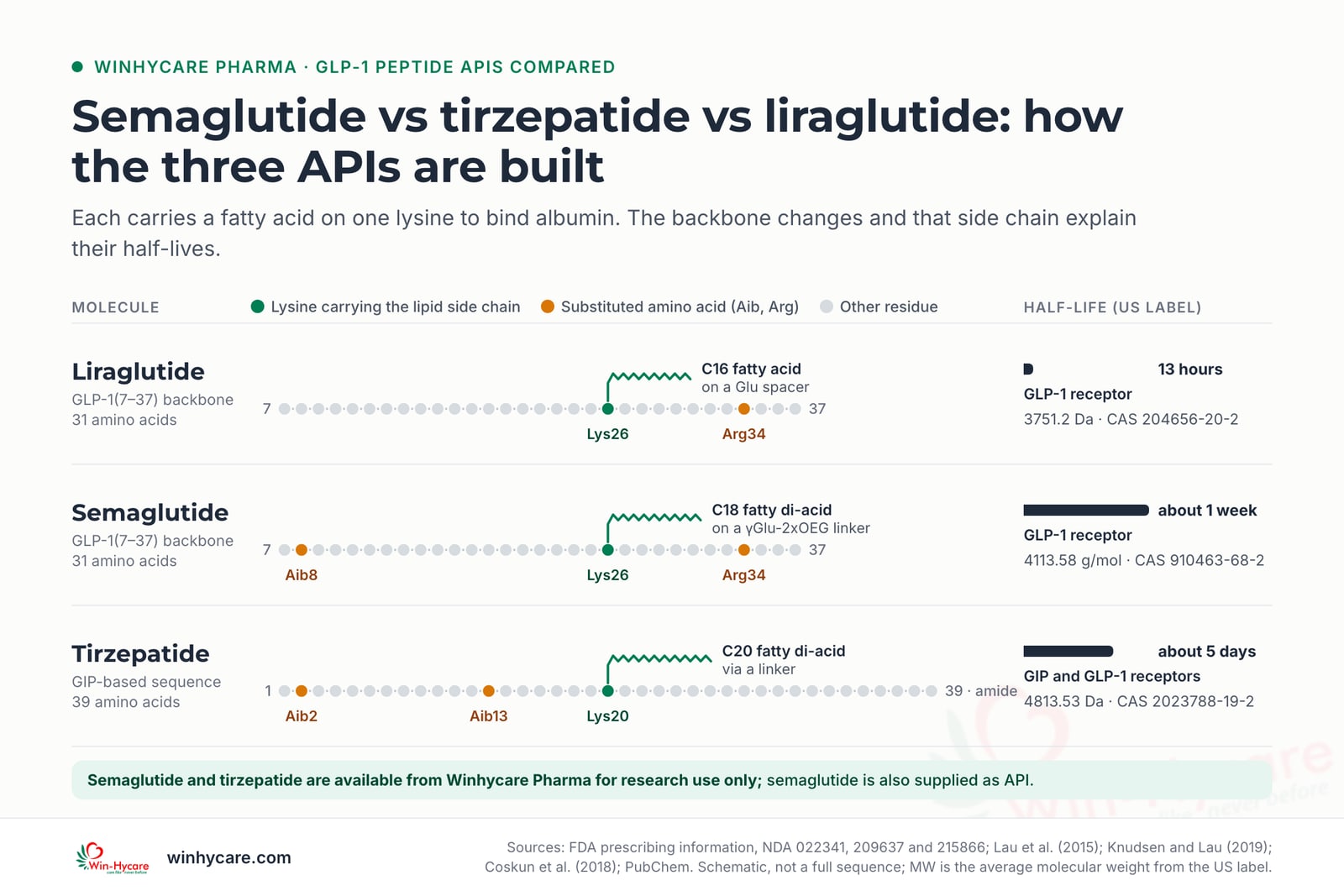
- Liraglutide and semaglutide are GLP-1 receptor agonists built on the human GLP-1(7–37) backbone; tirzepatide is a 39-amino-acid peptide based on the GIP sequence that activates both GIP and GLP-1 receptors.
- All three are lipidated at a lysine to bind albumin: liraglutide carries a C16 fatty acid at Lys26, semaglutide a C18 fatty di-acid at Lys26, and tirzepatide a C20 fatty di-acid at Lys20.
- Half-lives in the US labels follow that design: about 13 hours for liraglutide, about 1 week for semaglutide and about 5 days for tirzepatide.
- Molecular weights are 3751.2 Da (liraglutide), 4113.58 g/mol (semaglutide) and 4813.53 Da (tirzepatide); CAS numbers 204656-20-2, 910463-68-2 and 2023788-19-2.
- All three are active ingredients of approved medicines in the US and EU. FDA's Orange Book lists approved ANDAs for liraglutide from December 2024, but none for semaglutide or tirzepatide (data downloaded October 2026).
Short answer: liraglutide and semaglutide are GLP-1 receptor agonists built on the 31-residue human GLP-1(7–37) backbone, each with a fatty acid at lysine 26 to bind albumin. Tirzepatide is a 39-amino-acid, GIP-based peptide with a C20 fatty di-acid at lysine 20 that activates both GIP and GLP-1 receptors. Those design choices explain their half-lives: about 13 hours, 1 week and 5 days.
This is a structural comparison for people who specify, buy or develop the APIs, not a clinical one, and it contains no dosing or treatment information. Semaglutide and tirzepatide are available from Winhycare Pharma for research use only (liraglutide on request as a custom peptide). They are compared here because buyers compare them constantly.
How do semaglutide, tirzepatide and liraglutide compare at a glance?
| Attribute | Liraglutide | Semaglutide | Tirzepatide |
|---|---|---|---|
| Sequence basis | Human GLP-1(7–37) | Human GLP-1(7–37) | GIP sequence |
| Length | 31 amino acids | 31 amino acids | 39 amino acids |
| Backbone changes | Lys34→Arg | Ala8→Aib, Lys34→Arg | Aib at positions 2 and 13; C-terminal amide |
| Lipid side chain | C16 fatty acid (palmitic acid) on a glutamic acid spacer | C18 fatty di-acid on a hydrophilic γGlu-2xOEG linker | C20 fatty di-acid (1,20-eicosanedioic acid) via a linker |
| Attachment site | Lys26 | Lys26 | Lys20 |
| Receptor target(s) | GLP-1 receptor | GLP-1 receptor | GIP and GLP-1 receptors |
| Half-life (US label) | 13 hours | About 1 week | About 5 days |
| Molecular formula | C172H265N43O51 | C187H291N45O59 | C225H348N48O68 |
| Molecular weight (US label) | 3751.2 Da | 4113.58 g/mol | 4813.53 Da |
| CAS number | 204656-20-2 | 910463-68-2 | 2023788-19-2 |
| First US approval | 2010 | 2017 | 2022 |
| First EU authorisation | 30 June 2009 | 8 February 2018 | 15 September 2022 |
Sources: structure, molecular weight, half-life and initial US approval year from the FDA prescribing information for each reference product (semaglutide, tirzepatide, liraglutide); tirzepatide length from Coskun et al. (2018); semaglutide linker from Knudsen and Lau (2019); CAS numbers from PubChem (semaglutide, liraglutide, tirzepatide); EU dates from the EMA medicines report. The 31-residue length follows from the GLP-1(7–37) numbering, positions 7 to 37 inclusive.
What is the difference between GLP-1 and semaglutide?
Native GLP-1 is a hormone that barely survives in the bloodstream. The liraglutide prescribing information notes that GLP-1(7–37) “has a half-life of 1.5 to 2 minutes due to degradation by the ubiquitous endogenous enzymes, dipeptidyl peptidase 4 (DPP-4) and neutral endopeptidases (NEP).”
Semaglutide fixes both problems. Its discovery paper describes “two amino acid substitutions compared to human GLP-1 (Aib(8), Arg(34))” and derivatisation “at lysine 26” (Lau et al., 2015). FDA’s label explains the roles: the position 8 change provides “stabilization against degradation by the enzyme dipeptidyl-peptidase 4”, while the Lys26 modification with “a hydrophilic spacer and a C18 fatty di-acid” makes albumin binding “the main protraction mechanism.” The Arg34 change is described as “a minor modification… to ensure the attachment of only one fatty di-acid.” Without it, there would be two lysines to acylate.
So semaglutide is still recognisably GLP-1. It has the same receptor, a 31-residue backbone and two changed positions, plus one engineered side chain that changes how long it lasts.
How does liraglutide differ from semaglutide?
They are siblings from the same research programme, and the differences are small on paper but large in behaviour.
Liraglutide’s precursor is “engineered to be 97% homologous to native human GLP-1 by substituting arginine for lysine at position 34”, and the drug is made by “attaching a C-16 fatty acid (palmitic acid) with a glutamic acid spacer on the remaining lysine residue at position 26” (FDA, NDA 022341). Position 8 is unchanged.
Semaglutide makes three moves on that template:
- Aib at position 8 for DPP-4 resistance.
- A longer lipid, a C18 di-acid rather than a C16 mono-acid.
- A longer, more hydrophilic linker, γGlu-2xOEG. Knudsen and Lau report that “a C18 di-acid together with a γGlu-2xOEG linker resulted in the highest albumin affinity” in the series they tested.
The trade-off shows up in receptor binding. Lau and colleagues measured semaglutide’s GLP-1 receptor affinity at 0.38 ± 0.06 nM, “three-fold decreased compared to liraglutide, whereas the albumin affinity was increased.” Lower affinity at the receptor, much longer exposure in the body. In the US labels, that is the difference between a 13-hour half-life and roughly a week.
How is tirzepatide different from both?
It starts from a different hormone. FDA’s label describes tirzepatide as “based on the GIP sequence”, containing “aminoisobutyric acid (Aib) in positions 2 and 13, a C-terminal amide, and Lys residue at position 20 that is attached to 1,20-eicosanedioic acid via a linker” (FDA, NDA 215866). The discovery paper calls it “a 39 amino acid linear peptide conjugated to a C20 fatty diacid moiety” (Coskun et al., 2018).
Its receptor profile is deliberately unbalanced. In binding studies its affinity was “comparable to native GIP for the GIPR and approximately 5-fold weaker than native GLP-1 for the GLP-1R”, and in cell signalling its potency was “similar to native GIP and approximately 13-fold weaker than GLP-1.” The same paper found it less potent at the GLP-1 receptor than semaglutide.
Protraction works the same way as for semaglutide. The label says the C20 fatty diacid “enables albumin binding and prolongs the half-life”, reports 99% binding to plasma albumin and an elimination half-life of about 5 days. Coskun and colleagues measured a mean of 116.7 hours in their early clinical study.
Why do their half-lives differ?
Two levers, used to different degrees:
| Lever | Liraglutide | Semaglutide | Tirzepatide |
|---|---|---|---|
| Enzyme stability | Position 8 unchanged; label states it is stable against DPP-4 and NEP | Aib at position 8, for stability against DPP-4 | Non-coded Aib at positions 2 and 13 |
| Albumin binding through a lipid | C16 fatty acid; >98% plasma protein bound | C18 fatty di-acid; albumin binding is the “main protraction mechanism” | C20 fatty di-acid; 99% albumin bound |
| Half-life (US label) | 13 hours | About 1 week | About 5 days |
The table is drawn from the three FDA labels and the discovery papers cited above. Longer di-acid chains on suitable linkers raised albumin affinity in the semaglutide programme, and stability against DPP-4 and NEP removes the enzymes that clear native GLP-1 within minutes.
How do you tell the three APIs apart analytically?
Mass is the quickest check, provided you compare like with like. The FDA labels give average molecular weights. PubChem also lists monoisotopic masses, which is what high-resolution mass spectrometry usually reports:
| Molecule | Average molecular weight (FDA label) | Monoisotopic mass (PubChem) |
|---|---|---|
| Liraglutide | 3751.2 Da | 3748.95 Da |
| Semaglutide | 4113.58 g/mol | 4111.12 Da |
| Tirzepatide | 4813.53 Da | 4810.52 Da |
The tirzepatide discovery paper quotes a molecular weight of 4810.52 Da (Coskun et al., 2018), which matches the monoisotopic value rather than the label’s 4813.53 Da. Neither figure is wrong; they measure different things. A specification or certificate should say which one it uses.
On average mass, semaglutide is about 362 Da heavier than liraglutide and tirzepatide about 700 Da heavier than semaglutide, so a mix-up between the three is easy to catch by mass spectrometry. Mass alone still doesn’t prove the sequence. EMA’s synthetic peptides guideline recommends at least two orthogonal identity methods, chosen from mass, relative retention time, LC-MS, peptide mapping, amino acid analysis, bioactivity or NMR, that together “unambiguously confirm the sequence.” Our guide to reading a semaglutide API COA covers how those results appear on a certificate.
What do the structural differences mean for API manufacturing and specification?
For a buyer or developer, the comparison changes what the API specification and the impurity file have to cover.
- Length. A 39-residue peptide means more coupling steps than a 31-residue one in a stepwise synthesis, and more chances for deletion and insertion sequences. Our guide to SPPS vs LPPS covers route choices.
- Lipidation. All three carry a lipid side chain attached at a single lysine. EMA’s synthetic peptides guideline says conjugation adds complexity to characterisation and control, treats the unconjugated peptide as an intermediate that must be controlled, and names “the amount of the free unconjugated peptide and the free form of the conjugate moiety” as an additional quality attribute.
- Reference product route. FDA’s labels say the semaglutide backbone “is produced by yeast fermentation” and the liraglutide precursor by “expression of recombinant DNA in Saccharomyces cerevisiae.” The tirzepatide label does not describe the production route. A synthetic generic of a recombinant reference has to show its impurity profile compares with that reference.
- Regulatory comparison. FDA’s July 2026 Federal Register notice announced revised draft product-specific guidances for all three molecules (FR Doc. 2026-15285).
What is the approval and generic status of each?
All three are active ingredients of approved medicines in the US and the EU (dates in the first table). Generic status differs:
- Liraglutide. FDA’s Orange Book data files list approved ANDAs, the first dated 23 December 2024. In the EU, the EMA medicines report shows two liraglutide medicines from a second marketing authorisation holder authorised on 15 July 2026.
- Semaglutide. The Orange Book data files downloaded in October 2026 list no approved ANDA. The EU market-protection period for the first reference product runs to February 2028 at the earliest; patents and supplementary protection certificates run separately, as our guide to semaglutide patent expiry explains.
- Tirzepatide. No ANDA is listed; it remains with the originator in both regions. See our tirzepatide page for more background.
Winhycare Pharma supplies semaglutide API for pharmaceutical manufacturing and R&D. Semaglutide and tirzepatide are also available for research use only, and liraglutide can be discussed as a custom peptide, not for human or veterinary use; research-grade material is not GMP API and cannot be used in a medicinal product.
Frequently asked questions
What is the difference between GLP-1 and semaglutide?+
GLP-1 is the natural hormone; semaglutide is an engineered analogue of it. Native GLP-1(7–37) lasts 1.5 to 2 minutes in the body because DPP-4 and neutral endopeptidases degrade it. Semaglutide swaps alanine 8 for Aib to resist DPP-4 and carries a C18 fatty di-acid that binds albumin, giving a half-life of about one week.
Is tirzepatide a GLP-1 receptor agonist?+
It is a dual agonist. Tirzepatide is based on the GIP sequence and binds both the GIP receptor and the GLP-1 receptor. In its discovery paper, its GIP receptor affinity was comparable to native GIP and its GLP-1 receptor affinity about five-fold weaker than native GLP-1.
Why does semaglutide last longer than liraglutide?+
Both bind albumin through a fatty acid at lysine 26, but semaglutide uses a C18 fatty di-acid on a γGlu-2xOEG linker, chosen because it gave the highest albumin affinity, and adds Aib at position 8 for DPP-4 stability. Liraglutide uses a C16 palmitic acid on a glutamic acid spacer.
Which of these APIs does Winhycare Pharma supply?+
Semaglutide and tirzepatide are available from Winhycare Pharma for research use only, not for human or veterinary use; liraglutide is not in our catalogue but can be discussed as a custom peptide. Semaglutide is also supplied as API to pharmaceutical manufacturers and R&D teams.
Sources
- Semaglutide injection prescribing information (NDA 209637), sections 11 and 12, US Food and Drug Administration
- Tirzepatide injection prescribing information (NDA 215866), sections 11 and 12, US Food and Drug Administration
- Liraglutide injection prescribing information (NDA 022341), sections 11 and 12, US Food and Drug Administration
- Discovery of the once-weekly glucagon-like peptide-1 (GLP-1) analogue semaglutide (Lau J et al. J Med Chem 2015;58:7370–7380), Journal of Medicinal Chemistry
- The discovery and development of liraglutide and semaglutide (Knudsen LB, Lau J. Front Endocrinol 2019;10:155), Frontiers in Endocrinology (open access)
- LY3298176, a novel dual GIP and GLP-1 receptor agonist for the treatment of type 2 diabetes mellitus: from discovery to clinical proof of concept (Coskun T et al. Mol Metab 2018;18:3–14), Molecular Metabolism (open access)
- Semaglutide (CID 56843331), PubChem, US National Library of Medicine
- Liraglutide (CID 16134956), PubChem, US National Library of Medicine
- Tirzepatide (CID 166567236), PubChem, US National Library of Medicine
- Guideline on the Development and Manufacture of Synthetic Peptides (EMA/CHMP/CVMP/QWP/367182/2025), European Medicines Agency
- Medicines output: medicines report (EPAR data download, accessed October 2026), European Medicines Agency
- Orange Book Data Files (products file, downloaded October 2026), US Food and Drug Administration
- Product-Specific Guidances; Revised Draft Guidances for Industry; Availability (FR Doc. 2026-15285, 29 July 2026), Federal Register