Platelet Storage Requirements: Temperature, Agitation and Shelf Life
Platelet storage in India: 20–24°C with continuous gentle agitation, a 3–5 day shelf life, and pH and swirling checks, per the Drugs Rules, NACO and WHO.
Published · 8 min read
Key facts
- Indian rules require platelet concentrates to be stored at 20–24°C with continuous gentle agitation, for no more than 5 days (Drugs Rules, 1945, Schedule F Part XII-B).
- NACO sets a 3-day expiry for platelets prepared in a closed system, extendable to 5 days when special bags are used; the 2022 national standards say 3 or 5 days according to the bag manufacturer.
- NACO specifies flatbed agitation at 60–70 oscillations per minute or a rotor at 5–10 cycles per minute. WHO recommends a flatbed agitator at 65–75 strokes per minute.
- Platelets must keep a pH of at least 6.0 to the end of storage, and the swirling check is done daily and before issue under the 2022 national standards.
- Platelets are kept warm because chilled platelets are cleared rapidly from the circulation; the cost is a higher risk of bacterial growth, which is why shelf life is short.
Platelets are stored at 20–24°C with continuous gentle agitation, and in India they can be kept for no more than 5 days, or 3 days for platelets prepared in a closed system unless the bag is approved for longer storage. Those rules come from Schedule F Part XII-B of the Drugs Rules, 1945 and from NACO’s national standards. This guide explains each requirement, the reason behind it, and what it means for the equipment a blood centre buys.
The requirements at a glance
| Requirement | India | Source |
|---|---|---|
| Storage temperature | 20–24°C (22°C ± 2°C) | Drugs Rules Sch. F XII-B; NACO H-3.3 |
| Agitation | Continuous and gentle, throughout storage | Drugs Rules; NACO |
| Agitation rate | Flatbed 60–70 oscillations/min, or rotor 5–10 cycles/min | NACO E-3.4, H-3.3 |
| Shelf life | Not more than 5 days; 3 days in a closed system, extendable to 5 with special bags | Drugs Rules; NACO H-3.3 |
| pH at end of storage | Not less than 6.0 | Drugs Rules; NACO E-3.3 |
| Swirling check | Before issue (daily and before issue in the 2022 standards) | Drugs Rules; National Standards 2022 |
| Sterility testing | 1% of platelets prepared | Drugs Rules |
| Separation from whole blood | Within 6 hours of collection | Drugs Rules |
Sources: Drugs Rules, Sch. F XII-B III(E)(2), pp. 372–373; NACO 2007, pp. 39, 55; National Standards 2022, 8.10.3.5.
Temperature: why 20–24°C and not a refrigerator
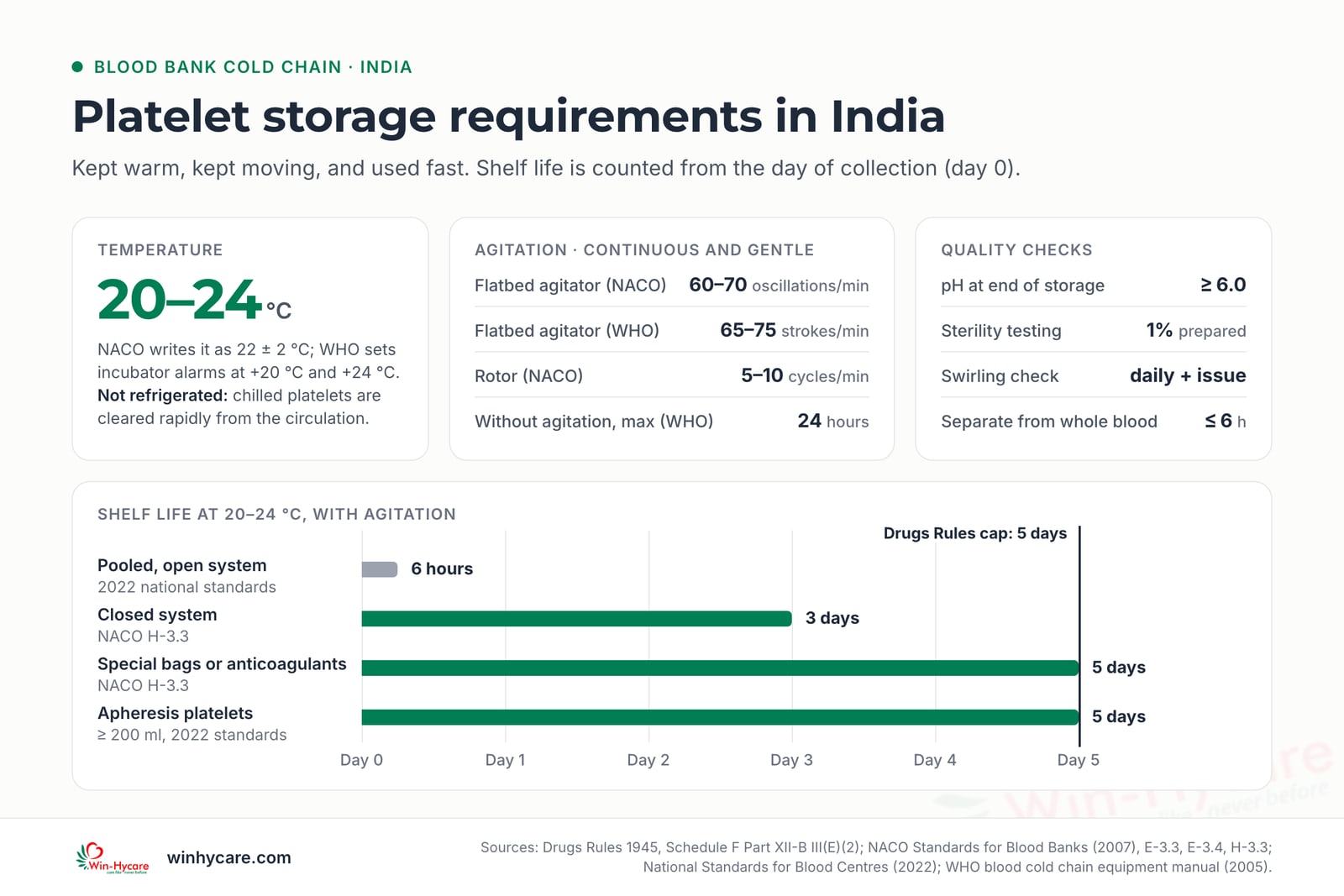
The Drugs Rules require that “platelets shall be placed in storage not exceeding for a period of 5 days, between 20 degree centigrade to 24 degree centigrade, with continuous gentle agitation of the platelet concentrates maintained through such storage” (Sch. F XII-B III(E)(2)(iii), p. 373). NACO writes the same band as 22°C ± 2°C (H-3.3, p. 55).
Unlike red cells and plasma, platelets are kept warm. WHO notes that “lower temperatures adversely affect platelet function and viability” (WHO manual, §2.1.4, pp. 7–8). The mechanism was described in Cell in 2003: platelets “rapidly leave the circulation if refrigerated prior to transfusion”, because chilling clusters their von Willebrand factor receptors, which liver macrophages then recognise (Hoffmeister et al., 2003).
Some countries now allow cold-stored platelets for specific uses. The UK guidelines provisionally permit storage at 4 ± 2°C for up to 14 days for the treatment of bleeding, from August 2026 (JPAC Red Book 7.4.1 and change notification 22-2026). Indian rules do not provide for this; standard platelet concentrates in India stay at 20–24°C.
Agitation: what it does and how fast
WHO gives two reasons for agitation: it “is essential to prevent platelet aggregation which results in loss of viability”, and it supports gas exchange between the bag and the environment, which “results in the maintenance of pH in the component, which is critical for platelet storage” (WHO manual, §2.1.4). A 2022 study in Thrombosis Journal linked loss of swirling to lactate accumulation and falling pH (Hosseini et al.).
The documents specify the motion:
| Source | Agitator type | Rate |
|---|---|---|
| NACO 2007 (E-3.4) | Horizontal (flatbed) agitator | 60–70 oscillations per minute |
| NACO 2007 (E-3.4) | Rotor | 5–10 cycles per minute |
| WHO manual (§3.6) | Flatbed, horizontal or vertical agitation (recommended) | 65–75 strokes per minute, amplitude 3.6–4.0 cm |
Sources: NACO, p. 39; WHO manual, pp. 22–23.
Short breaks are tolerated. WHO says platelets “should reach their destination within 24 hours, which is the maximum time allowed without agitation” (WHO manual, p. 10). The UK allows interruptions where “no single interruption lasts for more than eight hours, and the total length of all interruptions is no longer than 24 hours” (JPAC 7.4.1).
Shelf life: 3 days or 5 days
The Drugs Rules set an upper limit of 5 days. NACO’s standards add the closed-system rule: “The expiry date of platelet concentrate prepared in a closed system should be 3 days after the collection of original blood. The expiry date may be extended to 5 days or longer when special plastic bags or anticoagulants are in use” (H-3.3, p. 55). NACO counts the day of collection as day zero (E-3.4, p. 39).
The 2022 National Standards for Blood Centres put it as “3 or 5 days (as per manufacturer’s instructions) after the collection or as specified by the regulator from time to time” (8.18.3, p. 46). Apheresis platelets “shall be kept up to 5 days between 20°C to 24°C with continuous agitation”, with a minimum volume of 200 ml “in order to maintain optimum pH” (8.7.4.2–8.7.4.3). Platelets pooled in an open system have a shelf life of 6 hours (8.10.3.11, p. 39).
The reason for the short limit is bacteria. WHO notes that because platelet concentrates are stored at room temperature, “they pose a greater risk for bacterial proliferation” (WHO manual, p. 8). The US FDA states that room-temperature platelets carry “a higher risk of sepsis and related fatality than any other transfusable blood component”, and that 95–100% of platelet-related septic reactions, and all associated fatalities, in its data involved platelets stored for 4 or 5 days (FDA guidance 2020, p. 2). In the UK, storage beyond 5 days, up to 7, is allowed only with a bacterial assay or pathogen inactivation (JPAC 7.4.1).

Quality checks during storage
- pH. Indian rules require a pH “of not less than 6” measured at storage temperature; NACO says not lower than 6.0 at the end of storage (Drugs Rules p. 373; NACO E-3.3). For comparison, the US requires at least 6.2 (21 CFR 640.25(b)).
- Swirling. The Drugs Rules require “tests for functional viability of the platelets … by swirling movement before issue”; the 2022 standards say “The swirling phenomenon should be checked daily and before issue”.
- Platelet count. The Drugs Rules set minimums of 3.5 × 10^10 platelets per unit from 350 ml blood and 4.5 × 10^10 from 450 ml. NACO sets at least 3 × 10^11 for apheresis platelets in 75% of units tested (G-3.7.1, p. 50).
- Sterility. One per cent of platelets prepared are tested for sterility under the Drugs Rules.
Equipment: what a blood centre needs
Schedule F lists a “platelet agitator with incubator (wherever necessary)” in the equipment for component preparation (p. 369). NACO specifies that a “platelet incubator with agitator should have inside temperature of 22°C ±2°C having temperature indicator/recording facility with alarm system and provision for alternate power supply” (H-1.5, p. 53). WHO lists preset alarm points at +20°C and +24°C for platelet incubators (p. 23).
Monitoring follows the same pattern as other blood storage. NABH requires continuous monitoring of platelet incubators with entries at least every 8 hours, or 4-hourly where monitoring is not continuous (NABH 4.6.3, p. 15). If platelets sit on an open agitator, the room itself must be held at 22°C ± 2°C and “recorded at least at 4 hourly intervals” (National Standards 2022, 5.2.4). Where room temperature rises above 24°C in summer, an enclosed incubator is the simpler way to comply.
| Option | Temperature control | Agitation | Suits |
|---|---|---|---|
| Open platelet agitator | Relies on the room (22°C ± 2°C, 4-hourly records) | Yes | Rooms with reliable air conditioning |
| Platelet incubator with agitator | Cabinet holds 20–24°C and alarms | Yes | Most Indian blood centres |
WinHyCare’s platelet incubators with agitator are of the second type:
| Model | Capacity | Temperature | Agitation | Other |
|---|---|---|---|---|
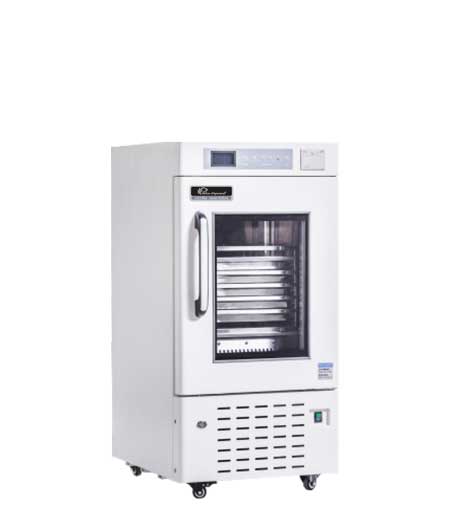 | 5 bags | 20–24°C | Oscillating shelves | Temperature and power-failure alarms, UV lamp |
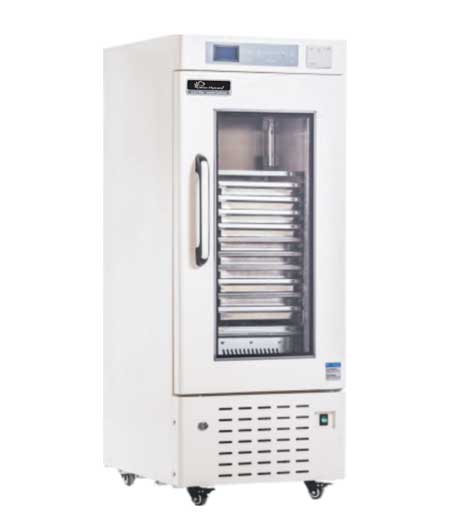 | 10 bags | 20–24°C | Oscillating shelves | Temperature and power-failure alarms, UV lamp |
When comparing any platelet incubator, ask the supplier for the agitation rate and amplitude and check them against NACO’s 60–70 oscillations per minute and WHO’s 65–75 strokes per minute; ask how temperature is recorded; and connect the unit to backup power, which NACO requires. The units are certified to ISO 9001/13485/14001 standards and designed to meet NABH/NBTC requirements.
Transport
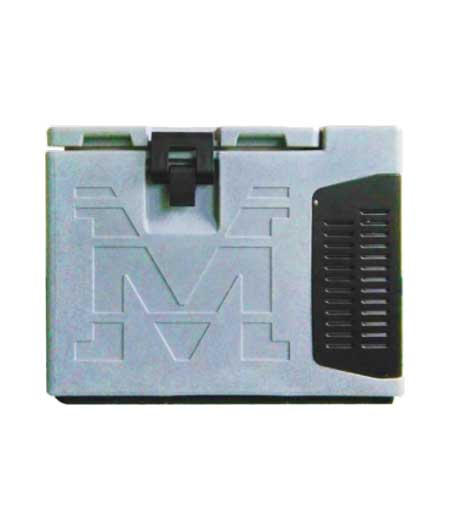
WHO’s limit for platelets in transit is 24 hours at 20–24°C, the maximum time without agitation. Because platelets must stay at 20–24°C, they cannot travel in a 2–8°C box with red cells. A powered transport cooler with a 22 ± 2°C mode can hold the platelet band during vehicle transfers. Storage rules for red cells, plasma and the other components are covered in our blood bank refrigerator requirements guide.
Frequently asked questions
At what temperature are platelets stored?+
20–24°C, often written as 22°C ± 2°C, with continuous gentle agitation. This is the requirement in Schedule F Part XII-B of the Drugs Rules, 1945 and in NACO's standards.
What is the shelf life of platelets in India?+
The Drugs Rules allow up to 5 days. NACO's 2007 standards give 3 days for platelets prepared in a closed system, extendable to 5 days with special bags, and the 2022 national standards say 3 or 5 days according to the bag manufacturer's instructions.
Why do platelets need agitation?+
WHO explains that agitation prevents platelet aggregation, which causes loss of viability, and supports gas exchange through the bag, which keeps the pH up. Indian rules require continuous gentle agitation throughout storage.
Why are platelets not stored in a refrigerator?+
Chilled platelets are cleared from the circulation quickly after transfusion. Research published in Cell in 2003 showed that chilling clusters platelet von Willebrand factor receptors, which liver macrophages then recognise and remove.
What is the difference between a platelet agitator and a platelet incubator?+
An agitator moves the bags; an incubator controls the temperature. A platelet incubator with agitator does both. If an open agitator is used, the 2022 national standards require the room to be held at 22°C ± 2°C and recorded at least every 4 hours.
Sources
- Drugs Rules, 1945 (formerly Drugs and Cosmetics Rules), consolidated copy: Schedule F Part XII-B, Central Drugs Standard Control Organisation (CDSCO), MoHFW
- Standards for Blood Banks & Blood Transfusion Services (2007), copy hosted by IAPSM, National AIDS Control Organisation (NACO), MoHFW
- National Standards for Blood Centres and Blood Transfusion Services, 2nd edition (2022), Directorate General of Health Services and NACO, MoHFW
- Accreditation Standards on Blood Banks/Blood Centres and Transfusion Services, 3rd edition with amendment, National Accreditation Board for Hospitals & Healthcare Providers (NABH)
- Manual on the management, maintenance and use of blood cold chain equipment (2005), World Health Organization
- 21 CFR 640.25 Platelets: general requirements, US Food and Drug Administration (via Cornell LII)
- Bacterial Risk Control Strategies for Blood Collection Establishments and Transfusion Services to Enhance the Safety and Availability of Platelets for Transfusion (December 2020), US Food and Drug Administration
- The clearance mechanism of chilled blood platelets (Hoffmeister et al., Cell, 2003), Cell / PubMed
- Guidelines for the Blood Transfusion Services in the UK, section 7.4.1: Platelets, Joint UKBTS Professional Advisory Committee (JPAC)