Blood Bank Refrigerator Price in India: What Drives the Cost
What sets the price of a blood bank refrigerator in India: capacity, temperature control, alarms, recorder, backup power, documents, service and tender terms.
Published · 8 min read
Key facts
- There is no single list price for a blood bank refrigerator in India. The quote depends on capacity, the temperature-control and alarm package, recording and power backup, and the installation, documentation and service terms you ask for.
- Indian rules require blood centre refrigerators to hold 2–6°C with a digital thermometer, a recording thermograph, an alarm device and provision for continuous power supply (Drugs Rules, Schedule F Part XII-B).
- WHO's minimum specification asks for ±1°C setting accuracy whatever the load, a 0.1°C display, a temperature recorder, audible and visual alarms with battery backup, and performance in ambient temperatures up to +43°C.
- Size by bag count as well as litres: WHO classifies blood refrigerators in five bands, from under 50 to about 1,000 units of 450 ml blood.
- For a quote you can compare, send the bag count, number of units, delivery city, procurement route (direct, e-tender or GeM) and the documents and AMC you need.
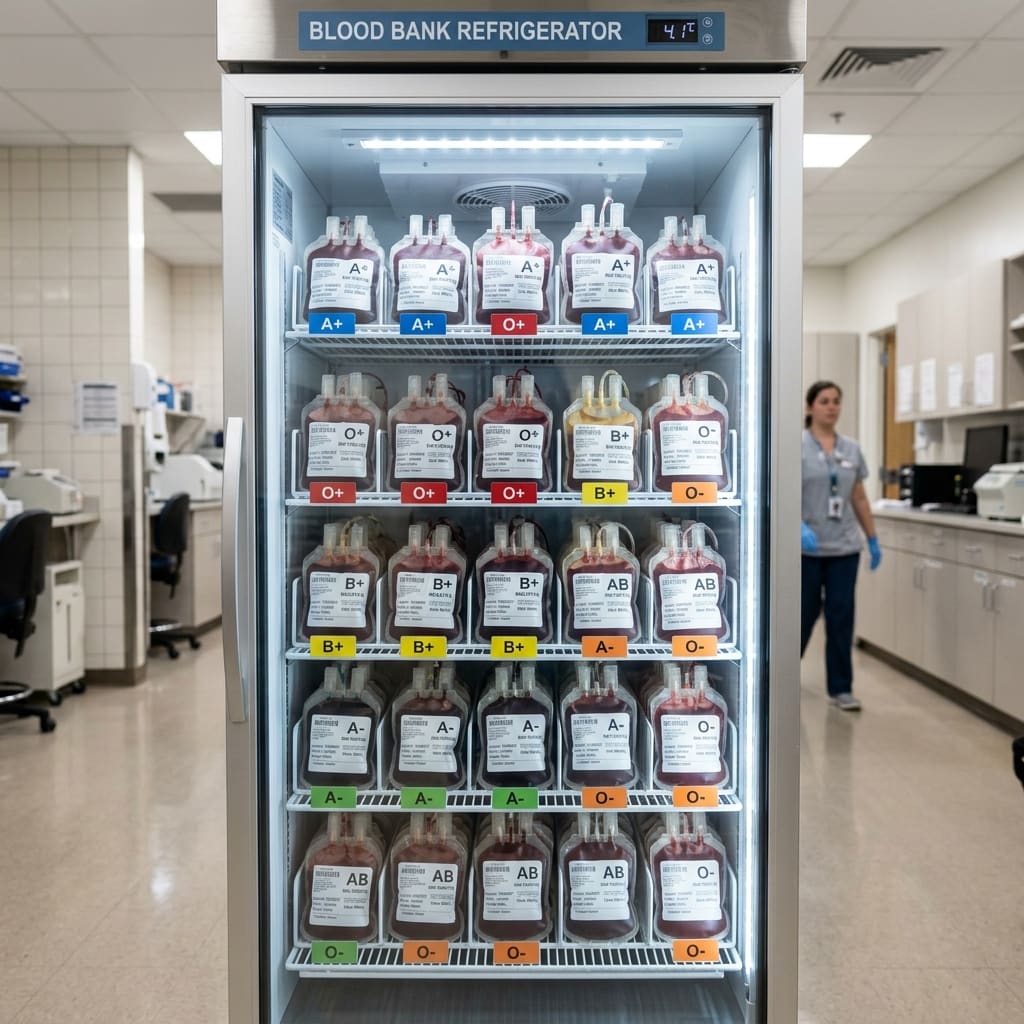
The price of a blood bank refrigerator in India is set by what the unit has to do, not by a catalogue figure. The biggest drivers are capacity (litres and bag count), temperature control under full load, the alarm and recording package, power backup, and the installation, documentation and service you ask for. That is why we quote our blood bank refrigerators per order rather than publishing a price list.
This guide breaks the quote into its parts so you can compare offers fairly, and so the cheapest line on a comparative statement is not the one that fails your next licence inspection.
How much does a blood bank refrigerator cost in India?
There is no fixed number. Two quotes for “a 200-litre blood bank refrigerator” can describe very different machines: one with fan-forced air, a recorder, five alarm conditions and a 72-hour alarm battery; another with a basic thermostat and a display. The price gap follows the specification gap.
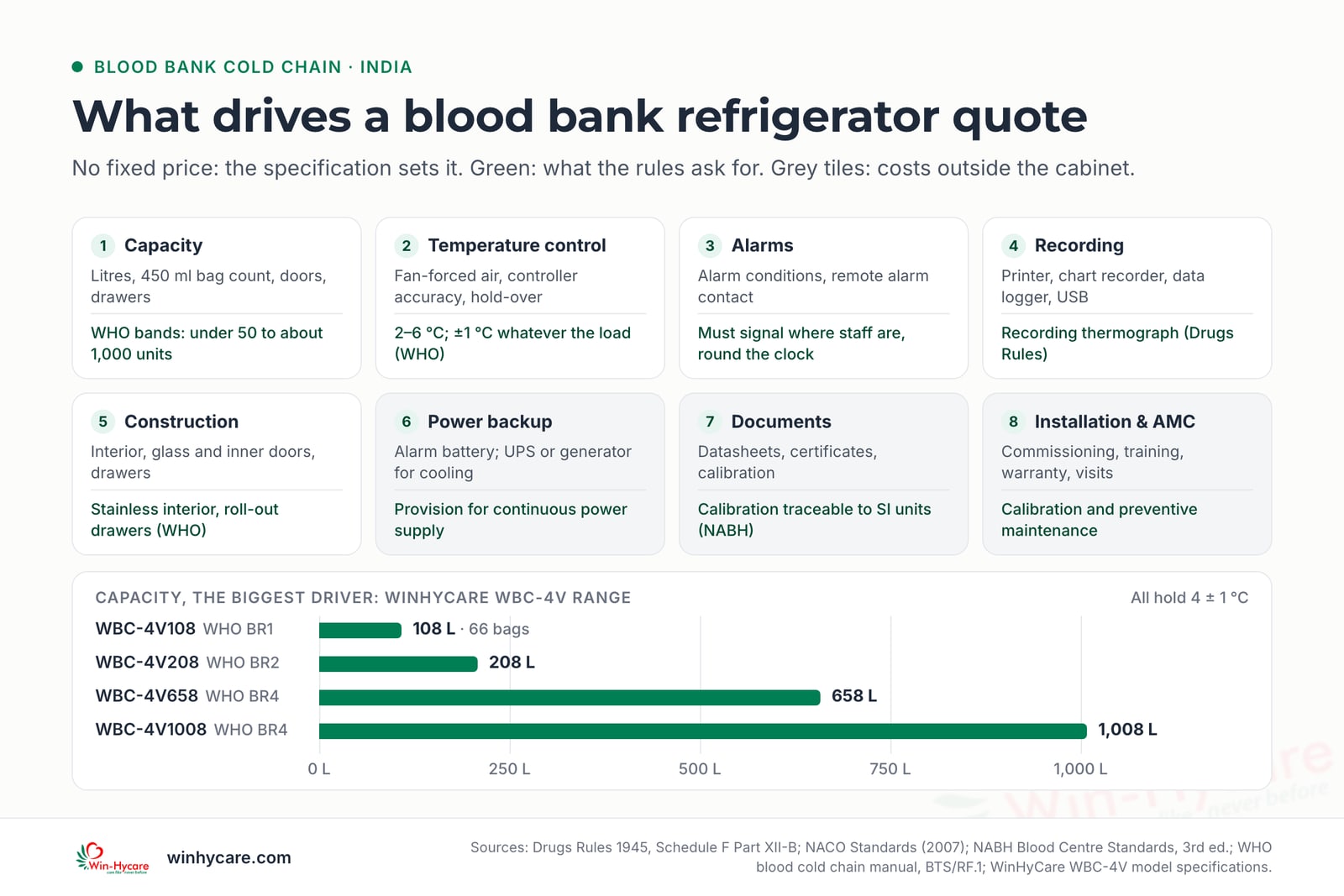
The table below lists the lines that move a quote, and what the regulators actually ask for on each one.
| Cost driver | What changes the price | What the rules ask for |
|---|---|---|
| Capacity | Litres, 450 ml bag count, doors, drawers | Size to your stock; WHO bands from under 50 to about 1,000 units |
| Temperature control | Fan-forced air, controller accuracy, hold-over time | 2–6°C (Drugs Rules); ±1°C setting accuracy whatever the load (WHO) |
| Alarms | Number of alarm conditions, remote alarm contact | Alarm device (Drugs Rules); alarm must signal where staff are present round the clock (NACO, NABH) |
| Recording | Built-in printer, chart recorder, data logger, USB export | Recording thermograph (Drugs Rules); continuous monitoring, or 4-hourly records if not continuous (NABH) |
| Power backup | Battery for alarms and display; UPS or generator for cooling | Provision for continuous power supply (Drugs Rules) |
| Construction | Interior material, glass door, inner doors, roll-out drawers, castors | Stainless steel interior and roll-out drawers (WHO specification) |
| Documents and calibration | Datasheets, ISO certificates, calibration certificate | Calibration traceable to SI units, with status labels (NABH) |
| Installation and AMC | Delivery, commissioning, training, warranty, maintenance visits | Calibration and preventive-maintenance programme (NABH) |
Read the right-hand column first. Anything in it is a requirement for a licensed blood centre, so a low quote that leaves it out is not a saving.
Which features does a blood centre refrigerator legally need?
Schedule F Part XII-B of the Drugs and Cosmetics Rules, 1945, sets the floor. For the blood collection room it lists refrigerators “for storing separately tested and untested blood, maintaining temperature between 2 to 6 degree centigrade with digital dial thermometer, recording thermograph and alarm device, with provision for continuous power supply.” The component-processing section repeats the same 2–6°C requirement. Since the 2020 amendment (G.S.R. 166(E)), the rules call these facilities blood centres rather than blood banks.
NABH’s accreditation standard adds operating detail: continuous temperature monitoring with readings recorded at least every 8 hours (every 4 hours if monitoring is not continuous), an alarm system, provision for alternate power, and a weekly check that the alarms trigger at their set points. NACO’s 2007 standards and NABH both say the alarm must sound in an area staffed round the clock.
That last point has a cost consequence people miss. If the refrigerator sits in a store room that is empty at night, a buzzer on the cabinet does not meet the requirement on its own. You will need a remote alarm contact wired to the duty room, or a monitoring system, and that belongs in the quote.
WHO’s minimum performance specification (BTS/RF.1) goes further than Indian law and is a good benchmark for “what good looks like”:
- electronic control across +2°C to +6°C with ±1°C setting accuracy whatever the load, using fan air cooling
- a digital display with 0.1°C graduation, a temperature recording device and visual and audible alarms
- battery backup for the alarm and recorder, and a facility for a remote alarm contact
- performance in ambient temperatures of +10°C to +43°C, with a full load at +4°C taking at least 30 minutes to rise above +6°C
WHO also lists preset alarm points of +1.5°C and +5.5°C as an ideal design feature, which gives staff a margin before the stored blood leaves its 2–6°C range.
How does capacity change the price?
Capacity is the largest single factor, and litres alone can mislead. What matters is how many 450 ml bags fit, in what arrangement, with room for air to circulate. WHO groups blood refrigerators into five capacity bands:
| WHO class (BTS/RF.1) | Approx. 450 ml units | Approx. internal capacity | WinHyCare model in this band |
|---|---|---|---|
| BR1 | Under 50 | Under 130 L | WBC-4V108 (108 L, rated for 66 bags) |
| BR2 | 51–150 | 131–390 L | WBC-4V208 (208 L) |
| BR3 | 151–250 | 391–650 L | none |
| BR4 | 251–500 | 651–1,350 L | WBC-4V658 (658 L), WBC-4V1008 (1,008 L) |
| BR5 | 501–1,000 | 1,351–2,700 L | none (use several units or a cold room) |
Two practical points. First, the rules ask for tested and untested blood to be stored separately, so check whether your layout calls for two smaller units rather than one large one; two doors on one cabinet may or may not satisfy your licensing inspector, so ask before you buy. Second, size for peak stock (camp days, festival-season drives), not the monthly average.
What does WinHyCare’s WBC-4V range include?
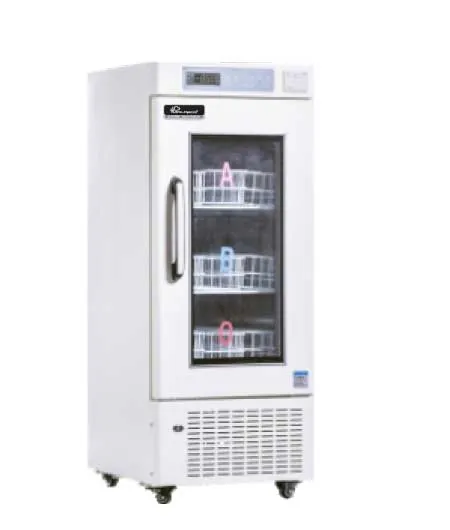
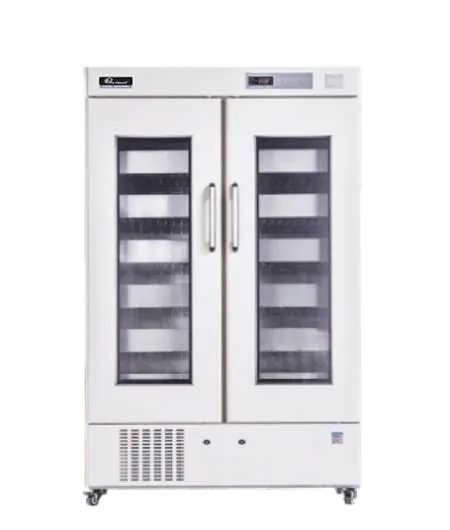
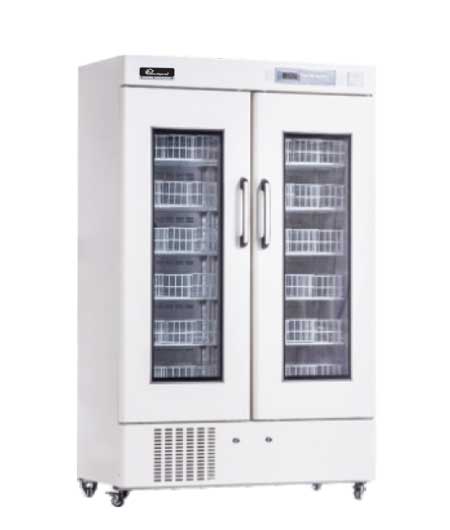
All four models are designed and supplied by WinHyCare, supplied to ISO 9001 and ISO 13485 quality standards, and serviced through our Hyderabad service centre. Every unit uses microprocessor-controlled, fan-forced cooling with electrical heat compensation, auto-defrost, a 0.1°C digital display, acrylic inner doors and a lock.
| Model | Capacity | Temperature | Alarm and display backup | Temperature records | Alarm conditions |
|---|---|---|---|---|---|
| WBC-4V108 | 108 L (66 × 450 ml bags) | 4 ± 1°C | 72-hour battery | Built-in printer | High/low temperature, power failure, abnormal voltage, door ajar, backup battery |
| WBC-4V208 | 208 L | 4 ± 1°C | 72-hour battery | Built-in printer | As WBC-4V108 |
| WBC-4V658 | 658 L | 4 ± 1°C | 72-hour battery | Built-in printer | As WBC-4V108 |
| WBC-4V1008 | 1,008 L | 4 ± 1°C | 72-hour battery | Built-in printer | As WBC-4V108 |
The battery keeps the display and alarms alive during an outage. It does not run the compressor, which brings us to the costs outside the box.
What costs sit outside the refrigerator itself?
A fair budget covers the whole installation, not only the cabinet.
Standby power. The Drugs Rules list a stand-by generator among blood bank accessories, and the refrigerator clause asks for continuous power supply. If your generator does not cover the cold room circuit, a UPS sized for the compressor is a separate line item.
The room. A unit rated for a cool, air-conditioned room behaves differently in a hot store room. WHO tests blood refrigerators at +43°C ambient for a reason. Ask each supplier for the rated ambient range and leave the ventilation clearance the manual specifies.
Calibration and alarm testing. NABH expects a calibration programme traceable to SI units, calibration status labels on each piece of equipment and weekly alarm checks. Price the first-year calibration certificate into the purchase and the later ones into the AMC.
Service. A lower purchase price with no service cover often costs more over the life of the unit. Compare warranty length, response time and what an AMC visit actually includes.
How do tenders and GeM change the quote?
Government hospitals, medical colleges and state blood transfusion councils usually buy through e-tenders or the Government e-Marketplace (GeM). In both cases the bid document fixes the specification, and the quote has to match it clause by clause: capacity, temperature range, alarm conditions, recorder, backup, warranty and installation. Documentation (datasheets, ISO certificates, compliance statements) is part of what you are paying for. Our tenders and GeM page explains what we prepare for institutional buyers.

How do you get a quote you can compare?
- State the bag count you need at peak, and whether tested and untested stock will share a unit.
- List the mandatory features from Schedule F and NABH: 2–6°C, recorder, alarm, alternate power, alarm signal to a staffed area.
- Ask each supplier for the rated ambient range and full-load hold-over time.
- Ask exactly what the backup battery powers, and for how long.
- Ask which documents come with the unit: datasheet, calibration certificate, ISO certificates, user and service manuals.
- Ask for installation, training, warranty and AMC terms in writing.
- Compare quotes line by line against your list before you compare totals.
If you are also deciding what else the blood centre needs, our guide to blood bank refrigerator requirements in India covers records and calibration in more depth, and the blood bank and transfusion solutions page shows how refrigerators, plasma freezers and platelet incubators fit together. For a quotation, send us the details in step 1 to step 6 and the delivery city.
Frequently asked questions
How much does a blood bank refrigerator cost in India?+
It depends on the configuration. Capacity is the largest factor, followed by the control and alarm package, the recorder and backup arrangement, and the installation, warranty, AMC and tender documentation included. Two quotes for the same litres can describe very different machines, so compare specifications line by line before comparing totals. WinHyCare quotes each order against the buyer's specification.
Does a more expensive blood bank refrigerator keep blood safer?+
Only if the extra cost buys something that affects safety: tight temperature control under full load, alarms that reach staff round the clock, continuous recording, and backup power for the alarm and recorder. Cosmetic extras do not change how long red cells stay usable.
Can a domestic refrigerator be used to store blood?+
No. Indian rules call for a refrigerator holding 2–6°C with a recording thermograph, an alarm device and provision for continuous power supply. WHO's specification also expects fan-forced air circulation, ±1°C setting accuracy at full load and battery backup for the alarm and recorder. Domestic refrigerators are not built or tested to that standard.
Is the battery backup on a blood bank refrigerator enough to keep it cold in a power cut?+
Usually not. On WinHyCare's WBC-4V series, as on most blood bank refrigerators, the battery keeps the display and alarms running during an outage, while the compressor still needs mains power, a UPS or a generator. Plan standby power separately.
What should I send to get an accurate quote?+
Send the bag count or litres you need, the number of units, the delivery city, whether it is a direct purchase, e-tender or GeM order, the documents you need with the bid (datasheets, ISO certificates, compliance statements) and the warranty and AMC period you expect.
Sources
- Safe blood and blood products: Manual on the management, maintenance and use of blood cold chain equipment (2005), World Health Organization
- Guidelines for blood bank, merged with G.S.R. 166(E) dated 11.03.2020 (Drugs and Cosmetics Rules, 1945, Part X-B and Schedule F Part XII-B), Central Drugs Standard Control Organisation (CDSCO), Government of India
- Standards for Blood Banks & Blood Transfusion Services (2007), National AIDS Control Organisation (NACO), Ministry of Health & Family Welfare (copy hosted by IAPSM)
- Accreditation Standards on Blood Banks/Blood Centres and Transfusion Services, 3rd edition (with amendments), National Accreditation Board for Hospitals and Healthcare Providers (NABH)