Plasma Freezer Temperature and FFP Storage: How Cold, How Long, and Can FFP Go in the Fridge?
Plasma freezer temperature and FFP storage in India: −30°C or colder for up to a year, freezing and thawing rules, cryo, and whether FFP can go in a fridge.
Published · 8 min read
Key facts
- In India, fresh frozen plasma (FFP) is plasma frozen within 6 hours of collection and stored at −30°C or colder for up to one year (Drugs and Cosmetics Rules, Schedule F Part XII-B).
- A blood centre that prepares components must have deep freezers holding −30°C to −40°C and −75°C to −80°C. WHO's plasma freezer specification calls for an operating range of −35°C to −40°C.
- Colder storage lasts longer: NACO allows FFP kept at −60°C or below with continuous monitoring to be used for up to 5 years; WHO's table runs from 3 months at −20°C to 7 years at −65°C or below.
- Frozen FFP must not be stored in a refrigerator. Once thawed at 30–37°C, NACO says it should be used within 6 hours, and WHO says it must never be refrozen.
- Cryoprecipitate is stored at −30°C or colder for up to a year and used within 6 hours of thawing.
A plasma freezer for an Indian blood centre has to hold fresh frozen plasma (FFP) at −30°C or colder, and the Drugs and Cosmetics Rules specify deep freezers that hold −30°C to −40°C, alongside a −75°C to −80°C unit for faster freezing. At −30°C or colder, FFP keeps for up to one year. WHO’s own plasma freezer specification sets the operating range at −35°C to −40°C. Our −40°C plasma freezer is built for that storage band.
The rest of this guide covers how long plasma keeps at different temperatures, how fast it must be frozen, what happens after thawing, and the question every ward asks sooner or later: can FFP go in the fridge?
What temperature should a plasma freezer be?
Three sources set the number, and they agree more than they differ.
| Source | Requirement for FFP storage | Freezer specification |
|---|---|---|
| Drugs and Cosmetics Rules, Schedule F Part XII-B (as amended 2020) | FFP stored “not warmer than minus 30 degree centigrade” for not more than one year | ”Deep Freezer or Snap Freezer” at −30°C to −40°C and at −75°C to −80°C |
| NACO Standards for Blood Banks (2007) and NABH 3rd edition | −30°C or below; FFP frozen solid at −30°C or lower as early as possible | Deep freezer with temperature indicator or recorder, alarm system and alternate power supply |
| WHO blood cold chain manual (2005) | At all times −20°C or lower; optimal −30°C or lower; no lower limit | Operating temperature −35°C to −40°C, ±1°C setting accuracy, preset alarm at −25°C |
The practical reading: set the storage freezer in the −35°C to −40°C range. That keeps the plasma comfortably below the −30°C legal limit even when the door opens or the freezer defrosts, and it matches WHO’s specification. WHO’s alarm point of −25°C is a last line of defence, not a target.
WHO’s specification (BTS/FR.1) adds performance tests worth asking any supplier about. With a full load at −36°C, the cabinet should take at least an hour to warm above −20°C after power loss, and a full load of plasma at +25°C should reach below −20°C within 30 hours. It should also work in ambient temperatures from +10°C to +43°C, which matters in an Indian store room in May.
How long can you freeze plasma?
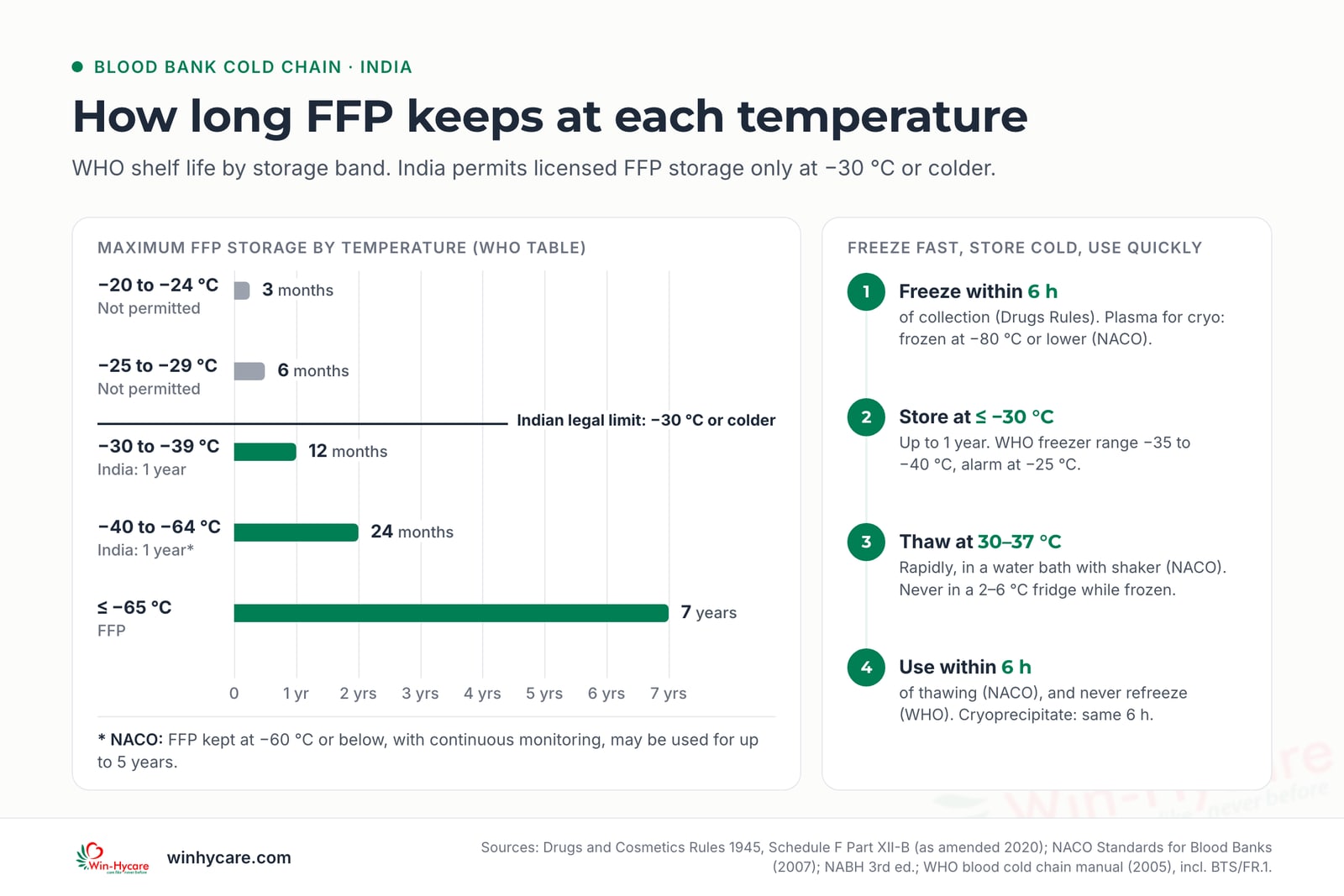
Shelf life depends on how cold the plasma is kept. WHO’s manual tabulates it; Indian rules fix the minimum.
| Storage temperature | Maximum storage (WHO table) | Indian rule |
|---|---|---|
| −65°C or below | 7 years (FFP) | NACO: FFP at −60°C or below, with continuous monitoring, up to 5 years |
| −40°C to −64°C | 24 months | Covered by the one-year limit below unless stored at −60°C or below |
| −30°C to −39°C | 12 months | Drugs Rules: up to 1 year at −30°C or colder |
| −25°C to −29°C | 6 months | Not permitted for licensed FFP storage |
| −20°C to −24°C | 3 months | Not permitted for licensed FFP storage |
NACO also allows FFP that is still unused after one year at −30°C to be relabelled as “plasma” and used for up to 4 more years, and the 2020 amendment lets excess and expired plasma go to a licensed fractionation centre, with the justification recorded. For comparison, US regulations (21 CFR 610.53) allow one year at −18°C or colder, which is warmer than India permits.
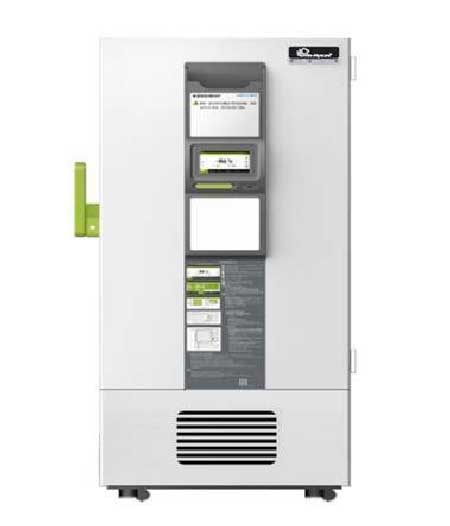
The −60°C figure is why some blood centres hold part of their plasma stock in an ultra low temperature freezer: our ULT range runs from −40°C to −86°C. Continuous monitoring is a condition of that 5-year limit, not an extra.
How fast does plasma need to be frozen?
Fast. The labile clotting factors, Factor V and Factor VIII, are the reason FFP exists, and WHO notes that they “will deteriorate and diminish in quantity if they are not stored at −20°C or lower.”
The rules set the clock:
- Drugs Rules: FFP is plasma frozen within 6 hours of blood collection.
- NACO: separate plasma within 6 to 8 hours of collection and freeze it solid at −30°C or lower “as early as possible.”
- For cryoprecipitate: NACO says plasma should be frozen within 6 hours at −80°C or lower, and the 2020 amendment adds that a −80°C deep freezer “should be used for faster freezing of plasma for preparation of cryoprecipitate.” WHO’s manual says plasma for cryo should be frozen solid “certainly within 30 minutes of separation.”
Quality is checked afterwards. The 2020 amendment sets at least 70 IU of Factor VIII per FFP bag, and NACO sets a minimum of 0.7 IU per ml in at least 90% of units tested.
There is a design lesson here. A storage freezer is built to hold a temperature, not to pull heat out of a batch of warm bags quickly; WHO allows up to 30 hours for a full warm load to drop below −20°C. That is why the rules list a −75°C to −80°C freezer, or a snap freezer, next to the −30°C to −40°C storage unit. Freeze cold and fast, then store.
Can we keep FFP in the fridge?
Frozen FFP, no. A blood bank refrigerator runs at 2–6°C, so the plasma would thaw, and the Factor V and Factor VIII activity that justifies the “fresh frozen” label would start to fall. FFP belongs in the freezer until the moment it is thawed for a patient.
Thawed FFP is a different question, and here India and the US part ways:
- India (NACO): thaw rapidly at 30–37°C in a water bath with shaker; once thawed, use within 6 hours.
- WHO: FFP is thawed at +30°C to +37°C in the blood bank, sent to the ward at ambient temperature, used immediately and never refrozen.
- US (AABB circular): thawed FFP may be held at 1–6°C for 24 hours, and if it was collected in a functionally closed system it can be relabelled “Thawed Plasma” and kept at 1–6°C for up to 4 more days.
Indian blood centres work to the national standard, so treat the 6-hour limit as the rule. The US practice explains why some search results say thawed plasma can be refrigerated for 5 days; that is not the Indian standard.
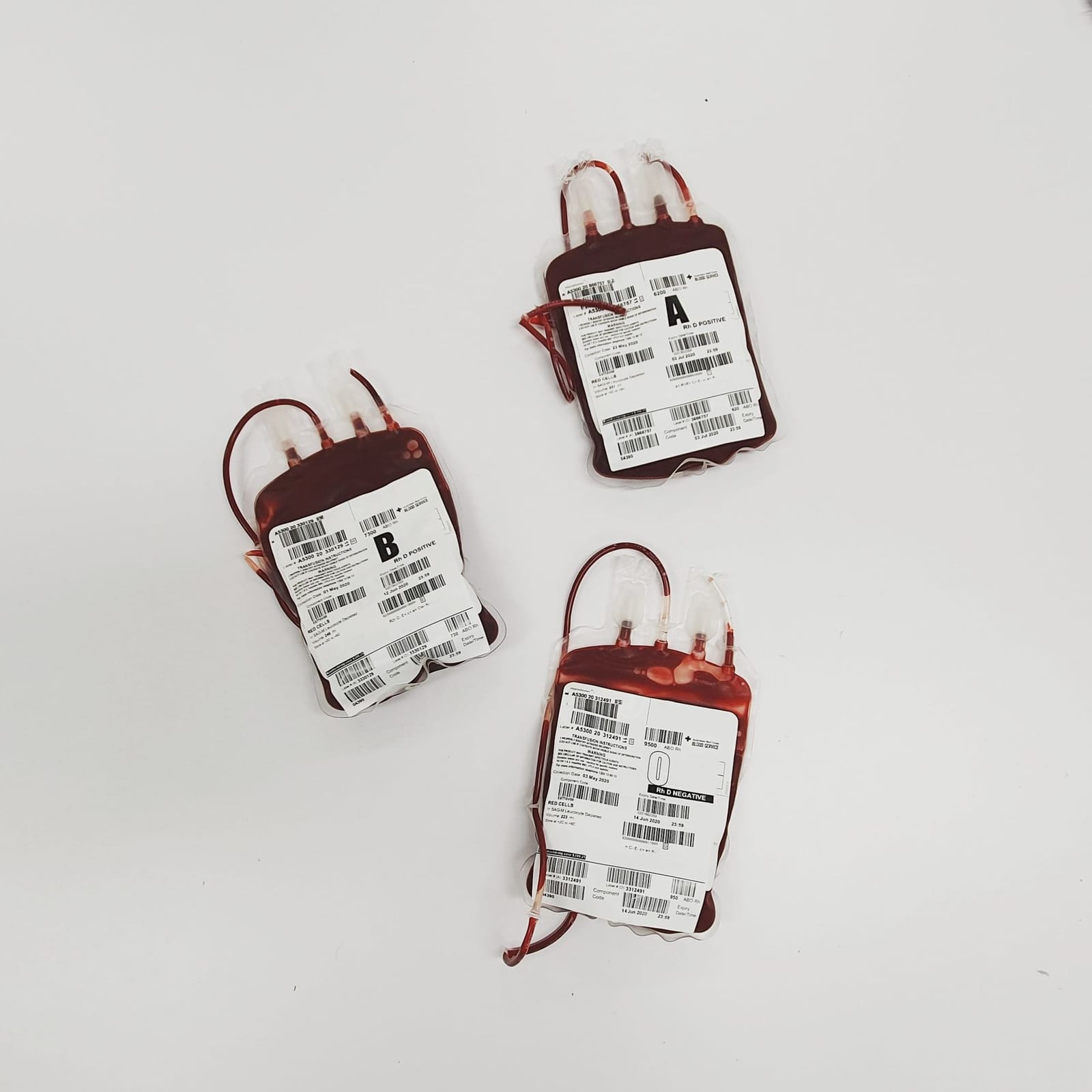
How is cryoprecipitate stored?
Cryoprecipitate is made by thawing FFP slowly at around 4°C. The 2020 amendment allows this “in a cold room or blood bank refrigerator or 4–10°C in a cryobath,” then the cold-insoluble material is separated and refrozen; NACO says within one hour. It is stored at −30°C or colder for up to one year.
After thawing, use it within 6 hours (NACO). Pooled cryoprecipitate made in an open system also has a 6-hour shelf life, while the 2020 quality criteria call for at least 150 mg of fibrinogen and 80 IU of Factor VIII per bag. The same freezer that stores FFP can store cryoprecipitate; the −75°C to −80°C unit earns its place in the freezing step.
What should you look for in a plasma freezer?
Use the rules as the checklist, then add WHO’s performance tests.
- Holds −30°C to −40°C across the whole cabinet, ideally set near −35°C to −40°C.
- Temperature recording facility and an alarm system, as NACO and NABH require.
- Alarm that reaches a staffed area round the clock, plus provision for alternate power.
- Auto-defrost within a safe range so defrost cycles do not warm the plasma above −30°C.
- Rated for your room: WHO tests plasma freezers in ambient temperatures up to +43°C.
- A separate −75°C to −80°C freezer if you prepare cryoprecipitate or want faster freezing.
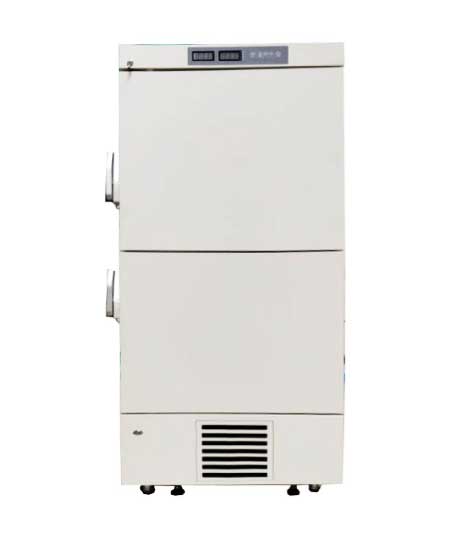
Our WDF-40V528 is a 528-litre upright freezer covering −10°C to −40°C, with microprocessor control, forced-air cooling, auto-defrost, a 0.1°C display, high and low temperature, power failure, door-ajar and sensor-failure alarms, and password protection. It is designed and supplied by WinHyCare to ISO 9001 and ISO 13485 quality standards. Because Indian standards require a temperature recording facility, confirm the recording arrangement for your installation when you ask for a quote. For the −80°C requirement, see our ULT freezer buying guide, and for red cell and platelet storage times, see how long blood can be stored.
Frequently asked questions
What is the temperature range of a plasma freezer?+
For blood centres in India, the Drugs Rules require deep freezers that hold −30°C to −40°C, plus a −75°C to −80°C freezer. WHO's minimum specification for a plasma freezer is an operating temperature of −35°C to −40°C with ±1°C setting accuracy, and WHO recommends a preset alarm at −25°C.
How long can you freeze plasma?+
In India, FFP stored at −30°C or colder keeps for up to one year. NACO allows FFP stored at −60°C or below with continuous monitoring to be used for up to 5 years. WHO's table ranges from 3 months at −20°C to −24°C up to 7 years at −65°C or below. The US FDA allows one year at −18°C or colder.
Can we keep FFP in the fridge?+
Not frozen FFP: a refrigerator would let it thaw, and WHO notes that Factors V and VIII deteriorate unless plasma is kept at −20°C or lower. Thawed FFP is a different case. NACO's standard is to use it within 6 hours of thawing. US rules allow thawed FFP to be held at 1–6°C for 24 hours, but Indian blood centres follow the national standard.
Can thawed FFP be refrozen?+
No. WHO states that thawed FFP and cryoprecipitate must be used immediately and should never be refrozen. AABB's circular gives the same instruction for cryoprecipitate.
Can a −20°C freezer be used to store FFP in India?+
Not as the licensed storage freezer. The Drugs Rules require FFP to be stored at a temperature not warmer than −30°C, and the equipment list specifies deep freezers at −30°C to −40°C. WHO's table shows why: at −20°C to −24°C, FFP keeps for only 3 months.
Sources
- Guidelines for blood bank, merged with G.S.R. 166(E) dated 11.03.2020 (Drugs and Cosmetics Rules, 1945, Schedule F Part XII-B), Central Drugs Standard Control Organisation (CDSCO), Government of India
- Standards for Blood Banks & Blood Transfusion Services (2007), sections E-5, E-6, H-1 and H-3.5, National AIDS Control Organisation (NACO), Ministry of Health & Family Welfare (copy hosted by IAPSM)
- Safe blood and blood products: Manual on the management, maintenance and use of blood cold chain equipment (2005), section 2.1 and Annex 2, World Health Organization
- Accreditation Standards on Blood Banks/Blood Centres and Transfusion Services, 3rd edition (with amendments), National Accreditation Board for Hospitals and Healthcare Providers (NABH)
- Circular of Information for the Use of Human Blood and Blood Components (June 2024), AABB, American Red Cross, America's Blood Centers and Armed Services Blood Program
- 21 CFR 610.53: Dating periods for licensed biological products, US Food and Drug Administration (Electronic Code of Federal Regulations)