Blood Bank Refrigerator Requirements in India: Temperature, Alarms and Records
Blood bank refrigerator requirements in India: 2–6°C storage, alarm, recorder, backup power, records and calibration, per the Drugs Rules, NACO, NABH and WHO.
Published · 9 min read
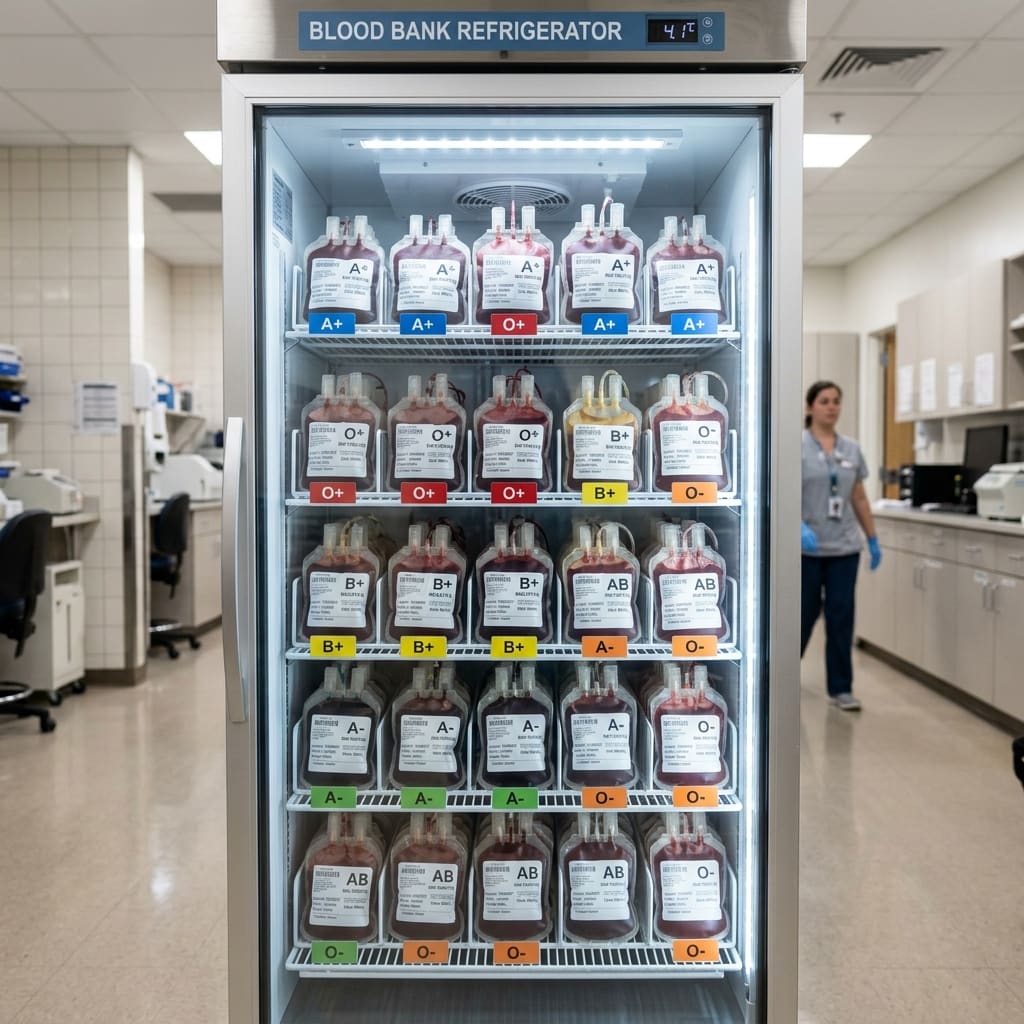
Key facts
- Schedule F, Part XII-B of the Drugs Rules, 1945 requires blood refrigerators that hold 2–6°C, with a digital thermometer, a recording thermograph, an alarm device and provision for continuous power supply.
- NACO's 2007 standards and NABH's blood centre standards both specify 4°C ± 2°C, an alarm system and an alternate power supply.
- Temperature must be monitored continuously or recorded at least every 4 hours (NACO). NABH asks for continuous monitoring with entries at least every 8 hours, or 4-hourly where monitoring is not continuous.
- NABH requires a weekly alarm check, a daily comparison against a thermometer and calibration every six months. Schedule F requires records to be kept for five years.
- WHO's blood cold chain manual recommends fan-forced air circulation, alarm points at +1.5°C and +5.5°C, and battery backup for the alarm and recorder.
A blood bank refrigerator in India must hold whole blood and red cells at 2–6°C, carry a thermometer, a temperature recorder and an alarm, and have a backup power arrangement. Those requirements come from Schedule F, Part XII-B of the Drugs Rules, 1945, which licensed blood centres must meet, and they are repeated in more detail by NACO’s standards and NABH’s accreditation standards. This guide sets out what each document says, where they differ, and how to turn them into a purchase specification.
Which rules apply
Four documents shape what a blood bank refrigerator has to do in India:
| Document | Status | What it covers |
|---|---|---|
| Drugs Rules, 1945, Schedule F Part XII-B | Legal requirement for licensed blood centres | Equipment list, storage temperatures, shelf life, records |
| NACO Standards for Blood Banks & Blood Transfusion Services (2007) | National technical standard | Storage temperatures, monitoring frequency, alarms, validation |
| NABH Accreditation Standards for Blood Centres (3rd edition) | Voluntary accreditation | Monitoring, alarm checks, calibration intervals |
| WHO blood cold chain equipment manual (2005) | International technical reference | Equipment design and performance |
Part XII-B is titled “Requirements for the functioning and operation of a blood bank and/or for preparation of blood components” (Drugs Rules, p. 347). Since G.S.R. 166(E) of 11 March 2020 the rules use the term “blood centre” in place of “blood bank” in Part X-B, although the Schedule F heading in CDSCO’s consolidated copy still reads “blood bank” (Drugs Rules, p. 833).
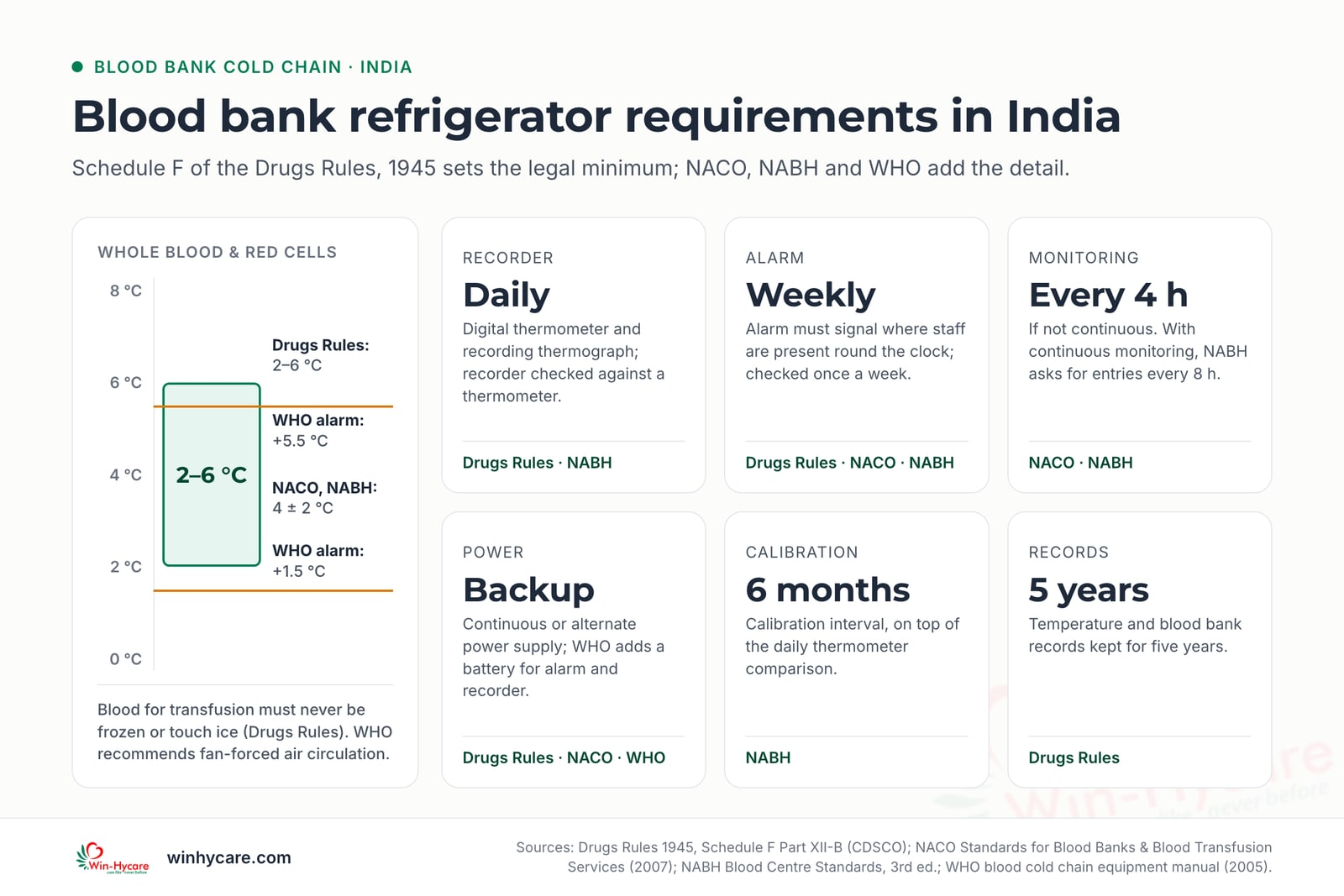
Storage temperature: 2–6°C
Schedule F requires “refrigerators, for storing separately tested and untested blood, maintaining temperature between 2 to 6 degree centigrade with digital dial thermometer, recording thermograph and alarm device, with provision for continuous power supply” (Drugs Rules, Sch. F XII-B I.1(v), p. 358). Component preparation units need a refrigerator with the same features (p. 369).
The documents express the band in slightly different ways:
| Source | Whole blood / red cell storage |
|---|---|
| Drugs Rules, Schedule F Part XII-B | 2–6°C |
| Drugs Rules, Schedule P (whole blood shelf life table) | 4–6°C |
| NACO Standards (2007), H-1.3 | 4°C ± 2°C |
| NABH Standards, 6.4.1 | 4°C ± 2°C |
| Drugs Rules, Schedule K 5B (licence-exempt storage centres at FRUs, CHCs, PHCs) | 2–8°C |
| US 21 CFR 640.11 and the AABB Circular of Information | 1–6°C |
Sources: Drugs Rules pp. 358, 523–524, 685; NACO p. 53; NABH p. 32; 21 CFR 640.11; AABB Circular.
For a licensed blood centre, a refrigerator that controls around 4°C and alarms before it leaves 2–6°C satisfies every Indian document at once. Two further rules matter for cabinet design: “The blood intended for transfusion shall not be frozen at any stage”, and “Blood containers shall not come directly in contact with ice at any stage” (Drugs Rules, pp. 362–363). Cold spots near the evaporator are a real risk in refrigerators without forced-air circulation.
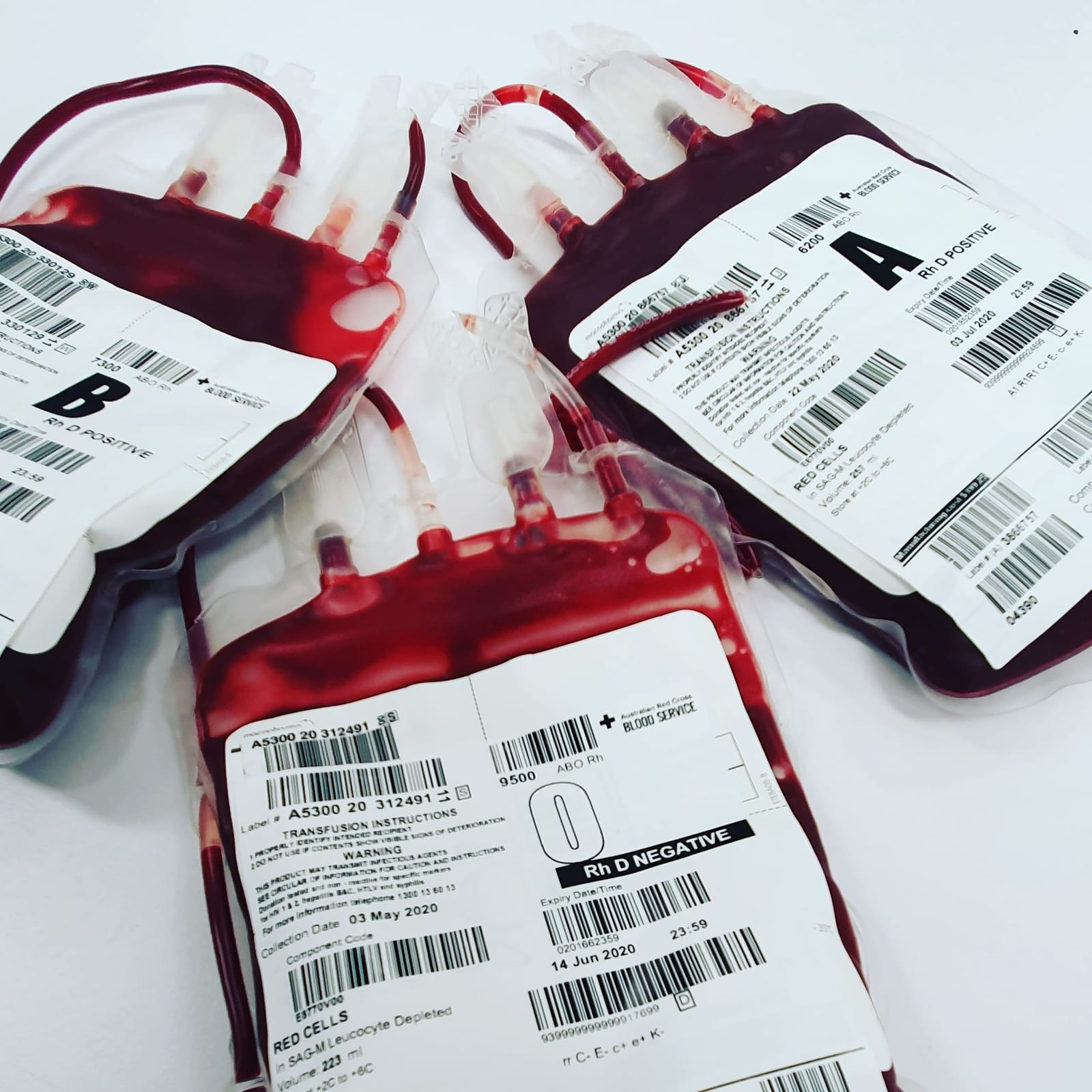
Storage temperature and shelf life by blood component
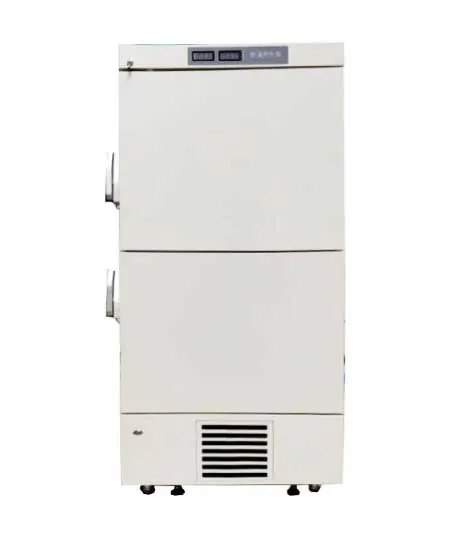
A blood centre needs more than a refrigerator. Schedule F lists, for component units, a “platelet agitator with incubator (wherever necessary)” and “deep freezers maintaining a temperature between minus 30 degree centigrade to minus 40 degree centigrade and minus 75 degree centigrade to minus 80 degree centigrade” (Drugs Rules, p. 369).
| Component | Storage temperature | Maximum storage (Drugs Rules) | Equipment |
|---|---|---|---|
| Whole blood | 2–6°C | 21 days (ACD), 35 days (CPDA) | Blood bank refrigerator |
| Packed red cells | 2–6°C | Up to 42 days in additive solutions such as SAGM | Blood bank refrigerator |
| Platelets | 20–24°C, continuous gentle agitation | 5 days | Platelet incubator with agitator |
| Fresh frozen plasma | -30°C or colder | 1 year | -40°C plasma freezer |
| Cryoprecipitate | -30°C or colder | 1 year | -40°C plasma freezer |
| Frozen red cells | -65°C or colder | Not stated in this table | -86°C ULT freezer |
Source: Drugs Rules, pp. 359, 370–374, 685.
NACO allows longer FFP storage at colder temperatures: “If FFP is stored at -60°C or below with continuous monitoring it should be used up to 5 years” (NACO, H-3.5.2, p. 56). For platelets, NACO gives 3 days in a closed system, extendable to 5 days with special bags; our platelet storage guide covers that in detail.
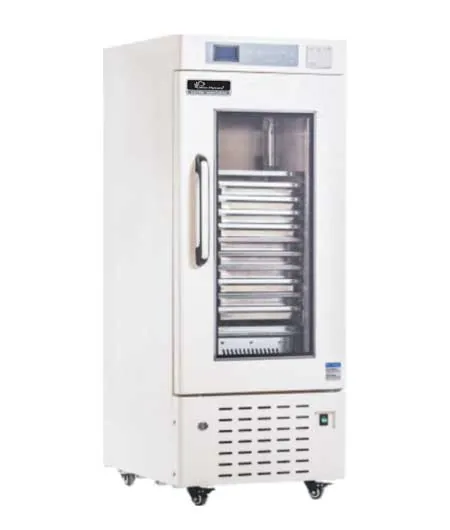
Alarm requirements
All the Indian documents require an alarm. They differ in how much detail they give.
- Drugs Rules: an “alarm device” on blood storage refrigerators, with no set points or alarm types specified (p. 358).
- NACO: “An alarm system and a provision for alternate power supply should be available,” and the alarm of all storage equipment “should signal in an area that has adequate personnel coverage round the clock to ensure immediate corrective action” (NACO H-1.3 and H-1.6, pp. 53–54).
- NABH: the same alarm and backup power requirement, plus “The performance of alarms for the set temperature of the equipment shall be checked once a week” (NABH 6.4.1, p. 32).
- WHO: alarm points at +1.5°C and +5.5°C, so staff can act before blood leaves 2–6°C. The alarm probe should measure “a liquid with the same viscosity as blood, e.g. 10% glycerol”, and alarm probes “should be checked at least every three months” (WHO manual, §3.3 and §4.5, pp. 19, 34).
WHO’s list of ideal features adds audiovisual alarms for temperature out of range, door ajar and power failure, with battery backup (§3.2, p. 17).
Temperature recording, calibration and records
Schedule F requires a recording thermograph and a digital thermometer, and its calibration table says the temperature recorder must be compared against a thermometer daily (Drugs Rules, p. 351). Records must be kept “for a period of five years” (p. 364).
| Requirement | NACO (2007) | NABH (3rd ed.) |
|---|---|---|
| Monitoring | Continuous, or recorded at least every 4 hours | Continuous, with entries at least every 8 hours; 4-hourly if not continuous |
| Thermometer comparison | Daily temperature records kept | Daily, against a calibrated thermometer |
| Calibration | Validation at installation and at intervals; AMC with preventive maintenance and calibration | Every 6 months |
Sources: NACO pp. 53, 92, 107; NABH 4.6.3 and Annexure H, pp. 15, 85.
WHO notes that where a refrigerator has no continuous recording thermograph, “the temperature must be recorded, preferably on a chart or in a record book, along with the date and time” (§4.4, p. 33). A built-in recorder or printer reduces that manual work but does not replace the daily check against a reference thermometer.
Power backup
Schedule F asks for “provision for continuous power supply”; NACO and NABH ask for “a provision for alternate power supply” (Drugs Rules p. 358; NACO p. 53). NACO also requires an alternate storage facility and written instructions for power or equipment failure (H-1.6). WHO describes a rechargeable battery or generator-backed circuit for the alarm as essential (§4.5, p. 34).
In practice this means two layers: a generator or UPS-backed circuit that keeps the compressor running, and a battery inside the refrigerator that keeps the display and alarm alive if that circuit also fails.
WHO minimum performance specification
WHO’s specification for a standard electric blood bank refrigerator (BTS/RF.1) is a useful benchmark when comparing quotations (Annex 2, p. 87):
- electronic temperature control, +2°C to +6°C, setting accuracy ±1°C whatever the load;
- fan air cooling;
- performance in ambient temperatures of +10°C to +43°C;
- hold-over: a full load at +4°C takes at least 30 minutes to rise above +6°C (tested at +43°C ambient);
- a temperature recording device, visual and audible alarms, and battery backup for both;
- a facility for a remote alarm contact.
Checklist: specifying a blood bank refrigerator
| Requirement | Basis | WinHyCare WBC-4V models |
|---|---|---|
| 2–6°C storage | Drugs Rules, NACO, NABH | 4 ± 1°C control |
| Digital thermometer | Drugs Rules | Digital display, 0.1°C resolution |
| Recording thermograph | Drugs Rules | Built-in printer for temperature records |
| Alarm device | Drugs Rules, NACO, NABH | High/low temperature, sensor error, power failure, door ajar, low battery |
| Uniform temperature | WHO | Forced-air cooling with automatic defrost |
| Backup for alarm | WHO, NACO | 72-hour battery for display and alarms |
| Remote alarm contact | WHO (BTS/RF.1) | Confirm with us per model |
The four WBC-4V blood bank refrigerators share the same control and alarm system:
| Model | Capacity | Blood bags (450 ml) | Control |
|---|---|---|---|
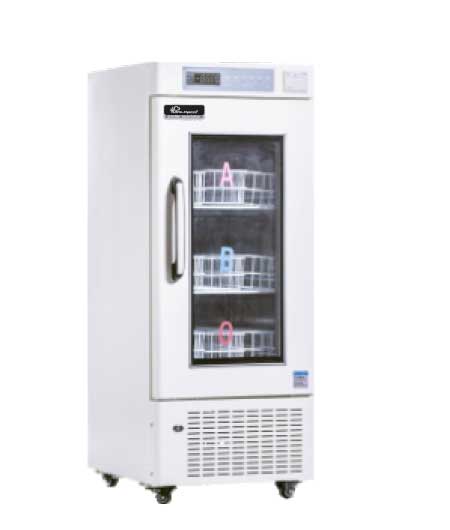 | 108L | 66 | 4 ± 1°C |
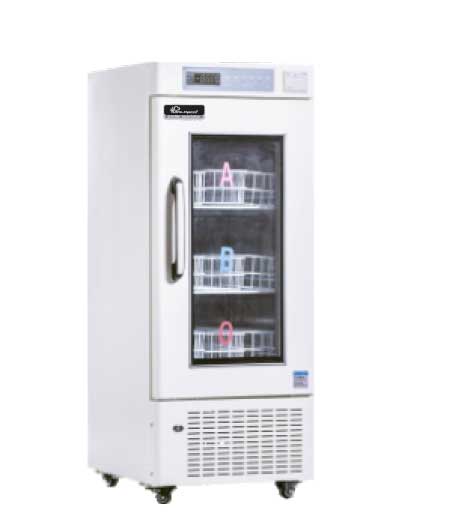 | 208L | On request | 4 ± 1°C |
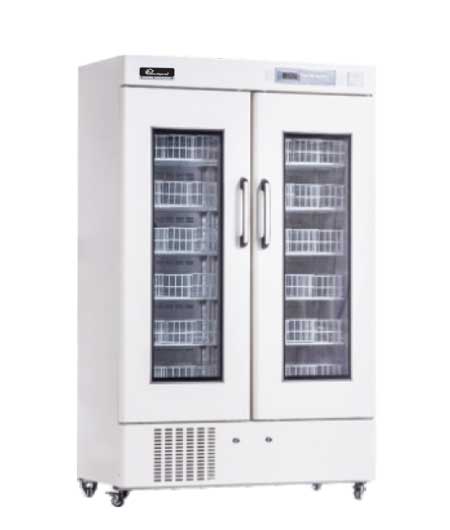 | 658L | On request | 4 ± 1°C |
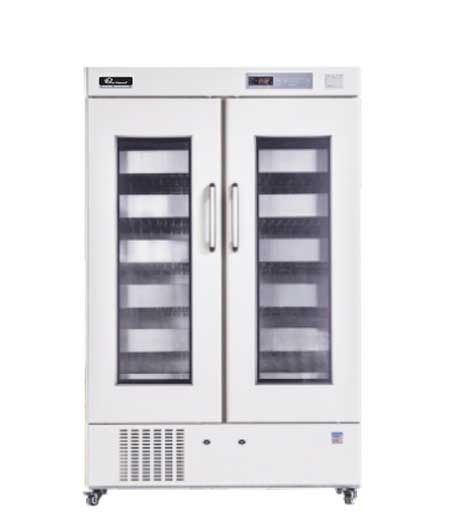 | 1008L | On request | 4 ± 1°C |
They are certified to ISO 9001/13485/14001 standards and designed to meet NABH/NBTC requirements. The battery covers the display and alarms, not the compressor, so connect the cabinet to a generator or UPS-backed supply as NACO and NABH require.
Transport between sites
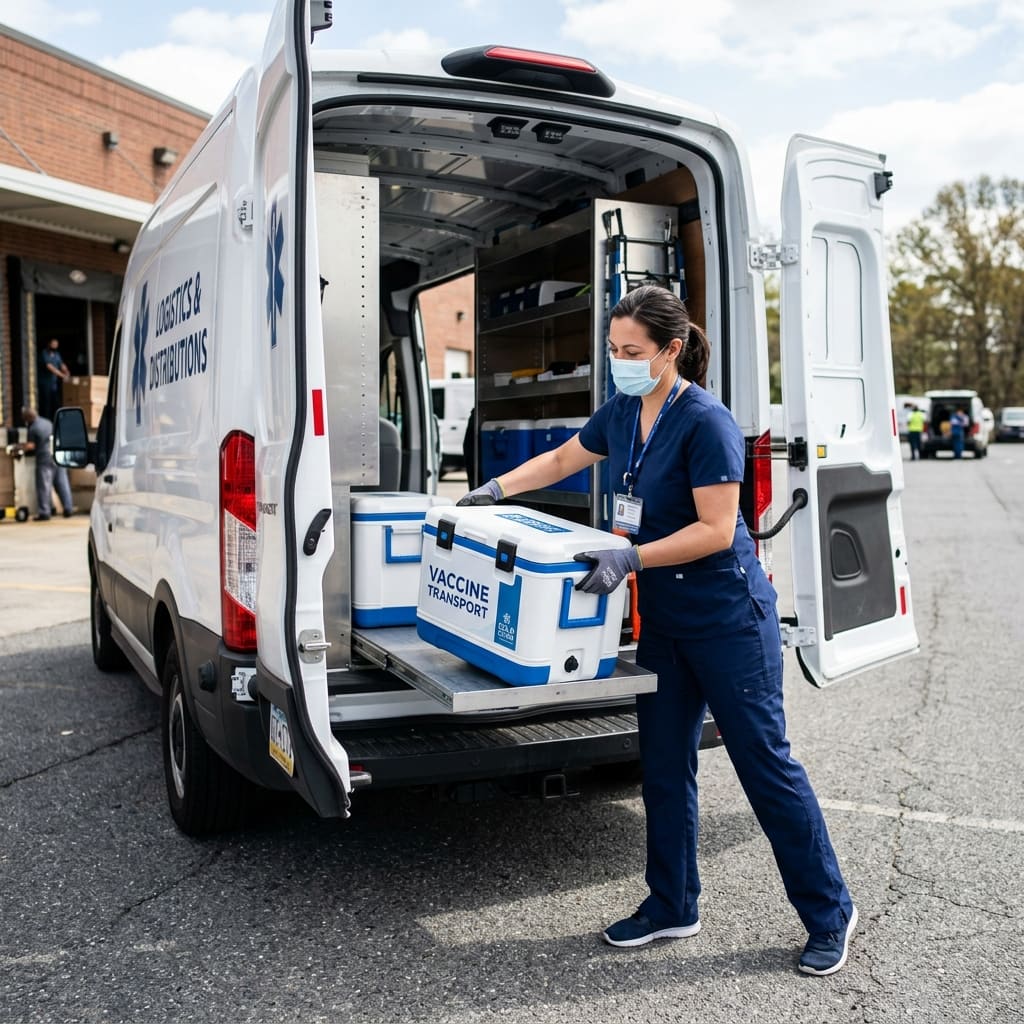
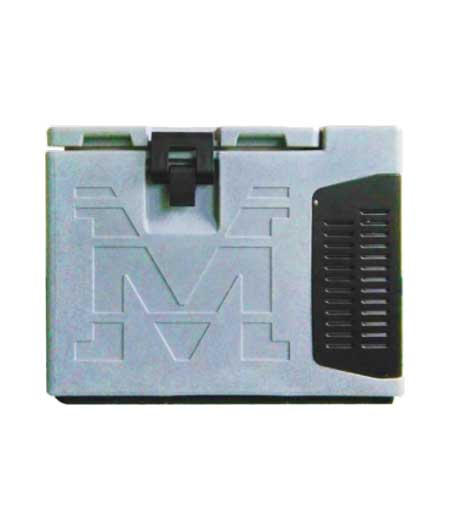
Schedule F specifies “insulated containers for transporting blood, between 2 degree centigrade to 10 degree centigrade temperatures, to wards and hospitals” (Drugs Rules, p. 361), and NACO sets a maximum of 10°C ± 2°C for whole blood and red cells in transit (H-2.0, p. 54). For longer journeys, a powered blood transport box with a 2–8°C mode holds that range from vehicle power.
Frequently asked questions
What temperature should a blood bank refrigerator maintain in India?+
2–6°C. Schedule F Part XII-B of the Drugs Rules, 1945 specifies refrigerators maintaining 2 to 6 degrees centigrade for whole blood, and NACO and NABH express the same band as 4°C ± 2°C.
Is an alarm mandatory on a blood bank refrigerator?+
Yes. Schedule F requires an alarm device on blood storage refrigerators, and NACO and NABH require an alarm system that signals in an area staffed round the clock. NABH also requires the alarm to be checked once a week.
How often must blood bank refrigerator temperature be recorded?+
NACO requires continuous monitoring or a recording at least every 4 hours. NABH requires continuous monitoring with entries at least every 8 hours, or 4-hourly recording where monitoring is not continuous.
Can a domestic refrigerator be used to store blood?+
No. The rules call for a refrigerator holding 2–6°C with a thermometer, recording thermograph, alarm and continuous power provision, and WHO recommends fan-forced air circulation. Domestic refrigerators are not built to these requirements.
What temperature is used for transporting blood?+
Schedule F specifies insulated containers holding 2–10°C for transport to wards and hospitals. NACO says whole blood and red cells should be transported at a maximum of 10°C ± 2°C.
Sources
- Drugs Rules, 1945 (formerly Drugs and Cosmetics Rules), consolidated copy: Schedule F Part XII-B, Schedule K, Schedule P, Central Drugs Standard Control Organisation (CDSCO), MoHFW
- Guidelines for blood bank, merged with G.S.R. 166(E) dated 11.03.2020, CDSCO
- Standards for Blood Banks & Blood Transfusion Services (2007), copy hosted by IAPSM, National AIDS Control Organisation (NACO), MoHFW
- Accreditation Standards on Blood Banks/Blood Centres and Transfusion Services, 3rd edition with amendment, National Accreditation Board for Hospitals & Healthcare Providers (NABH)
- Manual on the management, maintenance and use of blood cold chain equipment (2005), World Health Organization
- 21 CFR 640.11 Red Blood Cells: general requirements, US Food and Drug Administration (eCFR)
- Circular of Information for the Use of Human Blood and Blood Components, AABB, American Red Cross, America's Blood Centers, Armed Services Blood Program