Shipping peptides in the cold chain: packaging, dry-ice rules, receiving checks, excursions and long-term storage
Shipping peptides: lyophilized vs solution, gel packs, dry ice, data loggers, IATA dry-ice rules, receiving checks, excursions and −80 °C storage.
- Written by
- Kareem Ahmed BashaDirector & Chief Scientific Officer
- Reviewed by
- Nisar MohammedFounder & Managing Director
Published · Updated · 14 min read · 16 references
On this page
Short answer
Peptides should travel at the condition their stability data supports. Lyophilized peptides are often shipped cool or, where data allows, at ambient temperature with a data logger; peptide solutions usually travel frozen on dry ice. Air shipments with dry ice fall under IATA rules as UN 1845, Class 9, and every arrival should be checked against the logger before storage.
Key facts
- EMA notes that peptides are generally stored refrigerated (5 °C ± 3 °C) or frozen (−20 °C ± 5 °C), and expects data at higher temperatures to cover short-term excursions such as shipping.
- For a freezer-stored drug substance, ICH Q1A(R2) has no accelerated condition; instead it asks for a single-batch study at an elevated temperature, such as 5 °C or 25 °C, to address excursions during shipping or handling.
- Dry ice is UN 1845, Class 9, packed under IATA Packing Instruction 954. The package must vent carbon dioxide, and the net weight of dry ice must be marked on it.
- Common rubber stoppers have a glass transition between about −55 °C and −65 °C; below it they lose elasticity, so vials shipped on dry ice can leak transiently.
- WHO model guidance asks receivers to check logger status and delays on arrival, store goods at the right temperature immediately, and quarantine anything with an unacceptable excursion until it has been evaluated.
- Freezers used for storage should have calibrated, continuously recording sensors, alarms and a power-failure plan; WHO lists dry ice or liquid nitrogen as acceptable emergency cooling.
Shipping is the least controlled part of a peptide’s life. In a freezer it sits at a known temperature with an alarm watching it; in a courier network it spends hours or days in vans, sorting hubs and aircraft holds that nobody in the laboratory can see. The aim of a cold chain is not to make every parcel as cold as possible, but to keep the material inside the range its stability data supports, and to be able to prove that it stayed there.
This guide covers how lyophilized and dissolved peptides differ in transit, how to choose packaging and coolant, the air-transport rules for dry ice, what to check when a box arrives, how to judge a temperature excursion, and how to store material for the long term at −20 °C or −80 °C. The retest dates and ICH storage conditions behind all of this are explained in lyophilized peptide stability and storage; this page is about the journey and the freezer at the end of it.
Do peptides need to be refrigerated?
For storage, usually yes. EMA’s 2025 guideline on synthetic peptides states that “generally, to prevent or minimise degradation, peptides are stored under refrigerated (5°C ± 3°C) or frozen conditions (-20°C ± 5°C)” [1]. The same sentence continues: “the use of higher temperatures/humidities are also expected to address short term excursions” [1]. In other words, a regulator expects the manufacturer to know what happens when the peptide leaves the fridge for a while, and transport is exactly that situation.
The deciding factor is the form of the material:
- Lyophilized (dry) peptides degrade slowly but not at zero rate. Solid-state deamidation, peptide bond cleavage, oxidation and aggregation continue, influenced by “temperature, moisture content, excipients, and the physical state of the formulation” [14].
- Peptide solutions degrade faster and add the risks that come with freezing: freeze-concentration, ice formation and pH shifts [11] [13].
Can peptides be shipped at room temperature?
A lyophilized peptide can be shipped at ambient temperature when, and only when, data shows it tolerates the time and temperature of the journey. The regulatory logic is explicit. For a drug substance stored in a freezer, ICH Q1A(R2) has no accelerated study; instead, “testing on a single batch at an elevated temperature (e.g., 5°C ± 3°C or 25°C ± 2°C) for an appropriate time period should be conducted to address the effect of short term excursions outside the proposed label storage condition, e.g., during shipping or handling” [2]. WHO’s model guidance says the same thing from the logistics side: “Product stability data must demonstrate the acceptable temperature excursion time during transport” [3].
Why moisture and heat matter together: water lowers the glass transition temperature of a dried solid and speeds its chemistry. In a lyophilized monoclonal antibody (a protein, used here because the data set is unusually clear), the glass transition fell from 80 °C at 1% moisture to 25 °C at 8% moisture, and higher moisture reduced chemical stability; all formulations were stable at 5 °C [15]. A dry, tightly sealed peptide cake on a warm day is a very different risk from a cake that has picked up water.
Practical answer: ask the supplier for its excursion data or shipping qualification. If none exists, ship at the labelled condition with a logger. Do not ship peptide solutions at ambient temperature without specific data.
Lyophilized vs solution: how should each be shipped?
| Lyophilized peptide | Peptide solution (stock or aliquots) | |
|---|---|---|
| Typical shipping condition | Labelled condition (refrigerated or frozen), or ambient/cool where excursion data supports it [2] | Frozen, commonly on dry ice |
| Main transit risks | Heat; moisture uptake by often hygroscopic powders, through a compromised closure or condensation when opened cold [1] | Thawing and refreezing; freeze-concentration; pH shift in some buffers [11] [13] |
| Physical risks | Cake breaking up from vibration (usually cosmetic) | Agitation and air-liquid interfaces if thawed; agitation and air-water interfaces are reviewed factors in peptide aggregation [16] |
| Closure risk | Low at refrigerated temperatures | Rubber stoppers become brittle below their glass transition; transient leaks possible on dry ice [9] |
| Coolant | Gel packs or phase change materials conditioned to the target range | Dry ice, or frozen phase change materials for −20 °C |
| What to send with it | Temperature logger; certificate of analysis | Temperature logger; aliquot map; buffer composition |
Why freezing is a stress, not a pause
It is tempting to treat a frozen solution as safely paused. The literature disagrees. Bhatnagar and colleagues identify “low temperature, freeze-concentration, and ice formation” as the chief stresses during freezing, with freeze-concentration able to cause buffer crystallisation, phase separation and faster reactions [11]. Authelin and colleagues conclude that frozen-state stability “should not be taken for granted” and can depend on sample size, through its effect on freezing kinetics [12]. Buffers can move a long way: sodium phosphate at an initial pH of 7.4 reached pH 4.2 ± 0.1 at −10 °C at 50 and 100 mM in Gómez and colleagues’ measurements [13].
Each thaw in transit repeats those stresses. Shipping solutions as single-use aliquots, in a buffer that does not crystallise on freezing, limits the damage if something goes wrong.
Container closure at dry-ice temperatures
Vials and stoppers were designed for room temperature. Nieto and colleagues report that “the glass transition temperature (Tg) of commonly used rubber stoppers is between -55 and -65 °C”, that below it stoppers “lose their elastic properties and become brittle”, and that leaks during frozen storage and transport “are likely to be transient” and may reseal after thawing, so room-temperature integrity tests can miss them [9]. Victor and colleagues, developing a test method for vials stored at −80 °C, used carbon dioxide ingress into the headspace as the leak indicator [10], which is a reminder that the gas around a vial on dry ice is carbon dioxide.
EU GMP Annex 1 requires that container closure integrity validation “take into consideration any transportation or shipping requirements that may negatively impact the integrity of the container (e.g. by decompression or extreme temperatures)” [8]. For research material, the practical consequences are to ship lyophilized vials refrigerated rather than on dry ice unless frozen shipment is really needed, and to seal solution tubes or vials in a secondary bag inside the box.
What packaging is used to ship peptides?
WHO describes the options as passive systems, which “maintain a temperature-controlled environment inside an insulated enclosure… using a finite amount of pre-conditioned coolant in the form of chilled or frozen gel packs, phase change materials, dry ice or others”, and active, powered containers [3].
| Target condition | Typical system | Notes |
|---|---|---|
| Ambient or controlled room temperature | Insulated box, sometimes with conditioned packs to buffer heat and cold | Only with excursion data [2] |
| Refrigerated (2–8 °C) | Insulated box with conditioned gel packs or phase change materials | Freeze-sensitive items must be protected from frozen packs [3] |
| Frozen (around −20 °C) | Insulated box with frozen phase change materials, or dry ice with spacers | Choose by route length and season |
| Deep frozen | Dry ice in a vented insulated box | Dry ice sublimes at about −109 °F (around −78 °C) [7] |
Whatever is used, WHO’s guidance is to qualify the packaging system, “including any and all necessary ancillary packaging such as temperature stabilizing medium, dry ice, ice or gel packs… phase change materials, partitions, bubble wrap and dunnage”, for the route and “the anticipated ambient temperature profile over the duration of transport” [3]. The same section asks for “the correct placement of temperature monitors” [3].
Data loggers and indicators
WHO’s model guidance says to “use chemical or electronic freeze indicators, electronic loggers (with or without alarms) and/or other suitable indicators to monitor temperature and/or humidity exposure”, preferably for external distribution too, and to “monitor and document indicator status upon arrival” [3]. A logger turns an argument about what happened in transit into a comparison between a trace and a specification. For a frozen or refrigerated shipment, a logger with a probe placed next to the product, started before packing, is the single most useful item in the box.
IATA and ICAO rules for shipping dry ice
Dry ice is regulated as a dangerous good in air transport because it releases carbon dioxide gas as it sublimes. The international rules are set in the ICAO Technical Instructions; IATA describes its Dangerous Goods Regulations as the “field manual” version of them, with airline requirements that are somewhat stricter [5]. The full texts are sold by those bodies, so always check the current edition and your carrier’s variations. The core requirements, from IATA’s own conformity-check job aid and the matching US regulation, are:
| Requirement | Detail | Source |
|---|---|---|
| Identification | UN 1845, “Carbon dioxide, solid” or “Dry Ice”, Class 9 | [4] |
| Packing instruction | IATA PI 954 | [4] |
| Venting | Packagings “designed and constructed to permit the release of carbon dioxide gas to prevent a buildup of pressure that could rupture the packagings” | [6] |
| Package marks | UN number and proper shipping name; net weight of dry ice on each package; full name and address of shipper and consignee | [4] |
| Label | Class 9 hazard label, minimum 100 × 100 mm | [4] |
| Air waybill | ”Nature and Quantity of Goods” shows UN 1845, the proper shipping name, the number of packages and the net weight of dry ice per package | [4] |
| Shipper’s Declaration | Not required when dry ice is the only dangerous good (IATA lists UN 1845 among shipments that do not need one) | [4] |
| Operator arrangements | ”The shipper must make arrangements with the operator for each shipment” (US rule for aircraft) | [6] |
| Overpacks | Total net weight of dry ice marked on each overpack | [4] |
The US regulation adds an exception for small quantities: dry ice of not more than 2.5 kg (5.5 lb) per package, used as a refrigerant, is excepted from all other requirements of the US hazardous materials regulations if the package vents and is marked “Carbon dioxide, solid” or “Dry ice”, with the name of the contents being cooled and the net weight of the dry ice (or that it is 2.5 kg or less) [6]. Air carriers apply their own rules on top of this, so confirm with the carrier before relying on it.
Dry-ice safety at the receiving end
Carbon dioxide is colourless and odourless. NIOSH sets a recommended exposure limit of 5,000 ppm (time-weighted average) with a short-term limit of 30,000 ppm, and an immediately-dangerous-to-life-or-health concentration of 40,000 ppm [7]. Open dry-ice shipments in a ventilated area, never seal dry ice in an airtight container, and do not leave sublimating dry ice in a walk-in cold room or small unventilated store. Use insulated gloves: NIOSH lists frostbite as a hazard of skin or eye contact with dry ice [7].
Receiving SOP: what to check when peptides arrive
WHO’s model guidance lists the arrival checks for temperature-sensitive products, including examining containers “for tampering, damage or contamination”, recording “delays encountered during transport”, the “status of any attached temperature recording device(s) and/or time/temperature indicators”, and verifying that “required storage and transport conditions have been maintained” [3]. Goods should then be stored “under the correct temperature and security regime immediately upon receipt”, and products “that experienced unacceptable temperature excursions during transport” should be quarantined and not released “until checks have been completed satisfactorily” [3].
A laboratory version of that procedure:
- Before arrival: confirm the expected ship date, coolant and storage condition; make freezer or fridge space.
- On arrival: log date and time of receipt; note any courier delay.
- Outer box: check for damage, crushing, wet patches or tampering; for dry ice, check that some dry ice remains.
- Logger: stop it, download or read it, and save the trace with the receiving record. Check that it was placed with the product, not on the lid.
- Contents: check identity, lot number and quantity against the order and the certificate of analysis; check closures and seals.
- Appearance: for lyophilized vials, note the cake; for frozen solutions, confirm they are still solid.
- Store immediately at the labelled condition. Do not open cold vials: let them reach room temperature first when you later need them, because peptide powders “are often very hygroscopic” [1].
- If anything is out of range: label the material “quarantine”, store it at the labelled condition, and start an excursion assessment.
How to assess a temperature excursion
WHO defines an excursion as an event in which a product “is exposed to temperatures outside the range(s) prescribed for storage and/or transport” [3], and asks that “all unacceptable temperature excursions should be evaluated to determine their effect on the product” [3]. A practical assessment has four steps.
1. Characterise the excursion from the logger. Record the maximum (or minimum) temperature, total time outside range, and number of events. To summarise a fluctuating trace, mean kinetic temperature (MKT) is a single derived temperature that “affords the same thermal challenge” as the actual profile; ICH Q1A(R2) notes it “is higher than the arithmetic mean temperature and takes into account the Arrhenius equation” [2].
2. Compare with the excursion data. The relevant evidence is the supplier’s elevated-temperature study for that material [2] [1]. An excursion inside the time and temperature the data covers is usually acceptable; one outside it is not automatically a failure, but it needs testing.
3. Consider the form and the failure mode.
| Situation | Main concern | Typical decision |
|---|---|---|
| Lyophilized, short warm excursion within supplier data | Minimal | Release from quarantine; record |
| Lyophilized, long or hot excursion beyond data | Solid-state degradation, faster with moisture [14] [15] | Test purity and related substances (HPLC) and water content before use |
| Lyophilized, frozen in transit when labelled refrigerated | Usually low for a dry cake; check the closure | Inspect; release if closure intact and data supports it |
| Solution, thawed and refrozen | Freeze-thaw stresses, pH shift [11] [13] | Test by HPLC (purity, aggregates) before use, or discard |
| Solution, arrived liquid and warm | Chemical degradation and aggregation [16] | Discard unless data says otherwise |
| No logger in the box | Unknown exposure | Ask the supplier for its packaging qualification; test if the work is critical |
4. Document and decide. Record the trace, the comparison, any test results and the decision. If the material came from a supplier, report the excursion; a recurring pattern on one lane is a packaging or route problem to fix, not a series of one-off events.
Long-term peptide storage at −20 °C and −80 °C
Once the material is home, the freezer becomes the cold chain. ICH Q1A(R2) defines −20 °C ± 5 °C as the long-term condition for drug substances stored in a freezer and says storage “below -20°C should be treated on a case-by-case basis” [2]. Colder storage, such as −80 °C, is a reasonable choice for reconstituted aliquots and reserve material, but the right condition for a given lot is the one its data supports.
WHO’s model guidance sets out what the freezer itself should offer. Refrigerators and freezers should be purpose-designed for temperature-sensitive products, “capable of maintaining the temperature range specified by the… manufacturer over the full annual ambient temperature range”, “equipped with calibrated temperature monitoring devices… preferably capable of continuous recording”, and “preferably equipped with alarms to indicate temperature excursions and/or refrigeration failure” [3]. Monitoring sensors should be accurate to ”± 0.5 °C or better” for electronic devices, and records should be checked “at least twice a day” [3]. Sites should also have a power-failure contingency plan; WHO notes that “alternative emergency cooling systems (e.g. liquid nitrogen or dry ice) are acceptable” [3].
Good freezer practice for peptide stocks:
- Map where the warm and cold spots are and keep critical material away from the door.
- Keep an inventory so the door is open for seconds, not minutes.
- Store aliquots in labelled boxes by lot, with the receiving record and certificate filed alongside.
- Test the alarm and the call-out chain, not just the display.
- Keep a written plan for moving stock if a freezer fails, including where the dry ice comes from.
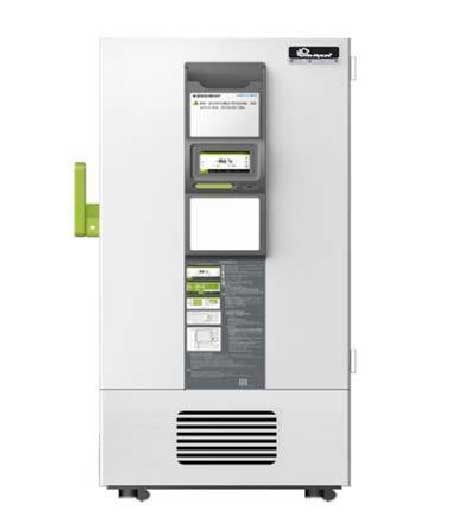
Winhycare’s medical freezer range
WinHyCare designs and supplies medical refrigeration for laboratories, hospitals and blood centres across India, which is why cold chain is home ground for us:
- Ultra-low temperature freezers from −40 °C to −86 °C, in cascade, self-cascade and dual-system designs. Dual-system models hold the chamber at −70 °C if one refrigeration system fails. The range also includes a −150 °C cryogenic chest freezer.
- Biomedical freezers from −10 °C to −40 °C for reagents, plasma and biological materials.
- Pharmacy and vaccine refrigerators for 2–8 °C storage.
- Mobile coolers rated from −25 °C to 30 °C, with AC/DC power for transport in vehicles.
For help choosing a freezer, read our ULT freezer buying guide or see laboratory cold storage and vaccine cold chain solutions.
How Winhycare Pharma ships peptides
Winhycare Pharma supplies research-use-only peptides (purity ≥99%, as stated in our brochure) and peptide APIs for licensed manufacturers, with custom synthesis and lyophilisation and vial filling available. See research peptides and peptide APIs, or send a research peptide enquiry.
For laboratory research use only. Not for human or veterinary use.
Frequently asked questions
Do peptides need to be refrigerated?+
Most do, at least for storage. EMA notes that peptides are generally stored refrigerated (5 °C ± 3 °C) or frozen (−20 °C ± 5 °C). The exact condition is the one on the label or certificate, which comes from the material's own stability data. Peptide solutions are almost always less stable than the dry powder and are normally kept frozen.
Can peptides be shipped at room temperature?+
Lyophilized peptides sometimes can, but only when stability data covers the expected time and temperature in transit. ICH Q1A(R2) asks for excursion data for exactly this purpose. Without that data, ship at the labelled condition, with a temperature logger. Peptide solutions should not be shipped at room temperature without specific data.
Should peptides be shipped with dry ice or gel packs?+
It depends on the storage condition. Gel packs or phase change materials suit refrigerated or cool shipments of lyophilized material; dry ice suits frozen solutions or anything that must stay well below −20 °C. Whatever the coolant, the packaging system should be qualified for the route and season.
What are the rules for shipping dry ice by air?+
Dry ice is UN 1845, Class 9, packed under IATA Packing Instruction 954. The packaging must let carbon dioxide gas escape, the package needs a Class 9 label, the UN number and proper shipping name, the net weight of dry ice and the shipper and consignee details, and the air waybill must state the dry ice. A Shipper's Declaration is not needed when dry ice is the only dangerous good.
What happens to a peptide if it gets warm during shipping?+
Usually nothing measurable for a short, mild excursion of a dry powder, but that is a conclusion to reach from data, not to assume. Heat and moisture speed solid-state deamidation, oxidation and aggregation. Compare the logger trace with the supplier's excursion data and quarantine the material until the comparison is done.
Is a warm ice pack a sign the peptide is ruined?+
No. A thawed gel pack only shows the coolant was used up; it does not show how warm the product became or for how long. The temperature logger is the evidence. If there is no logger, ask the supplier what its packaging was qualified to hold and for how long.
Can I refreeze a peptide solution that thawed in transit?+
Treat it as an excursion. Each freeze-thaw cycle repeats the stresses of freezing, including freeze-concentration and possible pH shifts, so the material should be quarantined and checked, for example by HPLC, before use. Ship solutions as single-use aliquots to limit the damage.
What is mean kinetic temperature?+
A single calculated temperature that gives the same thermal challenge as the varying temperatures actually experienced over a period. ICH Q1A(R2) defines it and notes that it is higher than the arithmetic mean because it follows the Arrhenius equation. It is a way to summarise a logger trace, not a substitute for excursion data.
Should peptides be stored at −20 °C or −80 °C?+
At the condition the stability data supports. EMA describes −20 °C ± 5 °C as the usual frozen condition for peptides; ICH Q1A(R2) treats storage below −20 °C case by case. Whichever you choose, use a freezer with alarms and continuous temperature records, and keep solutions as single-use aliquots.
How do I open a peptide that arrived frozen or cold?+
Store it at the labelled condition first. When you need it, let the closed vial reach room temperature before opening, ideally in a desiccator. Peptide powders are often very hygroscopic, and condensation on a cold, open vial adds water the material was never tested with.
Sources
- Guideline on the Development and Manufacture of Synthetic Peptides (EMA/CHMP/CVMP/QWP/367182/2025), European Medicines Agency
- ICH Q1A(R2): Stability Testing of New Drug Substances and Products, International Council for Harmonisation (ICH)
- Model guidance for the storage and transport of time- and temperature-sensitive pharmaceutical products. WHO Technical Report Series No. 961, Annex 9 (2011), World Health Organization
- Conformity Checks Job Aid for Shipments Do NOT Require Shipper's Declaration (includes UN 1845, Dry Ice), International Air Transport Association (IATA)
- Dangerous Goods Regulations (DGR), International Air Transport Association (IATA)
- 49 CFR 173.217: Carbon dioxide, solid (dry ice), US Code of Federal Regulations (eCFR)
- NIOSH Pocket Guide to Chemical Hazards: Carbon dioxide, US National Institute for Occupational Safety and Health (CDC)
- EudraLex Volume 4, Annex 1: Manufacture of Sterile Medicinal Products, C(2022) 5938 final, European Commission
- Nieto A, Roehl H, Brown H, et al. Evaluation of container closure system integrity for frozen storage drug products. PDA J Pharm Sci Technol 2016;70:120–133, PDA Journal of Pharmaceutical Science and Technology (PubMed)
- Victor K, Caudill AA, Veale J. Container closure integrity test method development on vials stored at −80 °C using headspace carbon dioxide analysis. PDA J Pharm Sci Technol 2022;76:395–415, PDA Journal of Pharmaceutical Science and Technology (PubMed)
- Bhatnagar BS, Bogner RH, Pikal MJ. Protein stability during freezing: separation of stresses and mechanisms of protein stabilization. Pharm Dev Technol 2007;12:505–523, Pharmaceutical Development and Technology (PubMed)
- Authelin JR, Rodrigues MA, Tchessalov S, et al. Freezing of biologicals revisited: scale, stability, excipients, and degradation stresses. J Pharm Sci 2020;109:44–61, Journal of Pharmaceutical Sciences (PubMed)
- Gómez G, Pikal MJ, Rodríguez-Hornedo N. Effect of initial buffer composition on pH changes during far-from-equilibrium freezing of sodium phosphate buffer solutions. Pharm Res 2001;18:90–97, Pharmaceutical Research (PubMed)
- Lai MC, Topp EM. Solid-state chemical stability of proteins and peptides. J Pharm Sci 1999;88:489–500, Journal of Pharmaceutical Sciences (PubMed)
- Breen ED, Curley JG, Overcashier DE, et al. Effect of moisture on the stability of a lyophilized humanized monoclonal antibody formulation. Pharm Res 2001;18:1345–1353, Pharmaceutical Research (PubMed)
- Zapadka KL, Becher FJ, Gomes dos Santos AL, Jackson SE. Factors affecting the physical stability (aggregation) of peptide therapeutics. Interface Focus 2017;7:20170030, Interface Focus, Royal Society (PMC)
About the author
Kareem Ahmed Basha
Director & Chief Scientific Officer, Winhycare Pharma
Kareem Ahmed Basha is a director and the chief scientific officer of Winhycare Pharma in Hyderabad, India, and writes and reviews the division’s technical content on peptides, peptide APIs and lyophilisation.
He has nearly two decades of pharmaceutical quality experience, including 11 years 8 months at Dr. Reddy’s Laboratories in India and Mexico and earlier roles at Biocon and Anthem Biosciences.
- Pharmaceutical quality assurance (cGMP, GLP)
- Vendor qualification and CMO audits
- Deviations, CAPA and change control
- Data integrity and LIMS
- Technology transfer
- Peptide APIs
- Peptide lyophilisation
Reviewed by Nisar Mohammed, Founder & Managing Director, on .