What is a lyophilized peptide? Freeze-drying explained, from the three stages to the finished cake
What lyophilized means, the three stages of freeze-drying, lyophilized vs liquid peptides, what a good cake looks like and how GMP sites make them.
- Written by
- Kareem Ahmed BashaDirector & Chief Scientific Officer
- Reviewed by
- Nisar MohammedFounder & Managing Director
Published · Updated · 13 min read · 17 references
On this page
Short answer
A lyophilized peptide is a peptide that has been freeze-dried: dissolved, frozen, then dried under vacuum so the ice sublimes and bound water desorbs. What remains is a porous solid, or cake, that is usually far more stable than the same peptide in solution and is dissolved again before use.
Key facts
- Lyophilized means freeze-dried. EU GMP Annex 1 defines lyophilization as a drying process that removes solvents by sublimation, primarily to achieve product or material stability.
- The process has three stages: freezing, primary drying (ice sublimes under vacuum) and secondary drying (bound water desorbs). Primary drying is usually the longest.
- EMA's 2025 synthetic peptides guideline calls lyophilisation of synthetic peptides common practice and notes that peptides are generally stored refrigerated (5 °C ± 3 °C) or frozen (−20 °C ± 5 °C).
- A dry cake slows degradation but does not stop it: deamidation, oxidation, peptide bond cleavage and aggregation still occur in the solid state, driven mainly by temperature and moisture.
- Collapse, meltback and shrinkage are the main cake defects. Some are only cosmetic; whether a defect matters is decided by data on moisture, reconstitution time and purity, not by appearance alone.
- Freeze-drying is slow, energy-intensive and capital-heavy, which is why lyophilized products cost more to make than liquid ones.
A lyophilized peptide is a peptide that has been freeze-dried. It was dissolved, frozen solid, and then held under vacuum while the ice turned straight to vapour and the remaining bound water was driven off. What is left in the vial is a dry, porous solid called a cake. It is lighter to ship, slower to degrade and has to be dissolved again before it is used.
This guide explains the term from the ground up: what “lyophilized” means, the three stages of the process in plain language, how a lyophilized peptide compares with a liquid one, what a good cake looks like, and how a GMP fill-finish site actually makes one. For the engineering detail behind cycle design (collapse temperature, Tg′, excipients, vial choice), read our peptide lyophilization guide.
What does lyophilized mean?
Lyophilized means freeze-dried. The two terms are interchangeable: the European Commission’s GMP Annex 1 defines lyophilization as “a physical-chemical drying process designed to remove solvents, by way of sublimation, from both aqueous and non-aqueous systems, primarily to achieve product or material stability”, and adds that it “is synonymous to the term freeze-drying” [2]. The US FDA’s inspection guide puts it more simply: freeze-drying is “a process in which water is removed from a product after it is frozen” [1].
The key word is sublimation. Ice under low pressure can pass straight from solid to vapour without melting. Because the water leaves without the product ever becoming a liquid again, the peptide molecules are not exposed to a warm, concentrated solution during drying, which is what makes the method suitable for heat-sensitive molecules.
You will see two spellings. “Lyophilized” and “lyophilization” are the US forms used in most searches and in FDA documents; “lyophilised” and “lyophilisation” are the British and EMA forms. They describe the same process.
Why peptides are lyophilized
The short reason is instability in water. FDA’s guide states that “products are manufactured in the lyophilized form due to their instability when in solution” [1]. For proteins, Wang’s review of solid protein pharmaceuticals notes that they “often have to be made into solid forms to achieve an acceptable shelf life”, and that freeze-drying is the most commonly used way of doing it [8].
Synthetic peptides follow the same logic. EMA’s 2025 guideline on synthetic peptides states that “lyophilisation of synthetic peptides is considered common practice” for isolating the active substance, with precipitation, crystallisation and spray drying as alternatives [3]. After purification by reversed-phase chromatography, freeze-drying also removes volatile acids from the mobile phase: Sikora and colleagues note that the common acids, except phosphoric acid, “can be removed by lyophilization”, although trifluoroacetate can remain bound to basic residues or adsorbed in the lyophilizate [16]. That is why a certificate of analysis for a lyophilized peptide often reports counter-ion content alongside purity.
What are the three stages of lyophilization?
FDA describes freeze-drying as three interdependent stages: “freezing, primary drying (sublimation), and secondary drying (desorption)” [1]. In plain terms:
| Stage | What happens | Simple analogy | What can go wrong |
|---|---|---|---|
| 1. Freezing | The solution is cooled until all the water turns to ice and the peptide and excipients are concentrated in the spaces between ice crystals | Making ice cubes, but slowly and evenly | Ice structure that is too fine slows drying [7] |
| 2. Primary drying | The chamber is put under vacuum and the shelves are warmed gently, so the ice sublimes and leaves pores behind | Frost disappearing on a cold, dry day without ever melting | If the product gets too warm, the structure softens and collapses |
| 3. Secondary drying | The shelves are warmed further to drive off water that never froze and is bound to the solid | Drying the damp sponge left behind after the ice has gone | Too much residual water left in the cake; too fast a ramp can still cause collapse |
Stage 1: freezing
The vials sit on temperature-controlled shelves inside the freeze-dryer, and the shelves are cooled until the contents are completely solid. As ice forms, the peptide and any excipients are squeezed into an increasingly concentrated, glassy or crystalline phase between the ice crystals. Kasper and Friess describe freezing as “presumably the most complex step in lyophilization”, because the size and shape of the ice crystals set the pore structure for everything that follows, including how fast the ice can later leave and how much water remains at the end [7].
For amorphous formulations, Tchessalov and colleagues’ 2023 review advises taking the shelf to −45 °C or lower so that vials at the edge of the shelf, which receive extra radiant heat, are also fully below the formulation’s glass transition [5].
Stage 2: primary drying
Once the product is frozen, the chamber pressure is pulled down and the shelves are warmed just enough to supply the energy that sublimation needs. Ice leaves from the top of the frozen plug downwards, and the vapour travels through the dried layer above it to a much colder condenser, where it refreezes.
The 2023 review reports that chamber pressure during primary drying “is almost universally maintained between 50 and 200 mTorr”, and that the target product temperature is commonly chosen as 2 °C below the formulation’s critical (collapse) temperature [5]. Primary drying is usually the longest stage: Assegehegn and colleagues call it “the longest and most critical one” of the three [6]. Running it as warm as the formulation tolerates is how cycles are shortened, which is the subject of our cycle and excipient guide.
Stage 3: secondary drying
After the ice is gone, the cake still contains water that never froze. Secondary drying removes it by desorption, mainly by raising shelf temperature; chamber pressure has little effect [5]. As a rule of thumb for typical amorphous formulations, the 2023 review reports that secondary drying “can be completed in 3–6 h at shelf temperature 40 or 50°C, with water content below 0.5 wt% commonly achieved” [5]. The same review notes that drier is not always better: some products are more stable at an intermediate water content, so the target comes from stability data [5].
At the end of the cycle, vials are normally closed inside the chamber. FDA notes that “the lyophilization process includes the stoppering of vials in the chamber” [1], usually by pressing the shelves together to seat the partially inserted stoppers.
Lyophilized vs non-lyophilized (liquid) peptides: what is the difference?
A non-lyophilized peptide is usually one supplied as a solution, ready to use. The comparison below covers the questions people ask most.
| Factor | Lyophilized (freeze-dried solid) | Liquid (solution) |
|---|---|---|
| Chemical stability | Much slower degradation because water, the main reactant and mobility medium, is mostly removed. Solid-state deamidation, oxidation, peptide bond cleavage and aggregation still occur [9] | Faster degradation; the reason many products are made lyophilized in the first place [1] |
| Typical storage | Label condition from stability data; EMA notes peptides are generally stored at 5 °C ± 3 °C or −20 °C ± 5 °C [3] | Usually refrigerated or frozen, and more sensitive to excursions |
| Shelf life | Set by real-time stability data; for freezer-stored drug substances ICH Q1A(R2) requires real-time data at the long-term condition [17] | Generally shorter for the same peptide, again set by data |
| Shipping | Lighter, no liquid to spill or freeze; excursion tolerance must still be shown by data [17] | Heavier, often needs colder transport; freeze-thaw risk if shipped frozen |
| Handling | Must be dissolved before use; peptide powders are often very hygroscopic [3], so cold vials are best warmed before opening | Ready to use; no dissolution step |
| Reconstitution | Takes time and the right solvent; FDA warns that longer reconstitution “may result in partial loss of potency” [1] | Not needed |
| Manufacturing cost | Higher: long cycles, high energy use and heavy capital investment [15] | Lower; no freeze-drying step |
The practical rule: if a peptide is stable enough in solution for the time and temperatures it will see, a liquid is simpler. If it is not, which is the usual case for research peptides held for months, the dry form wins.
Are lyophilized peptides stable?
More stable than in solution, but not permanently. Lai and Topp’s review of solid-state chemistry lists the reactions that continue in dried peptides and proteins: “deamidation, peptide bond cleavage, oxidation, the Maillard reaction, beta-elimination, and dimerization/aggregation”, influenced by “temperature, moisture content, excipients, and the physical state of the formulation (amorphous vs crystalline)” [9]. Wang’s review makes the same point for proteins: even after successful lyophilization, solid forms “may still have limited long-term storage stability” [8].
Moisture matters because water lowers the glass transition temperature of the dried solid and speeds up chemistry. In a study of a lyophilized monoclonal antibody (a protein, not a peptide, but the clearest data set), Breen and colleagues found the glass transition fell from 80 °C at 1% moisture to 25 °C at 8% moisture; high moisture decreased chemical stability, while all formulations were stable at 5 °C [10].
EMA’s peptide guideline turns this into expectations for manufacturers: peptides “are often very hygroscopic powders”, water content should be part of the stability protocol for hygroscopic material, and degradation routes to discuss include oxidation of Cys and Met, deamidation, hydrolysis and β-Asp formation [3]. For how retest dates, ICH conditions and shipping excursions are set, see lyophilized peptide stability and storage.
What should a lyophilized peptide cake look like?
The ideal is often described as “uniform and elegant”: an intact, evenly coloured, porous solid that occupies roughly the volume the liquid did. In practice, Patel and colleagues’ cross-industry commentary notes that “sometimes” a non-ideal cake appearance “has no impact on product quality and is an inherent characteristic of the product”, and proposes a harmonised nomenclature and a risk-based approach to acceptance criteria [11].
| Appearance | What it is | Usual cause | Does it matter? |
|---|---|---|---|
| Intact, uniform, porous cake | The target | Product kept below its critical temperature throughout drying [4] | Expected result |
| Shrinkage (cake pulled away from the wall, smaller diameter) | The solid contracts during or after drying | Partly inherent: about 17% shrinkage was measured even when drying well below Tg′ and Tg in a 5% sucrose model [12] | Often cosmetic if moisture, reconstitution time and purity pass |
| Collapse (loss of pore structure, dense or sunken areas) | The dried matrix softens and flows | Product temperature above the collapse temperature during primary drying [5] | Can raise residual water and reconstitution time; not always harmful [13] |
| Meltback (glassy, bubbled or liquid-looking pocket, often at the base) | “A form of cake collapse… caused by the change from the solid to liquid state” [1] | Incomplete sublimation; ice melts before it has left | Investigate; FDA links it to changes in physical form and increased degradation [1] |
| Film or powder instead of a cake | Very low solid content, or a cake disturbed in transit | Small fill mass; vibration | Usually cosmetic for research material; check the mass and identity on the certificate |
Two findings keep this in perspective. Exceeding the collapse temperature “would lead to less-than-elegant cake and could compromise other product quality attributes such as reconstitution time, residual water content and potency recovery”, yet several studies show collapse “does not necessarily lead to potency losses”, and microcollapse has even been associated with better long-term stability [5]. Schersch and colleagues deliberately collapsed protein cakes and found comparable residual moisture, no increase in reconstitution time and no relevant difference in protein stability versus non-collapsed cakes [13]. Appearance is a signal to look at the data, not a verdict on its own. Beyond visual inspection, development teams can use tools such as 3D laser scanning and micro-computed tomography to quantify cake structure [14].
Why a peptide cake can change after it leaves the factory
The commonest cause is moisture uptake. Because peptide powders are often very hygroscopic [3], a vial taken from a freezer and opened straight away in a warm, humid room can collect condensation, and the cake may shrink, clump or partly collapse. Letting the closed vial reach room temperature first prevents most of this. Laboratory handling after the vial is opened is covered in our guide to reconstituting lyophilized peptides in the lab.
How are lyophilized peptides made at a GMP fill-finish site?
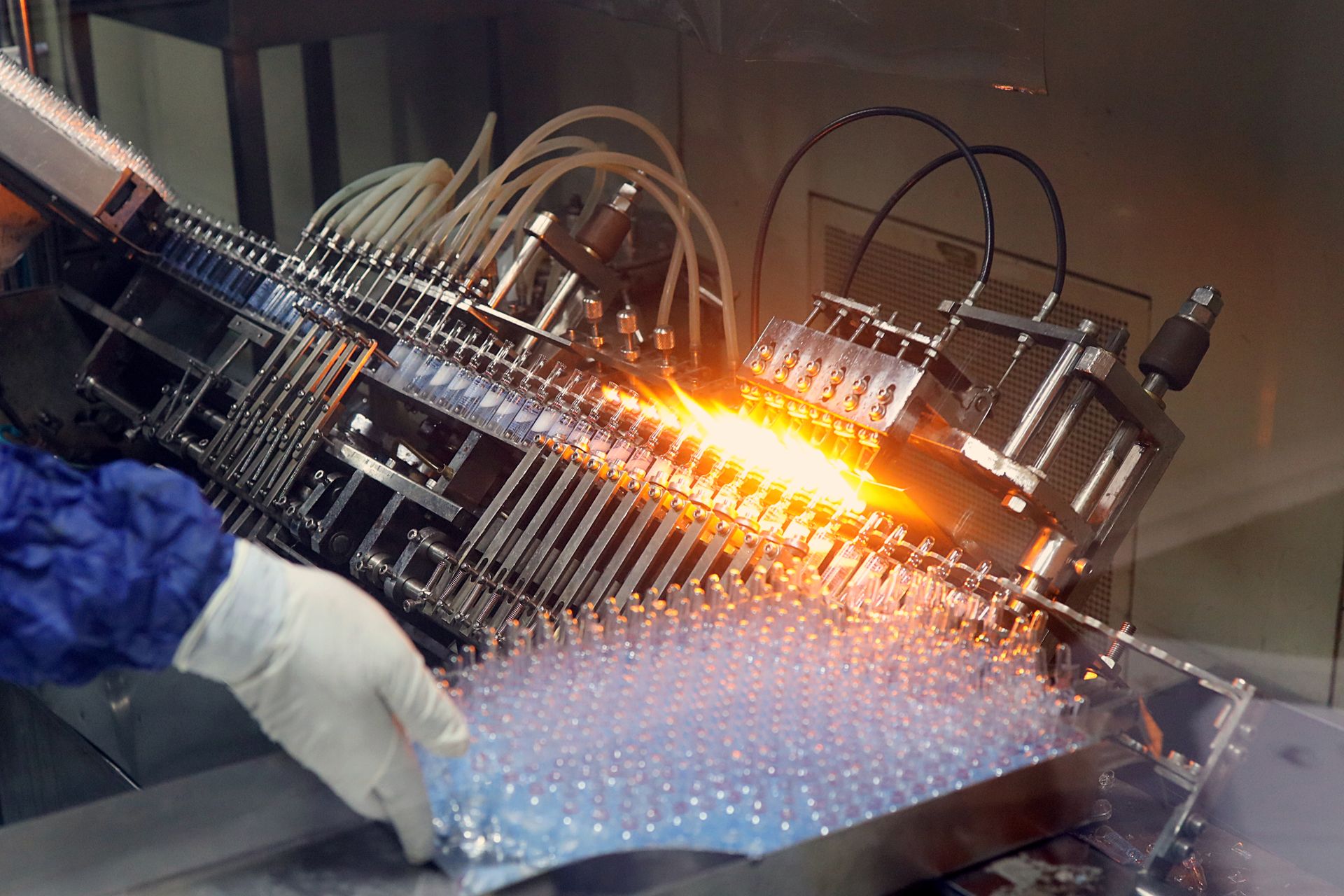
Freeze-drying a peptide for sterile vials is part of aseptic manufacturing, not a separate drying job. Annex 1 states that lyophilization “is a critical process step and all activities that can affect the sterility of the product or material need to be regarded as extensions of the aseptic processing of the sterilised product” [2]. A typical sequence:
- Compounding. The peptide, buffer and excipients (often a bulking agent and a lyoprotectant) are dissolved to a defined concentration.
- Sterile filtration. Because the product cannot be sterilised in its final container, the solution is passed through “a sterile sterilising grade filter (with a nominal pore size of a maximum of 0.22 µm…)” and “subsequently aseptically filled into a previously sterilised container” [2]. FDA’s guide describes the same steps for lyophilized parenterals [1].
- Aseptic filling and partial stoppering. Vials are filled and stoppers are seated only part way, leaving vents for vapour to escape. The transfer of partially closed containers to the freeze-dryer “should be undertaken under grade A conditions at all times” [2].
- Loading. The loading pattern “should be specified and documented” [2]. The freeze-dryer must be sterilised on a validated schedule, and its leak rate checked “at the start of every cycle” [2].
- The cycle. Freezing, primary drying and secondary drying run to a validated recipe developed for that formulation, vial and fill volume [4] [5].
- Stoppering in the chamber. At the end of the cycle the stoppers are pressed home inside the chamber, under vacuum or a controlled gas [1].
- Capping. Vials are unloaded and aluminium caps are crimped on, with the vials protected by grade A air until the cap is crimped [2].
- Inspection and integrity. “All filled containers of parenteral products should be inspected individually” for defects, containers sealed under vacuum are tested for maintenance of vacuum, and container closure integrity validation must consider transport conditions such as “decompression or extreme temperatures” [2].
- Release testing. Typical tests include appearance, identity, assay and purity, residual moisture, reconstitution time, and, for sterile products, sterility and endotoxin. FDA notes that “an obvious concern with the lyophilized product is the amount of moisture present in vials” [1].
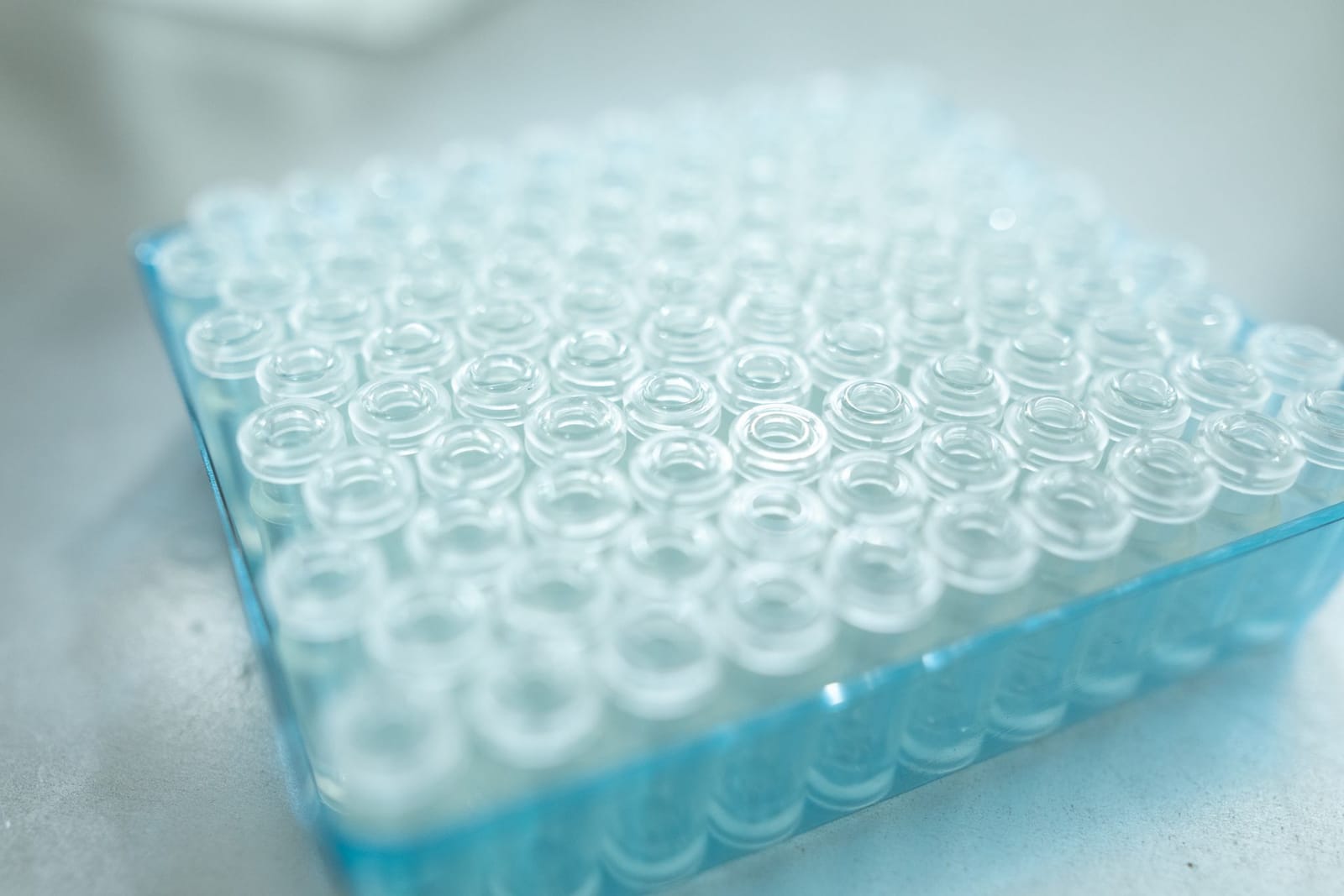
Research-grade peptide isolated in a chemistry laboratory may be freeze-dried in bulk trays or flasks rather than in sterile vials, and is not made under Annex 1. The science of the three stages is the same; the controls around sterility, documentation and inspection are what differ.
Is lyophilization expensive?
Yes, compared with making a liquid. Sharma and colleagues describe batch freeze-drying as “the primary commercial means of manufacturing solid biopharmaceuticals” but also “an economically unfriendly means of production with long production cycles, high energy consumption and heavy capital investment, resulting in high overall costs” [15]. Assegehegn and colleagues similarly call it “an energy-intensive, time-consuming, and expensive process” [6], and Kasper and Friess describe it as “cost-intensive” [7].
Where the money goes:
- Time in the dryer. Cycles are long, and primary drying usually dominates [6]. Every extra hour ties up an asset that can only run one batch at a time.
- Energy. Freezing shelves, running vacuum pumps and keeping a condenser far colder than the product all consume power for the whole cycle.
- Capital and qualification. A GMP freeze-dryer needs sterilisation, leak testing and loading systems designed around grade A conditions [2].
- Development. Mapping the conditions that keep a product below its collapse temperature experimentally “would require the manufacture of multiple batches… and therefore is very expensive”, which is why computer modelling is used to reduce that cost [5].
The trade-off is usually worth it when the alternative is a solution that degrades before it can be used.
How Winhycare Pharma handles lyophilization
Winhycare Pharma offers peptide and biosimilar lyophilisation and vial filling through WHO-GMP certified manufacturing partners in India, including a standalone service for clients who bring their own peptide. Cycle development, fill-finish and release testing are scoped per molecule. See peptide lyophilisation services or send a lyophilisation enquiry. Winhycare Pharma also supplies research-use-only peptides (purity ≥99%, as stated in our brochure), which can be lyophilised and filled into vials to the customer’s configuration; see research peptides, custom peptide synthesis or send a research peptide enquiry.
For laboratory research use only. Not for human or veterinary use.
Frequently asked questions
What does lyophilized mean?+
Lyophilized means freeze-dried. The material is frozen and the water is then removed under vacuum, first by sublimation of ice and then by desorption of the water that did not freeze. EU GMP Annex 1 treats lyophilization and freeze-drying as the same term.
What are the three stages of lyophilization?+
Freezing, primary drying and secondary drying. Freezing turns the water into ice; primary drying removes that ice by sublimation at low pressure; secondary drying warms the product to desorb the water bound to the solid. Primary drying is normally the longest stage.
Are lyophilized peptides stable?+
Usually much more stable than the same peptide in solution, which is why most synthetic peptides are isolated by lyophilisation. They are not indefinitely stable: solid-state deamidation, oxidation and aggregation still occur, faster with heat and moisture. The retest date and storage temperature on the certificate of analysis are the limits to work within.
What is the difference between lyophilized and non-lyophilized peptides?+
A lyophilized peptide is a dry solid that must be dissolved before use; a non-lyophilized peptide is supplied as a solution (or, less often, as a powder isolated another way, such as precipitation or spray drying). The dry form generally tolerates storage and transport better; the solution is ready to use but usually needs colder, tighter storage.
Is lyophilization expensive?+
Yes, relative to other drying methods. Reviews describe batch freeze-drying as time-consuming, energy-intensive and capital-heavy, with long production cycles. Manufacturers accept that cost when the product is not stable enough in solution.
What should a lyophilized peptide cake look like?+
Ideally a uniform, intact, porous solid that fills roughly the volume the liquid occupied, with no glassy, melted or bubbled areas. Some variation, such as slight shrinkage from the vial wall, is common and may have no effect on quality; collapse and meltback deserve investigation.
Do lyophilized peptides need to be refrigerated?+
They should be kept at the condition on the label, which comes from the material's stability data. EMA notes that peptides are generally stored refrigerated or frozen. Short periods outside that range are acceptable only if stability data covers them.
Why does lyophilized powder clump or look like a film?+
Peptide powders are often very hygroscopic. If a cold vial is opened before it reaches room temperature, moisture condenses on the solid and it can clump or partly collapse. Very small fill masses can also leave a thin film rather than a visible cake.
How long does lyophilization take?+
There is no standard duration: it depends on fill depth, formulation, vial and equipment. Primary drying is usually the longest stage, which is why cycle development focuses on running it as warm as the formulation safely allows.
Sources
- Lyophilization of Parenteral (7/93), Guide to Inspections, US Food and Drug Administration
- EudraLex Volume 4, Annex 1: Manufacture of Sterile Medicinal Products, C(2022) 5938 final, European Commission
- Guideline on the Development and Manufacture of Synthetic Peptides (EMA/CHMP/CVMP/QWP/367182/2025), European Medicines Agency
- Tang X, Pikal MJ. Design of freeze-drying processes for pharmaceuticals: practical advice. Pharm Res 2004;21:191–200, Pharmaceutical Research (PubMed)
- Tchessalov S, Maglio V, Kazarin P, et al. Practical advice on scientific design of freeze-drying process: 2023 update. Pharm Res 2023;40:2433–2455, Pharmaceutical Research (open access, PMC)
- Assegehegn G, Brito-de la Fuente E, Franco JM, Gallegos C. Freeze-drying: a relevant unit operation in the manufacture of foods, nutritional products, and pharmaceuticals. Adv Food Nutr Res 2020;93:1–58, Advances in Food and Nutrition Research (PubMed)
- Kasper JC, Friess W. The freezing step in lyophilization: physico-chemical fundamentals, freezing methods and consequences on process performance and quality attributes of biopharmaceuticals. Eur J Pharm Biopharm 2011;78:248–263, European Journal of Pharmaceutics and Biopharmaceutics (PubMed)
- Wang W. Lyophilization and development of solid protein pharmaceuticals. Int J Pharm 2000;203:1–60, International Journal of Pharmaceutics (PubMed)
- Lai MC, Topp EM. Solid-state chemical stability of proteins and peptides. J Pharm Sci 1999;88:489–500, Journal of Pharmaceutical Sciences (PubMed)
- Breen ED, Curley JG, Overcashier DE, et al. Effect of moisture on the stability of a lyophilized humanized monoclonal antibody formulation. Pharm Res 2001;18:1345–1353, Pharmaceutical Research (PubMed)
- Patel SM, Nail SL, Pikal MJ, et al. Lyophilized drug product cake appearance: what is acceptable? J Pharm Sci 2017;106:1706–1721, Journal of Pharmaceutical Sciences (PubMed)
- Rambhatla S, Obert JP, Luthra S, et al. Cake shrinkage during freeze drying: a combined experimental and theoretical study. Pharm Dev Technol 2005;10:33–40, Pharmaceutical Development and Technology (PubMed)
- Schersch K, Betz O, Garidel P, et al. Systematic investigation of the effect of lyophilizate collapse on pharmaceutically relevant proteins I: stability after freeze-drying. J Pharm Sci 2010;99:2256–2278, Journal of Pharmaceutical Sciences (PubMed)
- Haeuser C, Goldbach P, Huwyler J, et al. Imaging techniques to characterize cake appearance of freeze-dried products. J Pharm Sci 2018;107:2810–2822, Journal of Pharmaceutical Sciences (PubMed)
- Sharma A, Khamar D, Cullen S, et al. Innovative drying technologies for biopharmaceuticals. Int J Pharm 2021;609:121115, International Journal of Pharmaceutics (PubMed)
- Sikora K, Jaśkiewicz M, Neubauer D, et al. The role of counter-ions in peptides: an overview. Pharmaceuticals 2020;13:442, Pharmaceuticals (open access, PMC)
- ICH Q1A(R2): Stability Testing of New Drug Substances and Products, International Council for Harmonisation (ICH)
About the author
Kareem Ahmed Basha
Director & Chief Scientific Officer, Winhycare Pharma
Kareem Ahmed Basha is a director and the chief scientific officer of Winhycare Pharma in Hyderabad, India, and writes and reviews the division’s technical content on peptides, peptide APIs and lyophilisation.
He has nearly two decades of pharmaceutical quality experience, including 11 years 8 months at Dr. Reddy’s Laboratories in India and Mexico and earlier roles at Biocon and Anthem Biosciences.
- Pharmaceutical quality assurance (cGMP, GLP)
- Vendor qualification and CMO audits
- Deviations, CAPA and change control
- Data integrity and LIMS
- Technology transfer
- Peptide APIs
- Peptide lyophilisation
Reviewed by Nisar Mohammed, Founder & Managing Director, on .