
Growth & Metabolism · Research use only
AOD-9604 Research Peptide (RUO)
CAS 221231-10-3 · 1815.10 g/mol · >99% purity
AOD-9604 (CAS 221231-10-3) is a synthetic 16-amino-acid analogue of the C-terminal hGH(176-191) region of human growth hormone, studied in preclinical fat-metabolism research; it is not approved by the FDA, EMA or other major regulators. Winhycare Pharma supplies AOD-9604 for laboratory research use only, at >99% purity with QC documentation. It is not for human or veterinary use.
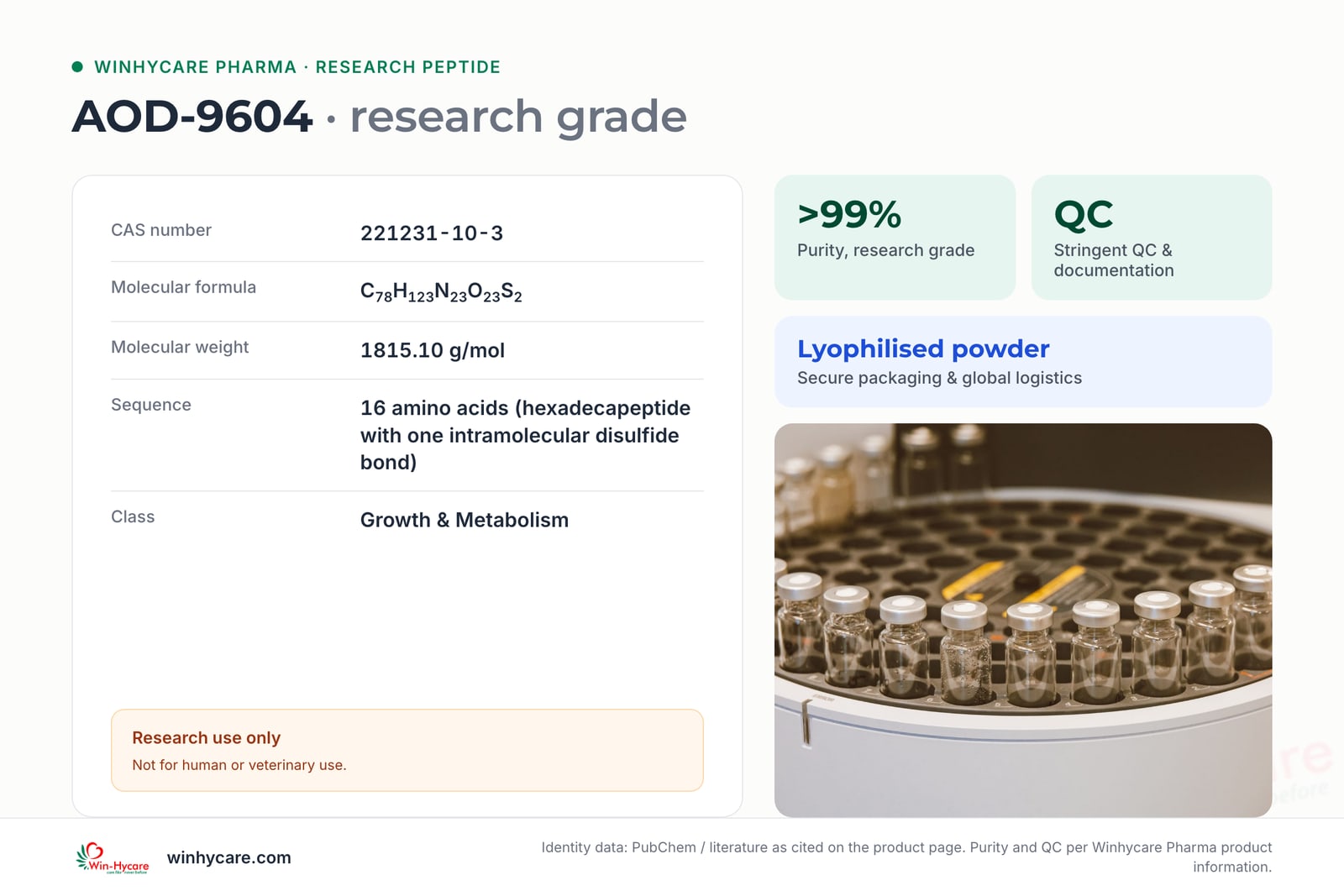
- >99% purityHigh-purity, research-grade material
- Research gradeFor research and development use only
- Quality assuredStringent QC and documentation
- Secure packagingGlobal-standard logistics
- Expert supportDedicated technical assistance
- CAS Number
- 221231-10-3
- Molecular Formula
- C78H123N23O23S2
- Molecular Weight
- 1815.10 g/mol
- Drug Class
- modified hGH(176-191) fragment
What is AOD-9604?
AOD-9604 is a synthetic 16-amino-acid peptide derived from the C-terminal lipolytic region of human growth hormone: the hGH(177-191) fragment with an additional tyrosine residue at the N-terminus (Tyr-Leu-Arg-Ile-Val-Gln-Cys-Arg-Ser-Val-Glu-Gly-Ser-Cys-Gly-Phe). The two cysteine residues form a single intramolecular disulfide bond. Its CAS number is 221231-10-3, with molecular formula C78H123N23O23S2 and a molecular weight of approximately 1815.10 g/mol.
Mechanistically, AOD-9604 has been studied in vitro and in preclinical models as a modulator of adipocyte fat metabolism, where it has been reported to stimulate lipolysis and reduce lipogenesis without the carbohydrate-metabolism effects (such as changes in blood glucose, insulin sensitivity or IGF-1) associated with full-length growth hormone. Importantly, AOD-9604 is not approved by the FDA, EMA or other major regulators for therapeutic use; clinical development as an anti-obesity agent did not lead to approval.
How AOD-9604 Is Produced & Characterised
AOD-9604 is a disulfide-bridged hexadecapeptide, and its production carries the usual short-peptide challenges: complete coupling of each residue, correct regioselective formation of the single Cys-Cys disulfide bond, and avoidance of scrambled or dimeric by-products. The peptide is generally prepared by Fmoc solid-phase peptide synthesis (SPPS), followed by controlled oxidative folding to set the correct disulfide, then purification on preparative dynamic axial compression (DAC) HPLC columns to resolve the target sequence from deletion sequences and disulfide isomers, and lyophilisation to a stable, uniform powder.
Analytical characterisation of a peptide of this class typically combines UPLC/HPLC for purity determination with LC-MS to confirm the sequence and to profile minor structural variants such as disulfide isomers and deletion sequences. This is the general industry approach for short, cysteine-bridged peptides.
Regulatory & Approval Context
AOD-9604 is not an approved active pharmaceutical ingredient. It is not approved by the FDA, EMA or other major regulators for therapeutic use, and its clinical development as an anti-obesity agent did not lead to approval. As a result it has no marketing authorisation as a finished therapeutic in major jurisdictions.
Where AOD-9604 appears in research, analytical or method-development contexts, it is handled as a research chemical or reference standard rather than as a medicine, and any associated characterisation data (identity, purity, impurity profiling and stability) is used to support analytical qualification and traceability. No efficacy or therapeutic-benefit claims are established for AOD-9604.
Research supply from Winhycare Pharma
Winhycare Pharma supplies research-grade AOD-9604 to research organisations and individual researchers for research and development purposes. Material is supplied at high purity (>99%) under stringent quality control with QC documentation, in secure packaging through global standard logistics, with dedicated technical assistance from our team. We focus on consistent quality and purity, reliable and timely supply, confidential and professional service, and long-term partnerships.
Research use only. Not for human or veterinary use, and not for use in food, drugs, medical devices or cosmetics.
To enquire, tell us the quantity you need, the purity grade, the documentation you require and the destination country. The buyer is responsible for complying with the import and use regulations that apply to AOD-9604 in their country.
AOD-9604: Specifications
| Compound | AOD-9604 |
|---|---|
| CAS Number | 221231-10-3 |
| Molecular Formula | C78H123N23O23S2 |
| Molecular Weight | 1815.10 g/mol |
| Sequence | 16 amino acids (one intramolecular disulfide bond) |
| Origin | Modified hGH(176-191) C-terminal fragment |
| Drug Class | Modified hGH(176-191) fragment |
| Appearance | White to off-white lyophilised powder |
| Purity | >99% (research grade) |
| Typical synthesis route | Fmoc SPPS + oxidative folding + DAC prep-HPLC |
| Regulatory Status | Not FDA/EMA approved for therapeutic use |
| Form | Lyophilised powder |
| Intended use | Research use only (RUO) |
Supplied for research use only: not for human or veterinary use, and not a GMP API. Regulatory status: Not approved by the FDA, EMA or other major regulators for therapeutic use. Clinical development as an anti-obesity agent did not progress to approval.
AOD-9604: Frequently Asked Questions
What is AOD-9604?
AOD-9604 is a synthetic 16-amino-acid peptide derived from the C-terminal lipolytic region of human growth hormone: the hGH(177-191) fragment with an additional N-terminal tyrosine residue. Its two cysteine residues form a single intramolecular disulfide bond. It has been studied in preclinical models as a modulator of fat metabolism.
What is the CAS number and molecular weight of AOD-9604?
AOD-9604's CAS number is 221231-10-3, its molecular formula is C78H123N23O23S2, and its molecular weight is approximately 1815.10 g/mol. It is a hexadecapeptide (16 amino acids) with a single intramolecular disulfide bond.
Is AOD-9604 approved?
No. AOD-9604 is not approved by the FDA, EMA or other major regulators for therapeutic use, and its clinical development as an anti-obesity agent did not lead to approval. No efficacy or therapeutic-benefit claims are established for it.
What class of peptide is AOD-9604?
AOD-9604 is a modified hGH(176-191) fragment: a synthetic analogue of the C-terminal region of human growth hormone. It belongs to the growth and metabolism class of peptides and is a short, cysteine-bridged (disulfide-bonded) peptide.
What is AOD-9604 being studied for?
AOD-9604 has been investigated in vitro and in preclinical models as a modulator of adipocyte fat metabolism, where it has been reported to stimulate lipolysis and reduce lipogenesis without the carbohydrate-metabolism effects (such as changes in blood glucose, insulin sensitivity or IGF-1) associated with full-length growth hormone. It was originally explored as a potential anti-obesity agent, though development did not lead to approval.
How is AOD-9604 produced?
AOD-9604 is generally produced by Fmoc solid-phase peptide synthesis (SPPS), followed by controlled oxidative folding to form its single disulfide bond, then preparative dynamic axial compression (DAC) HPLC purification and lyophilisation to a stable powder. This reflects typical industry practice for short, cysteine-bridged peptides.
Is AOD-9604 sold for human use?
No. Winhycare Pharma supplies AOD-9604 for research use only (RUO), for laboratory research and development. It is not for human or veterinary use, and not for use in food, drugs, medical devices or cosmetics.
What purity is AOD-9604 supplied at?
Research-grade AOD-9604 is supplied at high purity (>99%), produced under stringent quality control and accompanied by QC documentation. State any specific purity or documentation requirement in your enquiry.
How do I order AOD-9604 for research?
Send an enquiry with the quantity, purity, documentation you need and the destination country, and our team will reply with dedicated technical assistance. The buyer is responsible for complying with the import and use regulations for AOD-9604 in their country.
Related Peptides
Sermorelin
CAS 86168-78-7
Growth & MetabolismTesamorelin
CAS 218949-48-5
Growth & MetabolismCJC-1295
CAS 863288-34-0
GLP-1 & Incretin Multi-AgonistsSemaglutide API
CAS 910463-68-2
Request AOD-9604 for research use
Tell us the quantity, purity and documentation you need, the delivery country and the intended research use. Supplied for research use only; not for human or veterinary use. Need a different sequence? See custom peptide synthesis.