
Growth & Metabolism · Research use only
Tesamorelin Research Peptide (RUO)
CAS 218949-48-5 · 5135.86 g/mol · >99% purity
Tesamorelin (CAS 218949-48-5) is a 44-amino-acid stabilised analogue of growth-hormone-releasing hormone (GRF 1-44), approved as an active ingredient by the US FDA since 2010. Winhycare Pharma supplies Tesamorelin for laboratory research use only, at >99% purity with QC documentation. It is not for human or veterinary use.
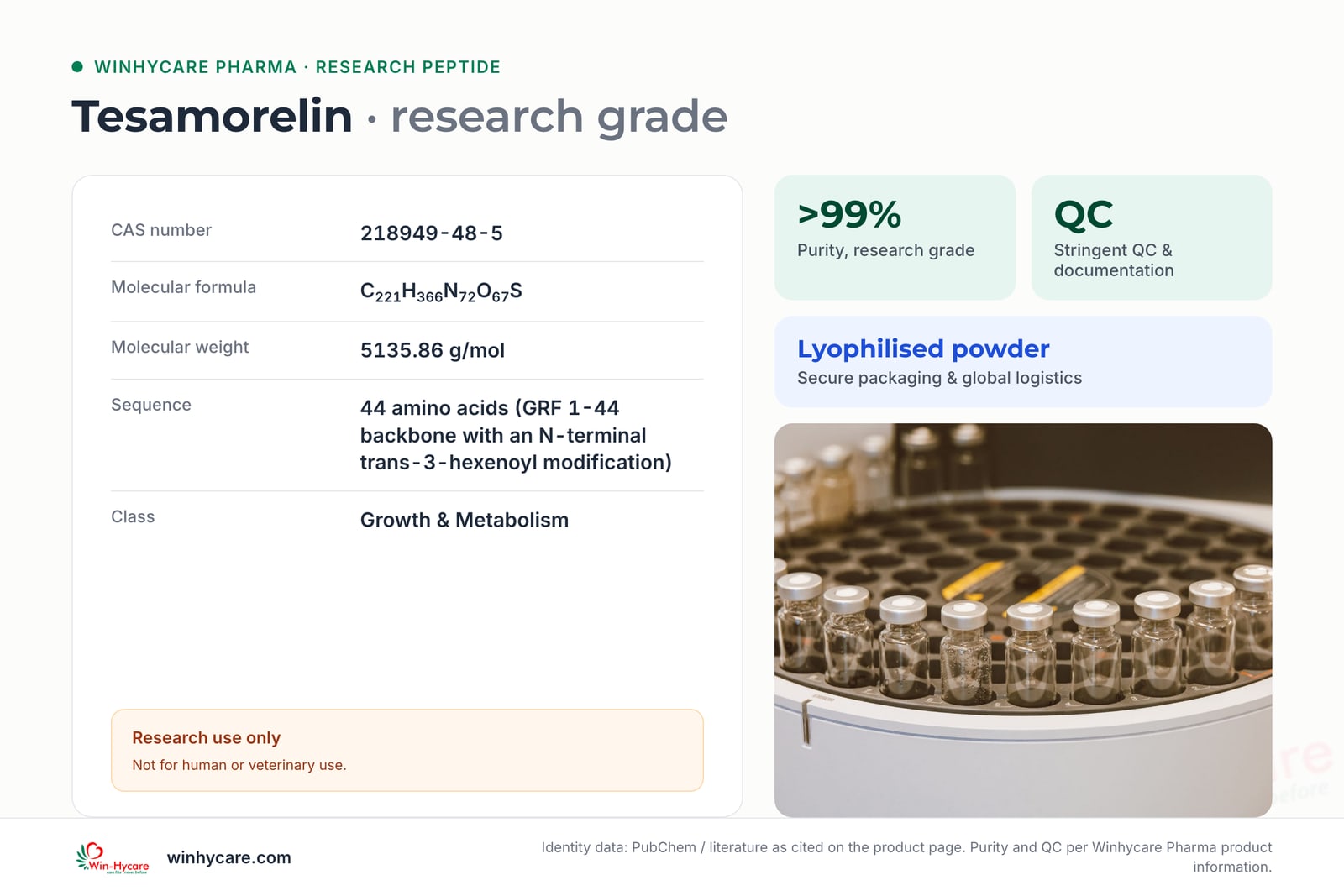
- >99% purityHigh-purity, research-grade material
- Research gradeFor research and development use only
- Quality assuredStringent QC and documentation
- Secure packagingGlobal-standard logistics
- Expert supportDedicated technical assistance
- CAS Number
- 218949-48-5
- Molecular Formula
- C221H366N72O67S
- Molecular Weight
- 5135.86 g/mol
- Drug Class
- GHRH analogue
What is Tesamorelin?
Tesamorelin is a stabilised analogue of human growth-hormone-releasing hormone (GHRH), built on the full 44-amino-acid GRF(1-44) sequence and modified at the N-terminus with a trans-3-hexenoyl (hexenoic acid) group. This lipophilic modification confers greater resistance to enzymatic degradation, including by dipeptidyl peptidase-4 (DPP-4), than endogenous GHRH. Mechanistically, tesamorelin acts on pituitary somatotroph cells to stimulate the synthesis and pulsatile release of endogenous growth hormone.
As an active pharmaceutical ingredient, tesamorelin (CAS 218949-48-5, molecular formula C221H366N72O67S, ~5135.86 g/mol) is typically presented as a lyophilised powder. It is approved by the US FDA (since 2010) for the reduction of excess visceral abdominal fat in patients with HIV-associated lipodystrophy.
How Tesamorelin Is Produced & Characterised
Tesamorelin is a long, synthetically demanding 44-mer peptide: the extended chain length, the N-terminal hexenoyl acylation and several difficult coupling regions all create opportunities for deletion sequences, diastereomers and incomplete modification. For this peptide class, production is typically carried out by Fmoc solid-phase peptide synthesis (SPPS) with controlled N-terminal acylation, followed by purification on preparative dynamic axial compression (DAC) HPLC columns that isolate the target sequence from closely related impurities.
The purified peptide is generally lyophilised to a stable, uniform powder and released against a defined specification for batch-to-batch consistency. Characterisation usually combines UPLC/HPLC for purity, LC-MS for sequence and impurity profiling, and tests for water content, counter-ion (acetate) content, residual solvents and peptide content. This reflects the general industry and analytical approach for stabilised GHRH-class peptides.
Regulatory & Documentation Context
Tesamorelin is an approved active ingredient: the US FDA cleared it in 2010 for the reduction of excess visceral abdominal fat in patients with HIV-associated lipodystrophy. For regulated finished products, the API is generally supported by CMC documentation such as US-DMF Type II dossiers and CTD Module 3 sections, analytical validation packages to ICH Q2(R1), and stability data. These are the standard filing materials referenced in IND/NDA/ANDA submissions.
Manufacturing for regulated markets is typically built around pre-approval-inspection (PAI) readiness aligned to FDA, EMA and PMDA expectations. Research-grade tesamorelin supplied for laboratory use is not the approved medicinal product.
Research supply from Winhycare Pharma
Winhycare Pharma supplies research-grade Tesamorelin to research organisations and individual researchers for research and development purposes. Material is supplied at high purity (>99%) under stringent quality control with QC documentation, in secure packaging through global standard logistics, with dedicated technical assistance from our team. We focus on consistent quality and purity, reliable and timely supply, confidential and professional service, and long-term partnerships.
Research use only. Not for human or veterinary use, and not for use in food, drugs, medical devices or cosmetics.
To enquire, tell us the quantity you need, the purity grade, the documentation you require and the destination country. The buyer is responsible for complying with the import and use regulations that apply to Tesamorelin in their country.
Tesamorelin: Specifications
| Compound | Tesamorelin |
|---|---|
| CAS Number | 218949-48-5 |
| Molecular Formula | C221H366N72O67S |
| Molecular Weight | 5135.86 g/mol |
| Sequence | 44 amino acids (GRF 1-44, N-terminal trans-3-hexenoyl) |
| Drug Class | GHRH analogue |
| Appearance | White to off-white lyophilised powder |
| Purity | >99% (research grade) |
| Typical synthesis route | Fmoc SPPS + DAC prep-HPLC purification |
| Regulatory Status | US FDA approved active ingredient (since 2010) |
| Form | Lyophilised powder |
| Storage | Store at -20°C, protected from light & moisture |
| Intended use | Research use only (RUO) |
Supplied for research use only: not for human or veterinary use, and not a GMP API. Regulatory status: Approved as an active ingredient by the US FDA (since 2010) for the reduction of excess visceral abdominal fat in patients with HIV-associated lipodystrophy.
Tesamorelin: Frequently Asked Questions
What is Tesamorelin?
Tesamorelin is a stabilised analogue of human growth-hormone-releasing hormone (GHRH), based on the full 44-amino-acid GRF(1-44) sequence with an N-terminal trans-3-hexenoyl modification that increases resistance to enzymatic degradation. It stimulates the pituitary to release endogenous growth hormone.
What is the CAS number and molecular weight of Tesamorelin?
Tesamorelin's CAS number is 218949-48-5, its molecular formula is C221H366N72O67S, and its molecular weight is approximately 5135.86 g/mol. It is a 44-amino-acid GHRH (GRF 1-44) analogue with an N-terminal trans-3-hexenoyl modification.
Is Tesamorelin approved?
Yes. Tesamorelin is approved as an active ingredient by the US FDA (since 2010) for the reduction of excess visceral abdominal fat in patients with HIV-associated lipodystrophy.
What class of peptide is Tesamorelin?
Tesamorelin is a growth-hormone-releasing hormone (GHRH) analogue, specifically a stabilised analogue of the GRF(1-44) sequence. It belongs to the growth and metabolism peptide class.
What is Tesamorelin studied or used for?
Tesamorelin's approved use is the reduction of excess visceral abdominal fat in patients with HIV-associated lipodystrophy. Its mechanism (stimulating endogenous growth hormone release via pituitary somatotroph cells) has also made it a subject of research interest in metabolic and related contexts.
How is Tesamorelin produced?
Peptides of this class are typically produced by optimised Fmoc solid-phase peptide synthesis (SPPS) with controlled N-terminal acylation, followed by preparative dynamic axial compression (DAC) HPLC purification and lyophilisation to a stable powder. Purity and identity are confirmed by UPLC/HPLC and LC-MS.
Is Tesamorelin sold for human use?
No. Winhycare Pharma supplies Tesamorelin for research use only (RUO), for laboratory research and development. It is not for human or veterinary use, and not for use in food, drugs, medical devices or cosmetics. Although Tesamorelin is an approved active ingredient in some markets, research-grade material is not a medicinal product.
What purity is Tesamorelin supplied at?
Research-grade Tesamorelin is supplied at high purity (>99%), produced under stringent quality control and accompanied by QC documentation. State any specific purity or documentation requirement in your enquiry.
How do I order Tesamorelin for research?
Send an enquiry with the quantity, purity, documentation you need and the destination country, and our team will reply with dedicated technical assistance. The buyer is responsible for complying with the import and use regulations for Tesamorelin in their country.
Related Peptides
Sermorelin
CAS 86168-78-7
Growth & MetabolismCJC-1295
CAS 863288-34-0
Growth & MetabolismAOD-9604
CAS 221231-10-3
GLP-1 & Incretin Multi-AgonistsSemaglutide API
CAS 910463-68-2
Request Tesamorelin for research use
Tell us the quantity, purity and documentation you need, the delivery country and the intended research use. Supplied for research use only; not for human or veterinary use. Need a different sequence? See custom peptide synthesis.