
Growth & Metabolism · Research use only
CJC-1295 Research Peptide (RUO)
CAS 863288-34-0 · 3367.9 g/mol · >99% purity
CJC-1295 (CAS 863288-34-0) is a synthetic 29-amino-acid modified GHRH(1-29) analogue, the form known as CJC-1295 without DAC; it is not approved by the FDA, EMA or other major regulators and is prohibited under WADA. Winhycare Pharma supplies CJC-1295 for laboratory research use only, at >99% purity with QC documentation. It is not for human or veterinary use.
By Kareem Ahmed Basha, Director & Chief Scientific Officer · Reviewed by Nisar Mohammed, Founder & Managing Director · Updated
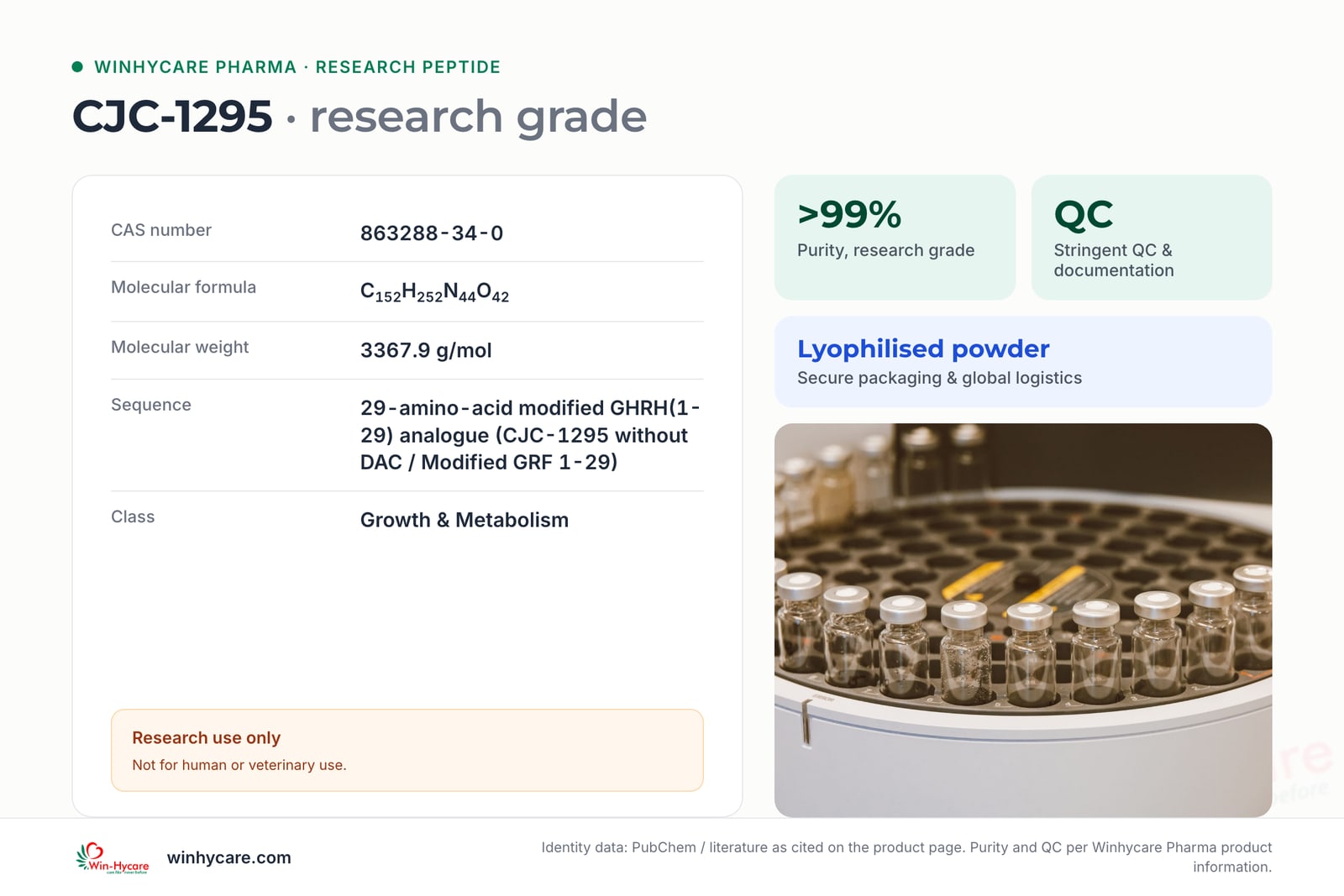
- >99% purityHigh-purity, research-grade material
- Research gradeFor research and development use only
- Quality assuredStringent QC and documentation
- Secure packagingGlobal-standard logistics
- Expert supportDedicated technical assistance
- CAS Number
- 863288-34-0
- Molecular Formula
- C152H252N44O42
- Molecular Weight
- 3367.9 g/mol
- Drug Class
- GHRH analogue
What is CJC-1295?
CJC-1295 is a synthetic analogue of growth-hormone-releasing hormone (GHRH), built on the GHRH(1-29) backbone with four amino-acid substitutions (D-Ala at position 2, Gln at 8, Ala at 15 and Leu at 27) intended to resist enzymatic degradation. The material supplied is the form known as CJC-1295 without DAC (also called Modified GRF 1-29): a 29-residue peptide amide and does not carry the maleimidopropionyl 'drug affinity complex' (DAC) albumin-binding modification, so it is shorter-acting than the separate DAC-conjugated variant. CAS numbers for the two forms are used inconsistently across databases: PubChem attaches 863288-34-0 to the 29-residue structure but lists it as a deprecated number for CJC-1295 with DAC (446262-90-4), so the sequence, formula and observed mass are the reliable identifiers. Mechanistically, GHRH analogues act on GHRH receptors of the anterior pituitary to influence growth-hormone signalling; this is described here as a factual mechanism, not a therapeutic claim.
Chemically, CJC-1295 (CAS 863288-34-0, molecular formula C152H252N44O42, ~3367.9 g/mol) is a 29-amino-acid modified GHRH(1-29) analogue typically encountered as a lyophilised powder. CJC-1295 is not approved by the FDA, EMA or other major regulators for therapeutic use; clinical development of the compound was discontinued and it is prohibited under the World Anti-Doping Agency code.
How CJC-1295 Is Produced & Characterised
CJC-1295 is a synthetically demanding peptide: the 29-mer length, the D-amino-acid substitution at position 2 and multiple non-native residues all create opportunities for deletion sequences, diastereomers and epimerisation that must be tightly controlled. Modified GHRH analogues of this type are generally prepared by optimised Fmoc solid-phase peptide synthesis (SPPS), then purified on preparative dynamic axial compression (DAC) HPLC columns to isolate the target sequence sharply from closely related impurities, and lyophilised to a stable, uniform powder.
Analytical characterisation for peptides of this complexity typically combines UPLC/HPLC purity determination with LC-MS to confirm the intended sequence and resolve minor structural variants, alongside measurement of water content, acetate/counter-ion content, residual solvents and peptide content.
Regulatory Status & Context
CJC-1295 is not approved by the FDA, EMA or other major regulators for therapeutic use. Its clinical development was discontinued, and it has no marketing authorisation as a finished medicinal product. The compound is prohibited under the World Anti-Doping Agency (WADA) code.
Because CJC-1295 has no approved therapeutic indication, it is encountered only in research and reference-standard contexts. No efficacy or therapeutic-benefit claims are associated with the molecule.
Research supply from Winhycare Pharma
Winhycare Pharma supplies research-grade CJC-1295 to research organisations and individual researchers for research and development purposes. Material is supplied at high purity (>99%) under stringent quality control with QC documentation, in secure packaging through global standard logistics, with dedicated technical assistance from our team. We focus on consistent quality and purity, reliable and timely supply, confidential and professional service, and long-term partnerships.
Research use only. Not for human or veterinary use, and not for use in food, drugs, medical devices or cosmetics.
To enquire, tell us the quantity you need, the purity grade, the documentation you require and the destination country. The buyer is responsible for complying with the import and use regulations that apply to CJC-1295 in their country.
CJC-1295: Specifications
| CAS Number | 863288-34-0 |
|---|---|
| Molecular Formula | C152H252N44O42 |
| Molecular Weight | 3367.9 g/mol |
| Sequence | 29-amino-acid modified GHRH(1-29) analogue (CJC-1295 without DAC / Mod GRF 1-29) |
| Drug Class | GHRH analogue |
| Appearance | White to off-white lyophilised powder |
| Purity | >99% (research grade) |
| Typical synthesis route | Fmoc SPPS + DAC prep-HPLC purification |
| Form | Lyophilised powder |
| Regulatory Status | Not FDA/EMA approved; WADA-prohibited; research use only |
| Storage | Store at -20°C, protected from light & moisture |
| Intended use | Research use only (RUO) |
Supplied for research use only: not for human or veterinary use, and not a GMP API. Regulatory status: Not approved by the FDA, EMA or other major regulators for therapeutic use. Clinical development was discontinued and the compound is prohibited under WADA. Handled only as a research / reference-standard material.
Research guides
Articles in the Peptide Research Library that cover CJC-1295.
- CJC-1295: research overviewCJC-1295 is a synthetic analogue of GHRH(1-29) with four amino-acid substitutions. The original molecule adds a lysine carrying a maleimidopropionyl 'Drug Affinity Complex' (DAC) that binds serum albumin, giving a 5.8–8.1 day half-life in healthy adults. The version without DAC, also called modified GRF(1-29), lacks that albumin-binding group. Neither is approved.
- Peptide modifications for stability and half-life: lipidation, PEGylation, Aib, cyclisation and fusionNative peptides are cleared in minutes. Modifications fix that in two ways: blocking proteolysis, with non-natural residues such as Aib, D-amino acids, cyclisation and terminal capping; and slowing renal clearance, with fatty acid acylation or PEGylation that enlarge the molecule or bind it to albumin.
- Sermorelin: what it is, how it works and what studies have foundSermorelin is a synthetic 29-amino-acid peptide amide identical to the first 29 residues of human growth hormone-releasing hormone (GHRH). It binds the GHRH receptor on pituitary somatotrophs and stimulates growth hormone release. FDA approved it in 1990 (diagnostic) and 1997 (paediatric GH deficiency); the products were discontinued in 2008, not for safety or effectiveness reasons.
- Tesamorelin: what it is, how it works and what studies have foundTesamorelin is a synthetic analogue of human growth hormone-releasing hormone: the full 44-amino-acid GHRH sequence with a trans-3-hexenoyl group on the N-terminal tyrosine. It stimulates pituitary growth hormone release, resists DPP-4 cleavage, and was FDA approved in November 2010 for excess abdominal fat in HIV-infected adults with lipodystrophy.
CJC-1295: Frequently Asked Questions
What is CJC-1295?
CJC-1295 is a synthetic analogue of growth-hormone-releasing hormone (GHRH), built on the GHRH(1-29) backbone with four amino-acid substitutions intended to resist enzymatic degradation. The form Winhycare Pharma supplies is CJC-1295 without DAC (Modified GRF 1-29), a 29-residue peptide amide that does not carry the DAC albumin-binding modification of the separate DAC-conjugated variant.
What is the CAS number and molecular weight of CJC-1295?
For CJC-1295 without DAC (Modified GRF 1-29), the form Winhycare Pharma supplies, the molecular formula is C152H252N44O42 and the molecular weight is approximately 3367.9 g/mol; the CAS number commonly used is 863288-34-0. CAS numbers are not used consistently for this peptide: PubChem attaches 863288-34-0 to the 29-residue structure but also lists it as a deprecated number for CJC-1295 with DAC (446262-90-4, C165H269N47O46, 3647.2 g/mol), so confirm identity by sequence and observed mass.
Is CJC-1295 approved?
No. CJC-1295 is not approved by the FDA, EMA or other major regulators for therapeutic use. Its clinical development was discontinued and it is prohibited under the World Anti-Doping Agency code. It is encountered only for research and reference-standard purposes, with no efficacy or therapeutic-benefit claims.
What class of peptide is CJC-1295?
CJC-1295 is a GHRH analogue: a synthetic peptide modelled on growth-hormone-releasing hormone. It falls within the growth and metabolism class of peptides. Mechanistically, GHRH analogues act on GHRH receptors of the anterior pituitary to influence growth-hormone signalling; this is stated as factual chemistry rather than a therapeutic indication.
What is CJC-1295 studied for?
CJC-1295 has been examined in research contexts as a GHRH analogue relevant to growth-hormone modulation. It has no approved therapeutic use; its clinical development was discontinued and it remains prohibited under the WADA code. Any references to it are limited to research and reference-standard work.
How is a peptide like CJC-1295 produced?
Modified GHRH analogues of this type are generally produced by optimised Fmoc solid-phase peptide synthesis (SPPS) with controlled coupling and epimerisation control across the 29-mer, followed by preparative dynamic axial compression (DAC) HPLC purification and lyophilisation to a stable powder.
Is CJC-1295 sold for human use?
No. Winhycare Pharma supplies CJC-1295 for research use only (RUO), for laboratory research and development. It is not for human or veterinary use, and not for use in food, drugs, medical devices or cosmetics.
What purity is CJC-1295 supplied at?
Research-grade CJC-1295 is supplied at high purity (>99%), produced under stringent quality control and accompanied by QC documentation. State any specific purity or documentation requirement in your enquiry.
How do I order CJC-1295 for research?
Send an enquiry with the quantity, purity, documentation you need and the destination country, and our team will reply with dedicated technical assistance. The buyer is responsible for complying with the import and use regulations for CJC-1295 in their country.
Sources
- CJC-1295: compound record, PubChem, NCBI
- CJC-1295: compound record, PubChem, NCBI
- CJC-1295, Wikipedia
Related Peptides
Sermorelin
CAS 86168-78-7
Growth & MetabolismTesamorelin
CAS 218949-48-5
Growth & MetabolismAOD-9604
CAS 221231-10-3
GLP-1 & Incretin Multi-AgonistsSemaglutide API
CAS 910463-68-2
Request CJC-1295 for research use
Tell us the quantity, purity and documentation you need, the delivery country and the intended research use. Supplied for research use only; not for human or veterinary use. Need a different sequence? See custom peptide synthesis.