
Growth & Metabolism · Research use only
Sermorelin Research Peptide (RUO)
CAS 86168-78-7 · 3357.93 g/mol · >99% purity
Sermorelin (CAS 86168-78-7) is a synthetic 29-amino-acid GHRH(1-29) analogue that acts on pituitary GHRH receptors; a branded product approved in 1997 was withdrawn in 2008, and no FDA- or EMA-approved sermorelin drug is marketed today. Winhycare Pharma supplies Sermorelin for laboratory research use only, at >99% purity with QC documentation. It is not for human or veterinary use.
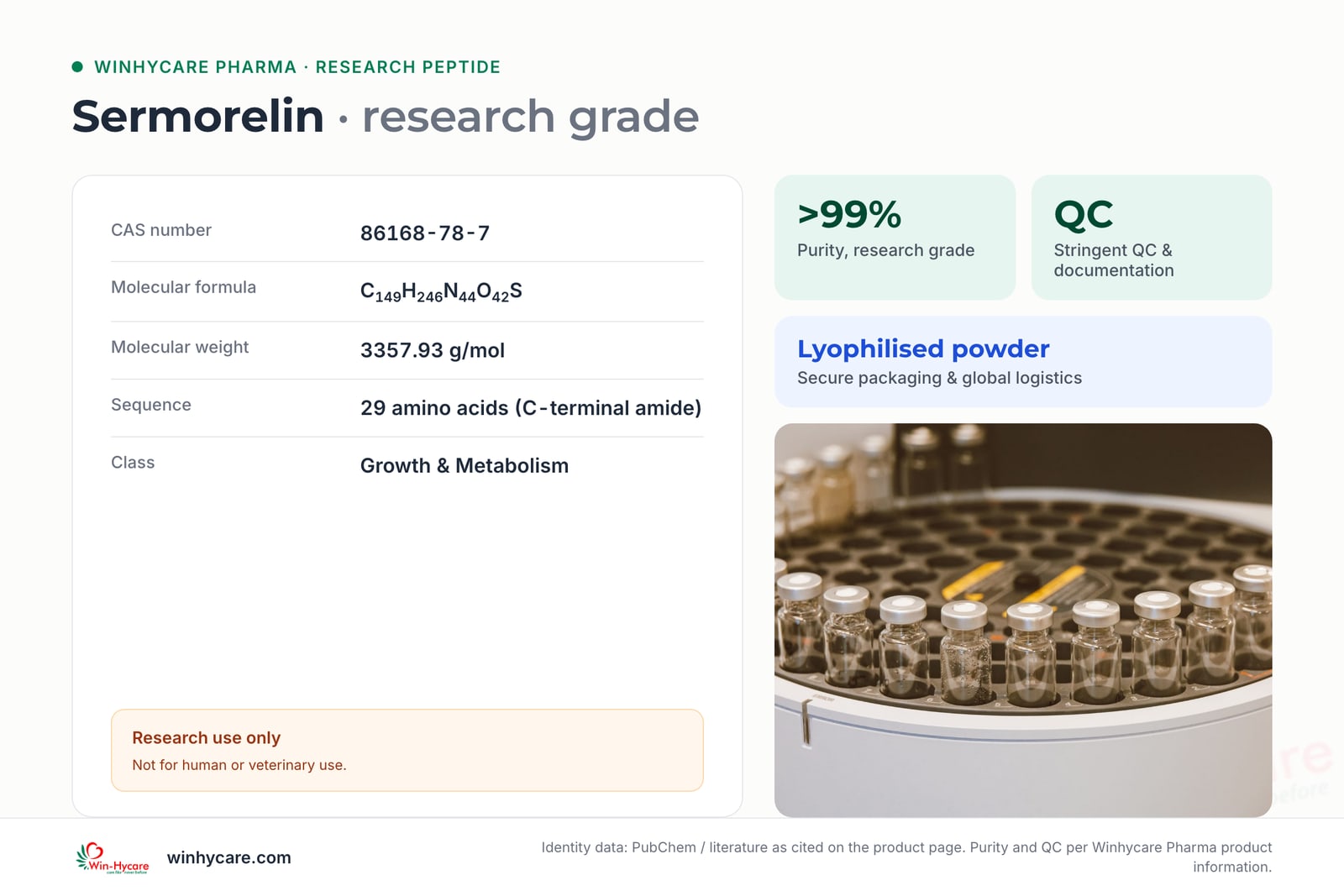
- >99% purityHigh-purity, research-grade material
- Research gradeFor research and development use only
- Quality assuredStringent QC and documentation
- Secure packagingGlobal-standard logistics
- Expert supportDedicated technical assistance
- CAS Number
- 86168-78-7
- Molecular Formula
- C149H246N44O42S
- Molecular Weight
- 3357.93 g/mol
- Drug Class
- GHRH(1-29) analogue / GH secretagogue
What is Sermorelin?
Sermorelin is a synthetic 29-amino-acid peptide corresponding to the biologically active 1-29 fragment of endogenous human growth hormone-releasing hormone (GHRH), terminated as a C-terminal amide. Mechanistically it acts as a GHRH analogue: it binds the growth hormone-releasing hormone receptor (GHRHR) on somatotroph cells of the anterior pituitary, mimicking native GHRH and stimulating the synthesis and pulsatile release of endogenous growth hormone.
As a chemical compound, sermorelin (CAS 86168-78-7, molecular formula C149H246N44O42S, ~3357.93 g/mol) is typically encountered as a lyophilised powder. A branded sermorelin product was approved by the US FDA in 1997 for growth hormone deficiency but was voluntarily withdrawn from the market in 2008 for commercial reasons; there is no marketed FDA- or EMA-approved sermorelin drug today.
How Sermorelin Is Produced & Characterised
Sermorelin is a 29-mer peptide whose length, multiple Arg/Lys basic residues and C-terminal amide create opportunities for deletion sequences, oxidation at the single methionine and incomplete amidation. Industry-standard production of peptides in this class uses Fmoc solid-phase peptide synthesis (SPPS) on an amide-forming resin, with controlled coupling and capping to suppress related-substance formation. The crude peptide is typically purified on preparative dynamic axial compression (DAC) reversed-phase HPLC columns, which resolve the target sequence from closely related impurities, and is then lyophilised to a stable powder.
Analytical characterisation of such peptides generally relies on UPLC/HPLC for purity, LC-MS for confirmation of the sequence and identification of minor structural variants, and complementary assays for water content, counter-ion (e.g. acetate) content, residual solvents, methionine-oxidation level and peptide content.
Regulatory Status & Reference Context
Sermorelin is not currently an approved drug in major markets. A branded sermorelin product received US FDA approval in 1997 for growth hormone deficiency but was voluntarily withdrawn from the US market in 2008 for commercial reasons, and there is no marketed FDA- or EMA-approved sermorelin drug today.
Where sermorelin is referenced in research, characterisation documentation such as CTD Module 3 CMC sections, analytical validation data to ICH Q2(R1), impurity and structural characterisation data, and stability data are the types of records typically associated with development-stage peptides. No therapeutic or efficacy claims are made for the molecule.
Research supply from Winhycare Pharma
Winhycare Pharma supplies research-grade Sermorelin to research organisations and individual researchers for research and development purposes. Material is supplied at high purity (>99%) under stringent quality control with QC documentation, in secure packaging through global standard logistics, with dedicated technical assistance from our team. We focus on consistent quality and purity, reliable and timely supply, confidential and professional service, and long-term partnerships.
Research use only. Not for human or veterinary use, and not for use in food, drugs, medical devices or cosmetics.
To enquire, tell us the quantity you need, the purity grade, the documentation you require and the destination country. The buyer is responsible for complying with the import and use regulations that apply to Sermorelin in their country.
Sermorelin: Specifications
| Compound | Sermorelin |
|---|---|
| CAS Number | 86168-78-7 |
| Molecular Formula | C149H246N44O42S |
| Molecular Weight | 3357.93 g/mol |
| Sequence | 29 amino acids, C-terminal amide (GHRH 1-29) |
| Drug Class | GHRH(1-29) analogue / GH secretagogue |
| Appearance | White to off-white lyophilised powder |
| Purity | >99% (research grade) |
| Typical synthesis route | Fmoc SPPS + DAC prep-HPLC purification |
| Regulatory Status | No current FDA/EMA-approved drug (1997 approval withdrawn 2008) |
| Form | Lyophilised powder; typically stored at -20°C, protected from light & moisture |
| Intended use | Research use only (RUO) |
Supplied for research use only: not for human or veterinary use, and not a GMP API. Regulatory status: Not currently approved by the FDA or EMA for therapeutic use. A branded sermorelin product was FDA-approved in 1997 but was voluntarily withdrawn from the US market in 2008 for commercial reasons; there is no marketed FDA-approved sermorelin drug today.
Sermorelin: Frequently Asked Questions
What is Sermorelin?
Sermorelin is a synthetic 29-amino-acid peptide corresponding to the biologically active 1-29 fragment of human growth hormone-releasing hormone (GHRH), with a C-terminal amide. It acts as a GHRH analogue and growth hormone secretagogue.
What is the CAS number and molecular weight of Sermorelin?
Sermorelin's CAS number is 86168-78-7, its molecular formula is C149H246N44O42S, and its molecular weight is approximately 3357.93 g/mol.
Is Sermorelin approved by the FDA or EMA?
Not currently. A branded sermorelin product received US FDA approval in 1997 but was voluntarily withdrawn from the US market in 2008 for commercial reasons, and there is no marketed FDA- or EMA-approved sermorelin drug today.
What class of peptide is Sermorelin?
It is a GHRH(1-29) analogue and growth hormone secretagogue. As a GHRH analogue it binds the growth hormone-releasing hormone receptor (GHRHR) on somatotroph cells of the anterior pituitary, mimicking native GHRH and stimulating the synthesis and release of endogenous growth hormone. This is a factual description, not a therapeutic claim.
What has Sermorelin been studied for?
Sermorelin has historically been associated with growth hormone deficiency; a branded product was FDA-approved for that indication in 1997 before being withdrawn in 2008. There is no current approved sermorelin drug. This page makes no therapeutic or efficacy claims about the molecule.
How is Sermorelin typically produced?
Peptides in this class are generally produced by Fmoc solid-phase peptide synthesis (SPPS) on an amide-forming resin, purified by preparative dynamic axial compression (DAC) reversed-phase HPLC, and lyophilised to a stable powder.
Is Sermorelin sold for human use?
No. Winhycare Pharma supplies Sermorelin for research use only (RUO), for laboratory research and development. It is not for human or veterinary use, and not for use in food, drugs, medical devices or cosmetics.
What purity is Sermorelin supplied at?
Research-grade Sermorelin is supplied at high purity (>99%), produced under stringent quality control and accompanied by QC documentation. State any specific purity or documentation requirement in your enquiry.
How do I order Sermorelin for research?
Send an enquiry with the quantity, purity, documentation you need and the destination country, and our team will reply with dedicated technical assistance. The buyer is responsible for complying with the import and use regulations for Sermorelin in their country.
Related Peptides
Tesamorelin
CAS 218949-48-5
Growth & MetabolismCJC-1295
CAS 863288-34-0
Growth & MetabolismAOD-9604
CAS 221231-10-3
GastrointestinalTeduglutide
CAS 197922-42-2
Request Sermorelin for research use
Tell us the quantity, purity and documentation you need, the delivery country and the intended research use. Supplied for research use only; not for human or veterinary use. Need a different sequence? See custom peptide synthesis.