
Regenerative & Repair · Research use only
TB-500 (Thymosin Beta-4) Research Peptide (RUO)
CAS 77591-33-4 · 4963.44 g/mol · >99% purity
TB-500 (Thymosin Beta-4) (CAS 77591-33-4) is a synthetic form of thymosin beta-4, a 43-amino-acid G-actin-sequestering peptide studied in preclinical tissue-repair models; it is not approved for any therapeutic use. Winhycare Pharma supplies TB-500 for laboratory research use only, at >99% purity with QC documentation. It is not for human or veterinary use.
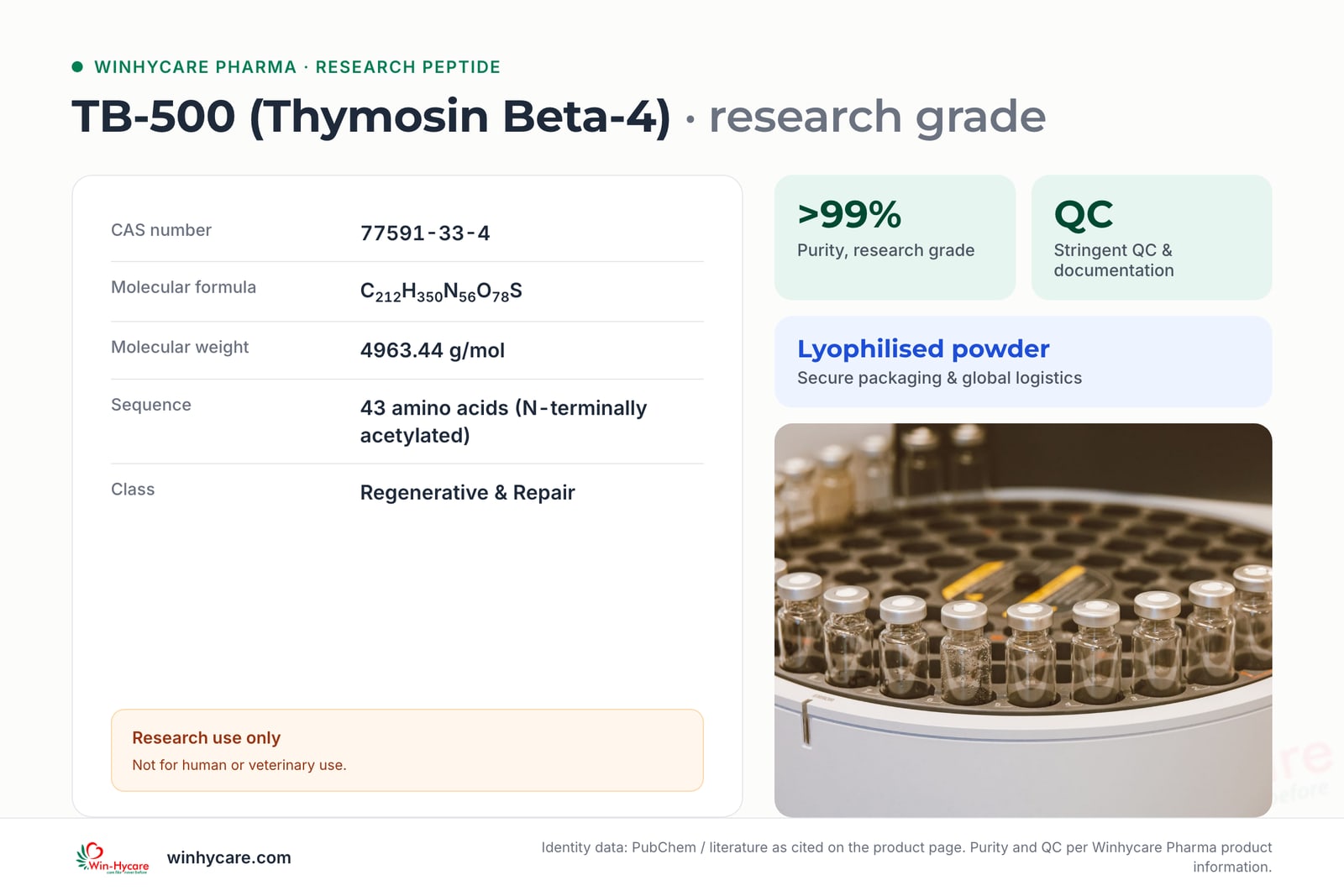
- >99% purityHigh-purity, research-grade material
- Research gradeFor research and development use only
- Quality assuredStringent QC and documentation
- Secure packagingGlobal-standard logistics
- Expert supportDedicated technical assistance
- CAS Number
- 77591-33-4
- Molecular Formula
- C212H350N56O78S
- Molecular Weight
- 4963.44 g/mol
- Drug Class
- synthetic thymosin beta-4 fragment
What is TB-500 (Thymosin Beta-4)?
TB-500 is a synthetic analogue of thymosin beta-4 (Tβ4), a naturally occurring 43-amino-acid peptide found in nearly all mammalian cells. The molecule (CAS 77591-33-4, molecular formula C212H350N56O78S, ~4963.44 g/mol) is N-terminally acetylated and is the principal G-actin-sequestering peptide in many cell types, binding monomeric (globular) actin in a 1:1 complex and thereby modulating the pool of actin available for polymerisation into filaments. Through this actin-regulating activity and interactions with additional molecular partners, it has been studied in research models of cell migration, angiogenesis and tissue repair.
It is important to state the regulatory position clearly: TB-500 / thymosin beta-4 is not approved by the FDA, EMA or other major regulators for any therapeutic indication, and it is prohibited in sport under the WADA Prohibited List. No efficacy or therapeutic-benefit claims are made for this molecule.
How TB-500 Is Produced & Characterised
At 43 residues with an acetylated N-terminus and a high content of glutamate and lysine, TB-500 is a synthetically demanding peptide in which deletion sequences, incomplete acetylation and closely related variants must be tightly controlled. In an industry setting this peptide class is typically produced by optimised Fmoc solid-phase peptide synthesis (SPPS), followed by preparative dynamic axial compression (DAC) HPLC purification to resolve the target sequence sharply from related impurities, and then lyophilisation to a stable, uniform powder.
Characterisation generally relies on UPLC/HPLC for purity determination and LC-MS for confirming the sequence and profiling minor structural variants. Controlled N-terminal acetylation and tight control of deletion sequences and related variants are central to producing a well-defined material with repeatable batch-to-batch consistency, from gram-scale research lots through to larger reference-standard campaigns.
Regulatory Status & Handling
TB-500 / thymosin beta-4 is not an approved drug substance and is not approved by the FDA, EMA or other major regulators for any therapeutic indication. It is handled strictly for research and reference-standard purposes and is not represented as suitable for finished human pharmaceutical products. It is also prohibited at all times in sport under the WADA Prohibited List (class S2).
As a peptide, TB-500 is typically presented as a lyophilised powder and stored at -20°C, protected from light and moisture. Nothing on this page is medical or patient advice.
Research supply from Winhycare Pharma
Winhycare Pharma supplies research-grade TB-500 to research organisations and individual researchers for research and development purposes. Material is supplied at high purity (>99%) under stringent quality control with QC documentation, in secure packaging through global standard logistics, with dedicated technical assistance from our team. We focus on consistent quality and purity, reliable and timely supply, confidential and professional service, and long-term partnerships.
Research use only. Not for human or veterinary use, and not for use in food, drugs, medical devices or cosmetics.
To enquire, tell us the quantity you need, the purity grade, the documentation you require and the destination country. The buyer is responsible for complying with the import and use regulations that apply to TB-500 in their country.
TB-500 (Thymosin Beta-4): Specifications
| Compound | TB-500 (Thymosin Beta-4) |
|---|---|
| CAS Number | 77591-33-4 |
| Molecular Formula | C212H350N56O78S |
| Molecular Weight | 4963.44 g/mol |
| Sequence | 43 amino acids, N-terminally acetylated |
| Drug Class | Synthetic thymosin beta-4 fragment (G-actin-sequestering peptide) |
| Appearance | White to off-white lyophilised powder |
| Purity | >99% (research grade) |
| Typical synthesis route | Fmoc SPPS + DAC prep-HPLC purification |
| Regulatory Status | Not approved for therapeutic use; research / reference-standard only; WADA-prohibited (S2) |
| Form | Lyophilised powder; typically stored at -20°C, protected from light & moisture |
| Intended use | Research use only (RUO) |
Supplied for research use only: not for human or veterinary use, and not a GMP API. Regulatory status: Not approved by the FDA, EMA or other major regulators for any therapeutic use. It is handled only as a research / reference-standard material. Thymosin beta-4 / TB-500 is also prohibited at all times in sport under the World Anti-Doping Agency (WADA) Prohibited List (class S2).
TB-500 (Thymosin Beta-4): Frequently Asked Questions
What is TB-500 (Thymosin Beta-4)?
TB-500 is a synthetic analogue of thymosin beta-4 (Tβ4), a naturally occurring 43-amino-acid peptide found in nearly all mammalian cells. It is N-terminally acetylated and acts as the principal G-actin-sequestering peptide in many cell types, binding monomeric (globular) actin in a 1:1 complex.
What is the CAS number and molecular weight of TB-500 (Thymosin Beta-4)?
TB-500's CAS number is 77591-33-4, its molecular formula is C212H350N56O78S, and its molecular weight is approximately 4963.44 g/mol. It is a 43-amino-acid synthetic thymosin beta-4 fragment with an N-terminally acetylated sequence.
Is TB-500 approved by the FDA or EMA?
No. TB-500 / thymosin beta-4 is not approved by the FDA, EMA or other major regulators for any therapeutic use. It is intended strictly for research and reference-standard purposes, and no efficacy or therapeutic-benefit claims should be inferred. It is also prohibited at all times in sport under the WADA Prohibited List (class S2).
What class of peptide is TB-500?
TB-500 is a synthetic thymosin beta-4 fragment, specifically a G-actin-sequestering peptide. It falls within the regenerative and repair peptide class and is studied in research models of cell migration, angiogenesis and tissue repair.
What is the mechanism of action of thymosin beta-4?
Thymosin beta-4 is the principal G-actin-sequestering peptide in many cell types. It binds monomeric (globular) actin in a 1:1 complex, regulating the pool of actin available for polymerisation into filaments, and is studied in research models of cell migration and tissue repair.
What is TB-500 being studied for?
Through its actin-regulating activity and interactions with additional molecular partners, thymosin beta-4 / TB-500 has been studied in research models of cell migration, angiogenesis and tissue repair. These are research contexts only; it is not approved for any therapeutic use.
Is TB-500 sold for human use?
No. Winhycare Pharma supplies TB-500 for research use only (RUO), for laboratory research and development. It is not for human or veterinary use, and not for use in food, drugs, medical devices or cosmetics.
What purity is TB-500 supplied at?
Research-grade TB-500 is supplied at high purity (>99%), produced under stringent quality control and accompanied by QC documentation. State any specific purity or documentation requirement in your enquiry.
How do I order TB-500 for research?
Send an enquiry with the quantity, purity, documentation you need and the destination country, and our team will reply with dedicated technical assistance. The buyer is responsible for complying with the import and use regulations for TB-500 in their country.
Related Peptides
BPC-157 API
CAS 137525-51-0
Growth & MetabolismSermorelin
CAS 86168-78-7
Growth & MetabolismCJC-1295
CAS 863288-34-0
Growth & MetabolismAOD-9604
CAS 221231-10-3
Request TB-500 (Thymosin Beta-4) for research use
Tell us the quantity, purity and documentation you need, the delivery country and the intended research use. Supplied for research use only; not for human or veterinary use. Need a different sequence? See custom peptide synthesis.