
Regenerative & Repair · Research use only · also supplied as API
BPC-157 API and Research Peptide Supplier
CAS 137525-51-0 · 1419.56 g/mol · >99% purity
BPC-157 (CAS 137525-51-0) is a synthetic 15-amino-acid pentadecapeptide studied in preclinical models; it is not approved by any drug regulator, and in 2023 the US FDA placed it in Category 2 of its compounding bulk-substances policy. Winhycare Pharma supplies BPC-157 as an API to licensed pharmaceutical manufacturers and developers and, separately, as a research-grade peptide for laboratory research use only, at >99% purity with QC documentation. Research-grade material is not for human or veterinary use.
Manufacturer sourcing BPC-157 API? Request API pricing & COA or see our peptide CDMO services.
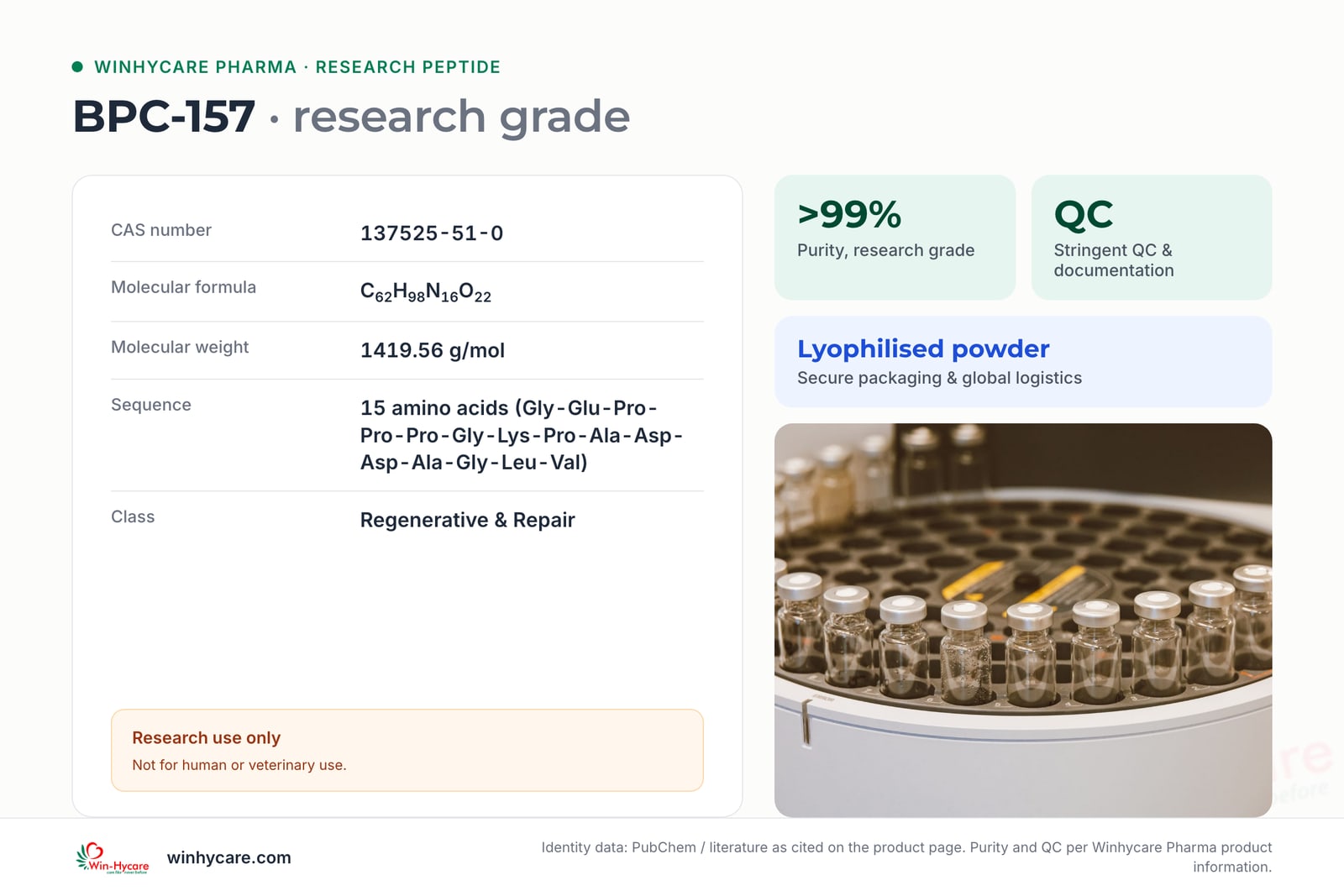
- >99% purityHigh-purity, research-grade material
- Research gradeFor research and development use only
- Quality assuredStringent QC and documentation
- Secure packagingGlobal-standard logistics
- Expert supportDedicated technical assistance
- CAS Number
- 137525-51-0
- Molecular Formula
- C62H98N16O22
- Molecular Weight
- 1419.56 g/mol
- Drug Class
- pentadecapeptide (body-protection compound)
What is BPC-157?
BPC-157 (Body Protection Compound 157, also designated PL 14736) is a synthetic pentadecapeptide of 15 amino acids with the sequence Gly-Glu-Pro-Pro-Pro-Gly-Lys-Pro-Ala-Asp-Asp-Ala-Gly-Leu-Val. The sequence corresponds to a partial fragment derived from a protein identified in human gastric juice. Its molecular formula is C62H98N16O22 with a molecular weight of approximately 1419.56 g/mol (CAS 137525-51-0).
In preclinical research the peptide has been studied for cytoprotective, angiogenic and tissue-repair related effects, predominantly in animal and in-vitro models. The current regulatory position is unambiguous: BPC-157 is not approved by the FDA, EMA or any other drug regulatory agency for human therapeutic use. In 2023 the US FDA placed it in Category 2 of its interim policy on bulk substances used in compounding, citing immunogenicity and impurity concerns, and it has no USP/NF monograph. No efficacy or therapeutic-benefit claims are established for this molecule.
How BPC-157 Is Produced & Characterised
As a 15-residue linear peptide rich in proline (three consecutive Pro residues) and acidic Asp/Glu residues, BPC-157 presents synthesis challenges around coupling efficiency, aspartimide formation and the resolution of closely related deletion and isomerisation sequences. For peptides of this class, the typical industry route is Fmoc solid-phase peptide synthesis (SPPS) with controlled coupling chemistry to suppress these side reactions, followed by purification on preparative HPLC (commonly dynamic axial compression, DAC, columns) to isolate the target sequence from related impurities, and lyophilisation to a stable powder.
Characterisation generally relies on UPLC/HPLC for purity, LC-MS for identity and minor structural-variant profiling, and determination of water content, counter-ion (salt) content, residual solvents and peptide content so the material is fully defined.
Regulatory Context
BPC-157 is not an approved active pharmaceutical ingredient. It carries no USP/NF monograph and no marketing authorisation from the FDA, EMA or any other drug regulatory agency for therapeutic use. In 2023 the US FDA placed BPC-157 in Category 2 of its interim policy on bulk drug substances used in compounding, citing immunogenicity and impurity concerns.
Because no regulatory therapeutic pathway exists for this molecule, it is encountered only as a research chemical or reference standard. Nothing on this page is medical advice.
Research supply from Winhycare Pharma
Winhycare Pharma supplies research-grade BPC-157 to research organisations and individual researchers for research and development purposes. Material is supplied at high purity (>99%) under stringent quality control with QC documentation, in secure packaging through global standard logistics, with dedicated technical assistance from our team. We focus on consistent quality and purity, reliable and timely supply, confidential and professional service, and long-term partnerships.
Research use only. Not for human or veterinary use, and not for use in food, drugs, medical devices or cosmetics.
To enquire, tell us the quantity you need, the purity grade, the documentation you require and the destination country. The buyer is responsible for complying with the import and use regulations that apply to BPC-157 in their country.
BPC-157 API: Specifications
| CAS Number | 137525-51-0 |
|---|---|
| Molecular Formula | C62H98N16O22 |
| Molecular Weight | 1419.56 g/mol |
| Sequence | 15 amino acids (Gly-Glu-Pro-Pro-Pro-Gly-Lys-Pro-Ala-Asp-Asp-Ala-Gly-Leu-Val) |
| Drug Class | Synthetic pentadecapeptide (body-protection compound) |
| Appearance | White to off-white lyophilised powder |
| Purity | >99% (research grade) |
| Typical synthesis route | Fmoc SPPS + preparative HPLC purification |
| Regulatory Status | Not FDA/EMA approved; FDA Category 2 (2023); no USP/NF monograph |
| Form | Lyophilised powder |
| Intended use | Research use only (RUO) |
API supplied for B2B pharmaceutical manufacturing and R&D. BPC-157 is also supplied for research use only, not for human or veterinary use. Regulatory status: Not approved by the FDA, EMA or any other drug regulatory agency for therapeutic use. Handled only as a research / reference-standard material. In 2023 the US FDA placed BPC-157 in Category 2 of its interim compounding bulk-substances policy, citing immunogenicity and impurity concerns; it has no USP/NF monograph and no marketing authorisation.
Buyer guides
Regulatory and technical reading for teams qualifying an Indian peptide API source.
- Sourcing peptide API for the EU, UK and SwitzerlandWritten confirmation, EU GMP Part II, ASMF / CEP and the QP declaration.
- Sourcing peptide API for the United StatesType II DMF, ICH Q7, FDA’s July 2026 peptide guidance changes and establishment registration.
- How to qualify a peptide API supplierA documentation and audit checklist for EU and US buyers.
- Peptide API impurities and specificationsRelated substances, thresholds and pharmacopoeial context.
- Peptide lyophilisation CMO servicesFrom your peptide API to lyophilised vials, starting with a pilot.
BPC-157 API: Frequently Asked Questions
What is BPC-157?
BPC-157 (Body Protection Compound 157, also designated PL 14736) is a synthetic 15-amino-acid pentadecapeptide with the sequence Gly-Glu-Pro-Pro-Pro-Gly-Lys-Pro-Ala-Asp-Asp-Ala-Gly-Leu-Val. Its sequence corresponds to a partial fragment of a protein identified in human gastric juice, and it has been studied in preclinical tissue-repair research.
What is the CAS number and molecular weight of BPC-157?
BPC-157's CAS number is 137525-51-0, its molecular formula is C62H98N16O22, and its molecular weight is approximately 1419.56 g/mol.
Is BPC-157 approved?
No. BPC-157 is not approved by the FDA, EMA or any other drug regulatory agency for therapeutic use, and it has no USP/NF monograph or marketing authorisation. In 2023 the US FDA placed it in Category 2 of its interim compounding bulk-substances policy, citing immunogenicity and impurity concerns.
What class of peptide is BPC-157?
BPC-157 is a synthetic pentadecapeptide: a 15-amino-acid linear peptide known as a body-protection compound. It is notably proline-rich, containing three consecutive proline residues alongside acidic aspartate and glutamate residues.
What is BPC-157 being studied for?
In preclinical research, BPC-157 has been investigated for cytoprotective, angiogenic and tissue-repair related effects, predominantly in animal and in-vitro models. No therapeutic efficacy in humans has been established and it remains unapproved.
How is BPC-157 typically produced?
Peptides of this class are typically produced by Fmoc solid-phase peptide synthesis (SPPS) with controlled coupling chemistry to suppress aspartimide formation and deletion sequences, followed by preparative HPLC purification and lyophilisation to a stable powder.
Do you supply BPC-157 as an API?
Yes. Winhycare Pharma supplies BPC-157 API to licensed pharmaceutical manufacturers and developers, with QC documentation. Tell us the quantity and the documentation your quality and regulatory teams need. Research-grade BPC-157 is supplied separately, for laboratory research use only.
Is BPC-157 sold for human use?
No. Research-grade BPC-157 is supplied for research use only (RUO), for laboratory research and development. It is not for human or veterinary use, and not for use in food, drugs, medical devices or cosmetics.
What purity is BPC-157 supplied at?
Research-grade BPC-157 is supplied at high purity (>99%), produced under stringent quality control and accompanied by QC documentation. State any specific purity or documentation requirement in your enquiry.
How do I order BPC-157 for research?
Send an enquiry with the quantity, purity, documentation you need and the destination country, and our team will reply with dedicated technical assistance. The buyer is responsible for complying with the import and use regulations for BPC-157 in their country.
Related Peptides
TB-500 (Thymosin Beta-4)
CAS 77591-33-4
Growth & MetabolismSermorelin
CAS 86168-78-7
Growth & MetabolismCJC-1295
CAS 863288-34-0
Growth & MetabolismTesamorelin
CAS 218949-48-5
Source BPC-157 API from Winhycare Pharma
Request pricing, a Certificate of Analysis and the documentation your quality and regulatory teams need. Bulk quantities available.