
Gastrointestinal · Research use only
Teduglutide Research Peptide (RUO)
CAS 197922-42-2 · 3752.13 g/mol · >99% purity
Teduglutide (CAS 197922-42-2) is a 33-amino-acid GLP-2 analogue made resistant to DPP-4 degradation, approved as an active ingredient by the US FDA and EMA in 2012 for short bowel syndrome. Winhycare Pharma supplies Teduglutide for laboratory research use only, at >99% purity with QC documentation. It is not for human or veterinary use.
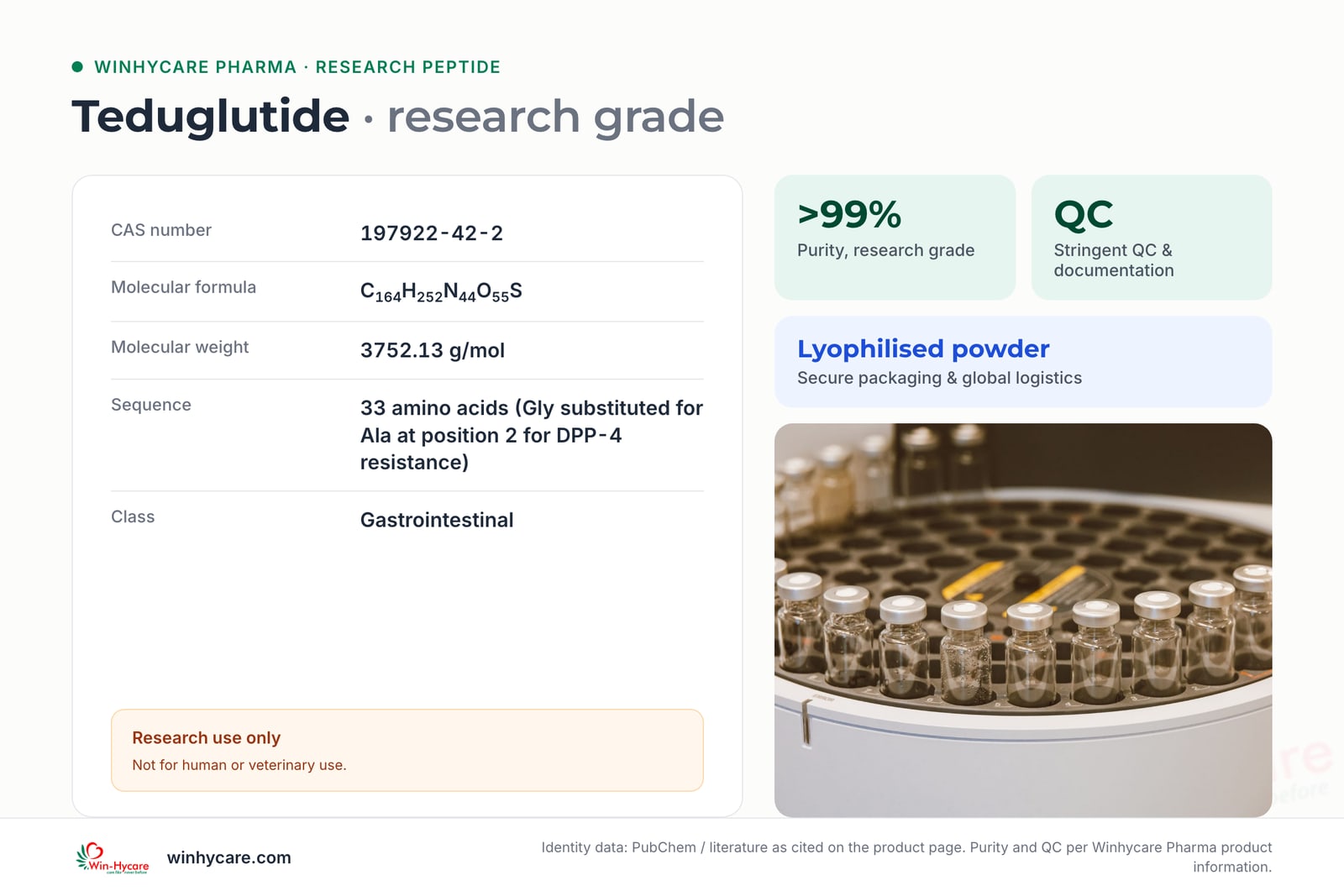
- >99% purityHigh-purity, research-grade material
- Research gradeFor research and development use only
- Quality assuredStringent QC and documentation
- Secure packagingGlobal-standard logistics
- Expert supportDedicated technical assistance
- CAS Number
- 197922-42-2
- Molecular Formula
- C164H252N44O55S
- Molecular Weight
- 3752.13 g/mol
- Drug Class
- GLP-2 analogue
What is Teduglutide?
Teduglutide is an analogue of human glucagon-like peptide-2 (GLP-2), a 33-amino-acid peptide derived from the native GLP-2 sequence. A single substitution of glycine for alanine at position 2 from the N-terminus confers resistance to degradation by dipeptidyl peptidase-4 (DPP-4), extending its in-vivo half-life relative to native GLP-2. As a GLP-2 receptor agonist it regulates the functional and structural integrity of the intestinal epithelium; in animal and clinical studies it has been shown to increase villus height and crypt depth, expanding the absorptive surface area of the intestine.
As an active pharmaceutical ingredient (API), teduglutide (CAS 197922-42-2, molecular formula C164H252N44O55S, ~3752.13 g/mol) is a lyophilised powder. It is an approved active: the US FDA granted approval in December 2012 and the EMA / European Commission in August 2012, for short bowel syndrome in patients dependent on parenteral support.
How Teduglutide Is Produced & Characterised
Teduglutide is a synthetically demanding 33-mer peptide: its length, the single methionine residue and the closely related deletion and oxidation variants all create real purification challenges. Industrially, peptides of this class are typically produced by Fmoc solid-phase peptide synthesis (SPPS), in which the chain is assembled residue-by-residue on a resin support through controlled coupling and deprotection cycles. The crude peptide is then purified by preparative reversed-phase HPLC, often on dynamic axial compression (DAC) columns, to resolve the target sequence from related impurities and to manage methionine oxidation.
Process controls aim for repeatable batch-to-batch consistency from optimisation runs through to larger campaigns, with controlled lyophilisation yielding a stable, uniform powder. Characterisation of the resulting material commonly combines UPLC/HPLC for purity, LC-MS for sequence and impurity profiling, and assays for water content, counter-ion content, residual solvents and peptide content, reflecting general analytical practice for therapeutic peptides.
Regulatory & Approval Status
Teduglutide is an approved active pharmaceutical ingredient. The US FDA approved it in December 2012 and the EMA / European Commission in August 2012, for the treatment of adults and children with short bowel syndrome who are dependent on parenteral support. As an approved active, it is the subject of established regulatory documentation frameworks, for example US Drug Master Files (Type II) and CTD Module 3 CMC sections used by manufacturers when referencing the substance in IND, NDA or ANDA submissions.
Quality systems for peptide APIs of this type are generally aligned with pre-approval-inspection (PAI) expectations of agencies such as the FDA, EMA and PMDA. Research-grade teduglutide supplied for laboratory use is not the approved medicinal product.
Research supply from Winhycare Pharma
Winhycare Pharma supplies research-grade Teduglutide to research organisations and individual researchers for research and development purposes. Material is supplied at high purity (>99%) under stringent quality control with QC documentation, in secure packaging through global standard logistics, with dedicated technical assistance from our team. We focus on consistent quality and purity, reliable and timely supply, confidential and professional service, and long-term partnerships.
Research use only. Not for human or veterinary use, and not for use in food, drugs, medical devices or cosmetics.
To enquire, tell us the quantity you need, the purity grade, the documentation you require and the destination country. The buyer is responsible for complying with the import and use regulations that apply to Teduglutide in their country.
Teduglutide: Specifications
| Compound | Teduglutide |
|---|---|
| CAS Number | 197922-42-2 |
| Molecular Formula | C164H252N44O55S |
| Molecular Weight | 3752.13 g/mol |
| Sequence | 33 amino acids (Gly²-substituted, DPP-4 resistant) |
| Drug Class | GLP-2 analogue (GLP-2 receptor agonist) |
| Appearance | White to off-white lyophilised powder |
| Purity | >99% (research grade) |
| Typical synthesis route | Fmoc SPPS + DAC prep-HPLC purification |
| Regulatory Status | Approved (US FDA 2012; EMA / EC 2012) |
| Form | Lyophilised powder |
| Intended use | Research use only (RUO) |
Supplied for research use only: not for human or veterinary use, and not a GMP API. Regulatory status: Approved as an active ingredient by major regulators including the US FDA (December 2012) and the EMA / European Commission (August 2012) for the treatment of adults and children with short bowel syndrome who are dependent on parenteral support.
Teduglutide: Frequently Asked Questions
What is Teduglutide?
Teduglutide is a 33-amino-acid analogue of human glucagon-like peptide-2 (GLP-2) and a GLP-2 receptor agonist. A glycine-for-alanine substitution at position 2 confers resistance to dipeptidyl peptidase-4 (DPP-4) degradation, extending its half-life relative to native GLP-2. It regulates the structural and functional integrity of the intestinal epithelium.
What is the CAS number and molecular weight of Teduglutide?
Teduglutide's CAS number is 197922-42-2, its molecular formula is C164H252N44O55S, and its molecular weight is approximately 3752.13 g/mol. The peptide is 33 amino acids long.
Is Teduglutide approved?
Yes. Teduglutide is an approved active ingredient. The US FDA approved it in December 2012 and the EMA / European Commission in August 2012, for the treatment of adults and children with short bowel syndrome who are dependent on parenteral support.
What class of peptide is Teduglutide?
Teduglutide is a GLP-2 analogue, specifically a glucagon-like peptide-2 receptor agonist. It belongs to the gastrointestinal class of therapeutic peptides and is structurally based on the native human GLP-2 sequence.
What is Teduglutide used for?
Teduglutide is indicated for the treatment of short bowel syndrome in patients who are dependent on parenteral support. By acting on the GLP-2 receptor it increases villus height and crypt depth, expanding the absorptive surface area of the intestine.
How is Teduglutide produced?
Peptides such as teduglutide are typically produced by Fmoc solid-phase peptide synthesis (SPPS), assembling the chain residue-by-residue on a resin through controlled coupling and deprotection cycles, followed by preparative reversed-phase (often DAC) HPLC purification and controlled lyophilisation to a stable powder. This describes the general industry approach for this peptide class.
Is Teduglutide sold for human use?
No. Winhycare Pharma supplies Teduglutide for research use only (RUO), for laboratory research and development. It is not for human or veterinary use, and not for use in food, drugs, medical devices or cosmetics. Although Teduglutide is an approved active ingredient in some markets, research-grade material is not a medicinal product.
What purity is Teduglutide supplied at?
Research-grade Teduglutide is supplied at high purity (>99%), produced under stringent quality control and accompanied by QC documentation. State any specific purity or documentation requirement in your enquiry.
How do I order Teduglutide for research?
Send an enquiry with the quantity, purity, documentation you need and the destination country, and our team will reply with dedicated technical assistance. The buyer is responsible for complying with the import and use regulations for Teduglutide in their country.
Related Peptides
Linaclotide
CAS 851199-59-2
GLP-1 & Incretin Multi-AgonistsSemaglutide API
CAS 910463-68-2
GLP-1 & Incretin Multi-AgonistsTirzepatide API
CAS 2023788-19-2
Growth & MetabolismTesamorelin
CAS 218949-48-5
Request Teduglutide for research use
Tell us the quantity, purity and documentation you need, the delivery country and the intended research use. Supplied for research use only; not for human or veterinary use. Need a different sequence? See custom peptide synthesis.