
Amylin & Co-Agonists · Research use only · also supplied as API
Cagrilintide API and Research Peptide Supplier
CAS 1415456-99-3 · 4409 g/mol · >99% purity
Cagrilintide (CAS 1415456-99-3) is an investigational 37-amino-acid acylated long-acting amylin analogue that acts at amylin and calcitonin receptors; it is in clinical development and not approved by major regulators. Winhycare Pharma supplies Cagrilintide as an API to licensed pharmaceutical manufacturers and developers and, separately, as a research-grade peptide for laboratory research use only, at >99% purity with QC documentation. Research-grade material is not for human or veterinary use.
Manufacturer sourcing Cagrilintide API? Request API pricing & COA or see our peptide CDMO services.
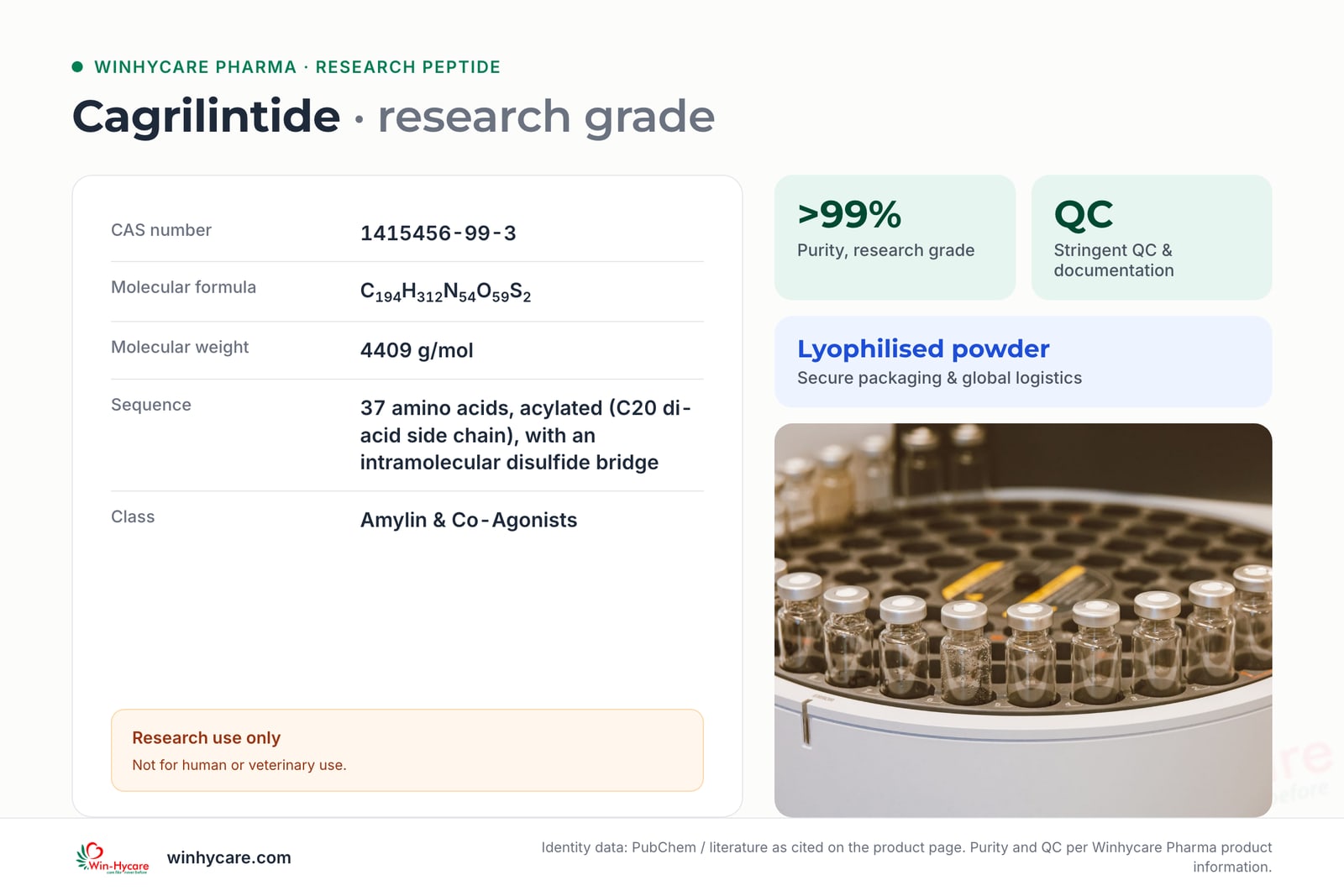
- >99% purityHigh-purity, research-grade material
- Research gradeFor research and development use only
- Quality assuredStringent QC and documentation
- Secure packagingGlobal-standard logistics
- Expert supportDedicated technical assistance
- CAS Number
- 1415456-99-3
- Molecular Formula
- C194H312N54O59S2
- Molecular Weight
- 4409 g/mol
- Drug Class
- long-acting amylin analogue
What is Cagrilintide?
Cagrilintide is a long-acting amylin analogue: a 37-amino-acid acylated peptide that acts as an agonist at amylin (AMY) and calcitonin (CTR) receptors. It is built on a pramlintide-like amylin backbone with sequence substitutions and N-terminal acylation by a C20 eicosanedioic fatty di-acid attached through a γGlu linker, plus an intramolecular disulfide bridge. The acylation drives albumin binding and confers a long elimination half-life.
As a chemical substance, cagrilintide (CAS 1415456-99-3, molecular formula C194H312N54O59S2, ~4409 g/mol) is typically handled as a lyophilised powder. It is being studied for obesity and weight management, including as part of a fixed combination with a GLP-1 receptor agonist. Cagrilintide is investigational: it is in clinical development and has not been approved by the FDA, EMA or other major regulators.
How Cagrilintide Is Produced & Characterised
Cagrilintide is a synthetically demanding acylated peptide: the 37-mer length, the disulfide bridge requiring controlled oxidative folding, and the lipid side-chain conjugation all create opportunities for deletion sequences, diastereomers, mis-folded variants and incomplete acylation. For this peptide class, production is generally based on Fmoc solid-phase peptide synthesis (SPPS) with controlled disulfide formation and side-chain conjugation, followed by purification on preparative dynamic axial compression (DAC) HPLC columns that isolates the target sequence from closely related impurities, and lyophilisation to a stable powder.
Quality control for acylated amylin analogues of this type typically combines UPLC/HPLC for purity, LC-MS for confirmation of sequence and disulfide connectivity, and characterisation of water content, counter-ion (acetate) content and residual solvents. These analytical approaches reflect general industry practice for complex peptides.
Regulatory & Development Context
Cagrilintide is an investigational molecule: it is in clinical development for obesity and weight management and has not been approved by the FDA, EMA or other major regulators. It has been studied both as a standalone amylin analogue and in fixed combination with a GLP-1 receptor agonist.
For investigational peptides such as cagrilintide, chemistry, manufacturing and controls (CMC) information is generally organised under CTD Module 3 to support IND/CTA submissions, with analytical methods validated to ICH Q2(R1) and stability assessed to ICH Q1A(R2). This section summarises the general regulatory framework that applies to molecules of this type and reflects cagrilintide's current investigational status.
Research supply from Winhycare Pharma
Winhycare Pharma supplies research-grade Cagrilintide to research organisations and individual researchers for research and development purposes. Material is supplied at high purity (>99%) under stringent quality control with QC documentation, in secure packaging through global standard logistics, with dedicated technical assistance from our team. We focus on consistent quality and purity, reliable and timely supply, confidential and professional service, and long-term partnerships.
Research use only. Not for human or veterinary use, and not for use in food, drugs, medical devices or cosmetics.
To enquire, tell us the quantity you need, the purity grade, the documentation you require and the destination country. The buyer is responsible for complying with the import and use regulations that apply to Cagrilintide in their country.
Cagrilintide API: Specifications
| CAS Number | 1415456-99-3 |
|---|---|
| Molecular Formula | C194H312N54O59S2 |
| Molecular Weight | 4409 g/mol |
| Sequence | 37 amino acids, acylated (C20 di-acid), one disulfide bridge |
| Drug Class | Long-acting amylin analogue (AMY/CTR agonist) |
| Regulatory Status | Investigational: in clinical development, not yet approved |
| Appearance | White to off-white lyophilised powder |
| Purity | >99% (research grade) |
| Typical synthesis route | Fmoc SPPS + DAC prep-HPLC purification |
| Form | Lyophilised powder |
| Storage | Store at -20°C, protected from light & moisture |
| Intended use | Research use only (RUO) |
API supplied for B2B pharmaceutical manufacturing and R&D. Cagrilintide is also supplied for research use only, not for human or veterinary use. Regulatory status: Investigational; in clinical development and not yet approved by the FDA, EMA or other major regulators. Used only in pharmaceutical R&D and as a reference standard.
Buyer guides
Regulatory and technical reading for teams qualifying an Indian peptide API source.
- Sourcing peptide API for the EU, UK and SwitzerlandWritten confirmation, EU GMP Part II, ASMF / CEP and the QP declaration.
- Sourcing peptide API for the United StatesType II DMF, ICH Q7, FDA’s July 2026 peptide guidance changes and establishment registration.
- How to qualify a peptide API supplierA documentation and audit checklist for EU and US buyers.
- Peptide API impurities and specificationsRelated substances, thresholds and pharmacopoeial context.
- Peptide lyophilisation CMO servicesFrom your peptide API to lyophilised vials, starting with a pilot.
Cagrilintide API: Frequently Asked Questions
What is Cagrilintide?
Cagrilintide is a long-acting amylin analogue: a 37-amino-acid acylated peptide that acts as an agonist at amylin (AMY) and calcitonin (CTR) receptors. It is built on a pramlintide-like backbone with a C20 fatty di-acid acylation and an intramolecular disulfide bridge, and is being investigated for obesity and weight management.
What is the CAS number and molecular weight of Cagrilintide?
Cagrilintide's CAS number is 1415456-99-3, its molecular formula is C194H312N54O59S2, and its molecular weight is approximately 4409 g/mol. It is a 37-amino-acid peptide acylated with a C20 fatty di-acid side chain and containing one intramolecular disulfide bridge.
Is Cagrilintide approved by the FDA or EMA?
No. Cagrilintide is investigational. It is in clinical development for obesity and weight management and has not been approved by the FDA, EMA or other major regulators.
What class of peptide is Cagrilintide?
It is a long-acting amylin analogue. Pharmacologically it acts as a dual agonist at amylin (AMY) and calcitonin (CTR) receptors, and its fatty-acid acylation promotes albumin binding for an extended half-life.
What is Cagrilintide being studied for?
Cagrilintide is being studied for obesity and weight management, both as a standalone amylin analogue and as part of a fixed combination with a GLP-1 receptor agonist. It remains investigational and has not been approved for therapeutic use.
How is Cagrilintide produced and characterised?
Peptides of this class are generally produced by Fmoc solid-phase peptide synthesis (SPPS) with controlled disulfide-bridge formation and lipid side-chain conjugation, followed by preparative HPLC purification and lyophilisation. Characterisation typically uses UPLC/HPLC for purity and LC-MS to confirm sequence and disulfide connectivity.
Do you supply Cagrilintide as an API?
Yes. Winhycare Pharma supplies Cagrilintide API to licensed pharmaceutical manufacturers and developers, with QC documentation. Tell us the quantity and the documentation your quality and regulatory teams need. Research-grade Cagrilintide is supplied separately, for laboratory research use only.
Is Cagrilintide sold for human use?
No. Research-grade Cagrilintide is supplied for research use only (RUO), for laboratory research and development. It is not for human or veterinary use, and not for use in food, drugs, medical devices or cosmetics.
What purity is Cagrilintide supplied at?
Research-grade Cagrilintide is supplied at high purity (>99%), produced under stringent quality control and accompanied by QC documentation. State any specific purity or documentation requirement in your enquiry.
How do I order Cagrilintide for research?
Send an enquiry with the quantity, purity, documentation you need and the destination country, and our team will reply with dedicated technical assistance. The buyer is responsible for complying with the import and use regulations for Cagrilintide in their country.
Related Peptides
Eloralintide
CAS 2883634-40-8
GLP-1 & Incretin Multi-AgonistsSemaglutide API
CAS 910463-68-2
GLP-1 & Incretin Multi-AgonistsAmycretin
CAS 3005889-81-3
GLP-1 & Incretin Multi-AgonistsRetatrutide API
CAS 2381089-83-2
Source Cagrilintide API from Winhycare Pharma
Request pricing, a Certificate of Analysis and the documentation your quality and regulatory teams need. Bulk quantities available.